
Digital growth rarely comes from a single marketing channel.
A business may invest in SEO but struggle to convert organic traffic. Another may generate leads through paid advertising but become dependent on continuously increasing ad spend. Some businesses publish content regularly without a clear connection to search demand, customer journeys or revenue.
The problem is usually not the absence of marketing activity. It is the absence of an integrated digital growth strategy.
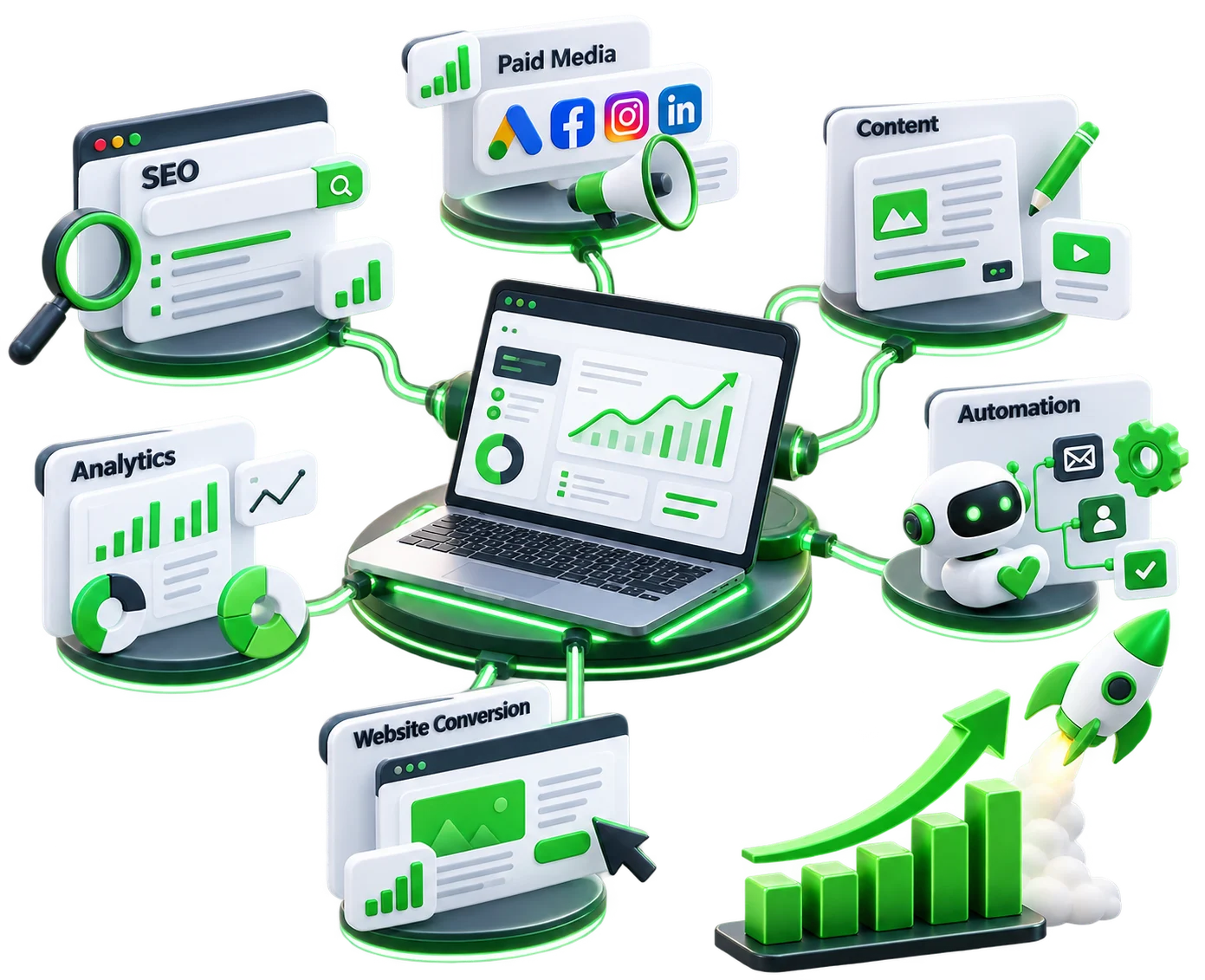
A scalable digital growth strategy connects SEO, paid media, content, website conversion, analytics and automation into one system. Each channel performs a different role, while data moves between them to improve decisions, customer experience and business outcomes.
The objective is not simply to attract more visitors. It is to build a digital ecosystem that can consistently attract the right audience, convert demand, measure performance and become more efficient as the business grows.
What Is a Digital Growth Strategy?
A digital growth strategy is a structured plan for using digital channels, technology and data to achieve measurable business objectives.
Unlike a basic marketing plan that may focus primarily on campaigns, a growth strategy considers the complete customer journey:
Discovery → Engagement → Evaluation → Conversion → Retention → Growth
This means asking more meaningful questions than simply:
- How can we increase website traffic?
- How many social media followers can we gain?
- How many advertisements should we run?
Instead, businesses need to understand:
- Who are we trying to reach?
- What problems are those customers trying to solve?
- Where do they search for information?
- What content helps them make decisions?
- What prevents them from converting?
- Which channels generate qualified opportunities?
- What can be automated?
- Which metrics actually contribute to revenue?
Answering these questions creates the foundation for sustainable digital growth.
1. Build Sustainable Visibility Through SEO
Search engine optimization should be viewed as a long-term business asset rather than a collection of keywords.
Effective SEO for business growth begins by understanding search intent. A business needs to identify what potential customers search for at different stages of their journey.
For example, search behavior may include:
Informational searches
Users are researching a problem or learning about a subject.
Commercial investigation
Users are comparing solutions, providers, technologies or strategies.
Transactional searches
Users are actively searching for a service, product or provider.
A strong SEO strategy creates useful pages for each stage.
It also requires more than content creation. Technical SEO, site architecture, internal linking, page experience, crawlability, mobile usability and website performance all influence how effectively search engines and users can understand a website.
The most sustainable approach is to create topic clusters.
A comprehensive pillar article can cover a major subject such as digital growth strategy, while supporting articles explore areas such as:
- Technical SEO
- Local SEO
- Google Ads
- Conversion optimization
- AI automation
- Content marketing
- Analytics
- Website development
These resources can then connect naturally to relevant service pages.
Over time, this creates a stronger information architecture and demonstrates deeper subject expertise.
2. Use Paid Media to Capture and Accelerate Demand
SEO builds long-term visibility, but businesses often need a faster way to reach potential customers.
That is where paid media becomes valuable.
Platforms such as Google Ads, Meta Ads and LinkedIn Ads can help businesses reach specific audiences based on search intent, interests, professional characteristics or previous interactions.
However, scalable paid advertising is not about continuously increasing the advertising budget.
The goal should be to improve the economics of customer acquisition.
This requires understanding metrics such as:
- Cost per click
- Cost per lead
- Conversion rate
- Customer acquisition cost
- Lead quality
- Return on ad spend
- Revenue generated by channel
Campaign data can also provide insights beyond advertising.
For example, high-converting search terms from Google Ads may reveal topics worth developing through SEO. Frequently asked questions from paid campaigns may become useful content. High-performing audience segments may influence landing page messaging.
Paid media becomes considerably more valuable when its insights are shared with the wider digital strategy.
3. Create Content That Supports Real Customer Decisions
Content should not exist simply because a company believes it needs to publish several blogs every month.
Every piece of content should serve a purpose.
Strong content may:
- Answer an important customer question
- Explain a complicated service
- Demonstrate expertise
- Address objections
- Compare different approaches
- Support organic search visibility
- Educate potential customers
- Strengthen a service or product page
- Assist sales conversations
For a technology and digital-growth business, authority is built by showing how problems are understood and solved, rather than repeating generic definitions already available across hundreds of websites.
That means useful content should include practical frameworks, examples, limitations, decision criteria and clear explanations.
Quality is more valuable than publishing volume.
A smaller library of genuinely useful resources can provide far greater long-term value than hundreds of shallow articles written only to capture keywords.
4. Turn Website Traffic Into Business Opportunities
Generating traffic is only half of digital growth.
The next question is:
What happens after someone reaches your website?
A high-performing business website needs to guide visitors toward a meaningful next step.
That requires clear:
- Value propositions
- Service descriptions
- Navigation
- Calls to action
- Trust signals
- Contact options
- Landing pages
- Mobile experiences
Page speed and usability also matter.
A beautifully designed website can still perform poorly if visitors cannot quickly understand what the company offers or how to proceed.
This is where conversion rate optimization (CRO) becomes part of the growth strategy.
Rather than relying on assumptions, businesses can study how visitors interact with important pages and test improvements to messaging, layouts, forms, calls to action and customer journeys.
Even small improvements in conversion efficiency can make existing SEO and advertising investments considerably more valuable.
5. Build an Analytics System That Measures What Matters
Digital growth without reliable measurement quickly becomes guesswork.
Analytics should connect marketing activity with meaningful business outcomes.
Website sessions and impressions are useful indicators, but they should not be the final measurement of success.
Depending on the business, more meaningful metrics may include:
- Qualified leads
- Conversion rates
- Cost per qualified lead
- Sales opportunities
- Customer acquisition cost
- Ecommerce revenue
- Repeat purchases
- Lead-to-customer conversion
- Marketing-generated revenue
Platforms such as website analytics, advertising dashboards, CRM systems and ecommerce platforms often contain different pieces of the customer journey.
A stronger analytics system connects these data sources wherever practical so decision-makers can understand which channels contribute to business results.
This also improves budget allocation.
Instead of asking which channel produces the most traffic, businesses can ask which combination of channels produces the strongest commercial outcome.
6. Use Automation to Scale Repetitive Processes
As digital activity increases, manually managing every interaction becomes inefficient.
Automation allows businesses to handle repetitive processes while keeping teams focused on decisions and activities that require human judgement.
Common opportunities include:
- Lead capture and routing
- CRM updates
- Email follow-ups
- Marketing workflows
- Customer support
- Reporting
- Appointment scheduling
- Lead qualification
- Internal notifications
- Data synchronization
AI can extend these capabilities through intelligent assistants, customer-support systems, workflow automation and other business-specific applications.
However, automation should not be introduced simply because a technology is available.
The better question is:
Which repeated business process is creating friction, delay or unnecessary cost?
Once that process is understood, the appropriate technology can be selected.
This problem-first approach produces far more useful automation than implementing disconnected tools without a clear objective.
How SEO, Paid Media, Content, Analytics and Automation Work Together
The greatest value appears when these channels operate as a connected system.
Consider a potential customer searching for a business solution.
They may first discover an educational article through organic search.
Later, they return through a remarketing advertisement.
They visit a service page, review the company's expertise and submit an enquiry.
The enquiry enters a CRM automatically.
The sales team receives the correct information, while analytics connects the enquiry back to the marketing touchpoints that contributed to it.
That single journey may involve:
SEO → Content → Website → Paid Media → Conversion → CRM → Analytics → Automation
This is why businesses should avoid treating individual channels as isolated departments.
Each part of the system generates information that can improve the others.
Common Digital Growth Mistakes
Even businesses investing heavily in digital marketing can struggle to scale when their strategy becomes fragmented.
Some recurring problems include:
Chasing Traffic Instead of Business Outcomes
More visitors do not automatically mean more revenue. Traffic should be evaluated alongside intent, lead quality and conversion performance.
Running Paid Ads Without Fixing the Website
Advertising can bring potential customers to a website, but it cannot compensate for confusing messaging, poor landing pages or unnecessary friction.
Publishing Content Without a Topic Strategy
Random blog posts rarely build meaningful authority. Content should support defined areas of expertise and connect logically with commercial pages.
Treating SEO and Advertising as Separate Activities
SEO data can improve paid campaigns, and paid search data can reveal valuable SEO opportunities.
Tracking Too Many Vanity Metrics
Large dashboards are not necessarily useful dashboards. Measurement should prioritize metrics connected to customer acquisition and revenue.
Automating Broken Processes
Automation can make a good process faster, but it can also make an inefficient process fail faster. Processes should be understood and improved before they are automated.
A Practical Framework for Building a Scalable Digital Growth Strategy
Businesses can approach digital growth in four stages.
Stage 1: Understand
Start with the business rather than the marketing channel.
Define:
- Business objectives
- Target customers
- Customer problems
- Competitive landscape
- Existing digital performance
- Customer journey
- Current technology
- Measurement gaps
Stage 2: Build
Create the necessary growth infrastructure.
This may include:
- Website improvements
- Technical SEO
- Search-focused content
- Landing pages
- Paid advertising campaigns
- Conversion tracking
- CRM integrations
- Analytics dashboards
Stage 3: Optimize
Once reliable data is available, improve performance continuously.
Evaluate:
- Search visibility
- Advertising efficiency
- Content engagement
- Conversion rates
- Lead quality
- Customer acquisition cost
- Revenue contribution
Optimization should focus on eliminating bottlenecks rather than chasing isolated metrics.
Stage 4: Scale
Scaling does not simply mean spending more.
It means expanding what works while improving operational efficiency.
This may involve entering new markets, expanding SEO coverage, increasing successful campaigns, creating new content clusters, improving automation or integrating additional systems.
The Falconics Approach to Digital Growth
At Falconics IT Solutions, we believe sustainable digital growth requires more than individual marketing campaigns.
Businesses increasingly need strategy, technology, marketing, analytics and automation to work together.
Our approach follows four connected stages:
Understand & Strategize → Build & Execute → Measure & Optimize → Scale & Grow
Depending on the business requirement, this may bring together areas such as SEO, paid advertising, website development, ecommerce, content marketing, analytics, custom software and AI-powered automation.
The objective is not to recommend every available digital service.
It is to identify the combination of channels and technologies that addresses the actual business requirement.
A company that needs organic visibility may require a stronger SEO and content foundation. Another may need paid acquisition and better landing pages. A growing organization may benefit more from CRM integration, analytics or automation.
The strategy should follow the business problem—not the other way around.
Final Thoughts
A scalable digital growth strategy is not built by finding one perfect marketing channel.
It is built by creating a system in which SEO generates long-term visibility, paid media captures demand, content builds understanding and trust, the website converts visitors, analytics improves decisions, and automation increases operational efficiency.
The businesses that develop these capabilities together are better positioned to understand what is working, adapt when conditions change and invest resources more intelligently.
Digital growth should therefore be treated as a continuous cycle:
Understand. Build. Measure. Improve. Scale.
For businesses looking to connect marketing, technology and data into a more structured growth system, Falconics IT Solutions provides integrated digital solutions designed around real business requirements and measurable objectives