
Ready to transform your business with Google Analytics Setup?
Contact our expert team today for a tailored strategy and free consultation.
Get a Free ConsultationNo services available in this category yet.
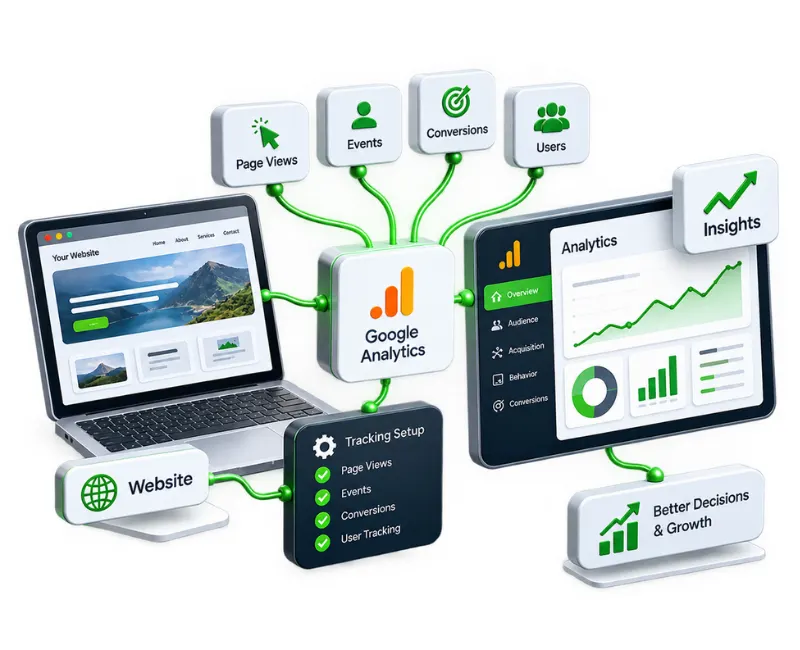
Google Analytics is only useful when it collects the right data.
A basic installation can tell you that people visited your website. A properly planned Google Analytics 4 setup can go further—helping you understand where users come from, what they do on your website, which actions lead to enquiries or purchases, and where potential customers drop out of the journey.
Falconics IT provides Google Analytics Setup services designed around your website, marketing objectives, conversion points, and reporting requirements. We configure the tracking foundation so your analytics data is structured, relevant, and easier to use for business decisions.
Key areas we can configure include:
CTA: Get Your Analytics Setup Started
A useful GA4 implementation starts before any tracking code is added. The first step is understanding what your business actually needs to measure.
We identify the important user actions, conversion points, traffic sources, and performance indicators for your website. The configuration is then built around those requirements rather than relying solely on Google's default measurement settings.
We configure your Google Analytics 4 property and connect the appropriate web data stream to your website.
The setup can include measurement configuration, account and property structure, data collection settings, and other foundational elements required for reliable website analytics.
For businesses with an existing GA4 property, we can review the current configuration before making changes so unnecessary duplication or tracking conflicts can be avoided.
Events allow GA4 to record meaningful interactions that standard pageview data may not fully explain.
Depending on your website, tracking can be configured for actions such as:
The objective is not to track everything simply because it can be tracked. We focus on interactions that provide useful information about visitor behaviour and business performance.
Conversion tracking connects website activity with the actions that matter commercially.
For a lead-generation website, this could include enquiry forms, consultation requests, calls, bookings, or sign-ups. For an ecommerce website, important actions may include product views, add-to-cart activity, checkout steps, and purchases.
We configure relevant events as conversions so your GA4 reports can distinguish general engagement from actions that have direct business value.
Google Tag Manager can provide a more manageable way to deploy and maintain tracking tags without repeatedly modifying website code.
Where appropriate, Falconics IT can configure GA4 tracking through Google Tag Manager, including tags, triggers, variables, and event-related configurations.
This creates a more structured tracking environment that can also support other marketing and measurement requirements as your setup develops.
The tracking requirements of a lead-generation website are different from those of an online store.
For ecommerce businesses, the setup can be structured around important stages of the customer journey, including product engagement, cart activity, checkout behaviour, and completed purchases.
For service and B2B websites, the focus may instead be on enquiries, form submissions, calls, bookings, downloads, and other lead-generation interactions.
The tracking framework should reflect how your website actually generates business—not simply how the analytics platform is structured.
GA4 audiences can help businesses analyse groups of users based on their interactions and behaviour.
We can help configure relevant audience definitions and measurement requirements based on your business objectives, such as engaged visitors, returning users, product-interest groups, or users who completed specific actions.
This can provide a more useful foundation for analysis, remarketing, and campaign evaluation when audience data is required.
You do not necessarily need a new analytics property if you already have GA4 installed.
An existing setup may contain duplicate events, incorrectly configured conversions, missing parameters, inconsistent tracking, or data that does not correspond with your actual business objectives.
Where required, we review the existing configuration, identify tracking gaps, and recommend or implement the necessary corrections rather than rebuilding everything unnecessarily.
Installing tracking is only one part of the implementation.
Tracking should be tested to confirm that important events are firing correctly and that the information being collected corresponds with the intended user action.
Testing can include checking event behaviour, conversion triggers, tag configurations, parameters, and data flow before considering the implementation complete.
This validation stage helps reduce the risk of making decisions based on incorrectly configured analytics.
Good analytics should make important information easier to understand.
Depending on your requirements, the setup can support reporting around areas such as traffic acquisition, user engagement, conversions, landing-page performance, ecommerce activity, and marketing performance.
For businesses that need more structured reporting, Falconics IT also provides dashboard reporting as part of its wider data and analytics services.
The right implementation depends heavily on how your business operates.
Lead-generation businesses can focus on enquiries, form submissions, calls, bookings, downloads, and other prospect actions.
Ecommerce businesses can focus on product interactions, shopping behaviour, checkout progression, purchases, and revenue-related events.
B2B businesses may need stronger visibility into content engagement, lead-generation journeys, campaign sources, and high-intent interactions.
SaaS and technology businesses may require measurement around registrations, feature engagement, trial activity, onboarding, and other product-specific actions.
The tracking plan should therefore be built around the customer journey rather than applying an identical configuration to every website.
The value of analytics comes from the quality and relevance of the information being collected.
A properly configured setup can help your team:
Understand visitor behaviour
See how users interact with important pages, features, forms, products, and content.
Measure meaningful conversions
Separate valuable business actions from general website activity.
Evaluate marketing channels
Understand how different acquisition sources contribute to website engagement and conversions.
Identify journey problems
Find stages where users stop engaging or fail to complete an intended action.
Improve reporting
Create a more reliable measurement foundation for marketing and business analysis.
Make better optimisation decisions
Use behavioural and conversion data to identify areas that deserve further attention.
A structured implementation helps prevent unnecessary tracking and keeps the setup aligned with actual business requirements.
We begin by understanding your website, business model, conversion journey, marketing channels, and the information you need from analytics.
This helps determine what should be measured and what can be left out.
If GA4, Google Tag Manager, advertising tags, or other analytics tools are already installed, we review the current setup before implementing new tracking.
This helps identify configuration gaps, duplicate tracking, and potential conflicts.
We configure the required GA4 property, data stream, events, conversions, parameters, audiences, and related tracking components according to the agreed measurement requirements.
Where appropriate, Google Tag Manager is used to manage the implementation.
Important tracking actions are tested to ensure that events and conversions are being triggered as intended.
Issues discovered during testing are corrected before the setup is considered ready for use.
Once the implementation is complete, the configured tracking structure can be documented and explained so your team understands what is being measured.
If your requirements change later, additional events, conversions, integrations, or reporting can be added as the website and marketing activity evolve.
The exact deliverables depend on the scope of your website and tracking requirements, but a typical Google Analytics Setup engagement may include:
| Deliverable | Purpose |
|---|---|
| GA4 property configuration | Establish the analytics foundation |
| Web data stream setup | Connect website data with GA4 |
| Event tracking | Measure important user interactions |
| Conversion configuration | Identify commercially valuable actions |
| Google Tag Manager setup | Manage tracking implementation where required |
| Audience configuration | Segment relevant user groups |
| Ecommerce tracking | Measure shopping and purchase activity where applicable |
| Tracking validation | Confirm that important measurements work correctly |
| Basic documentation | Make the implemented tracking easier to understand |
A Google Analytics setup may need attention when:
The solution is not always to add more tracking. Sometimes the better approach is to simplify the setup and focus measurement on the actions that actually matter.
A basic installation generally focuses on getting analytics code connected to a website.
A professional setup starts with the question: What does the business need to measure?
That difference affects everything from event architecture and conversion definitions to reporting and future optimisation.
For a business that depends on enquiries, purchases, bookings, or other measurable actions, simply knowing how many users visited the website is rarely enough.
Google Analytics Setup can be useful for businesses that want a clearer measurement foundation for their website.
It is particularly relevant for:
Startups and growing businesses
Build a structured measurement system before analytics requirements become difficult to manage.
B2B companies
Track lead-generation interactions and understand how visitors move through the website.
Ecommerce businesses
Measure shopping behaviour and important stages of the purchase journey.
Service businesses
Track enquiries, calls, bookings, forms, and other lead-generating actions.
Marketing teams
Create more reliable measurement for evaluating campaigns and website performance.
Businesses with an existing GA4 property
Identify configuration problems and improve an analytics implementation that is already in place.
Google Analytics setup pricing depends on the complexity of the implementation rather than a fixed package for every website.
Factors can include:
After understanding the requirements, the scope can be defined around the actual implementation instead of adding unnecessary services.
Google Analytics can improve measurement, but it does not automatically improve a website's performance.
The purpose of the setup is to create a reliable measurement foundation that helps your team understand what is happening and make better-informed decisions.
The quality of future insights will also depend on factors such as website implementation, traffic volume, business model, tracking requirements, and how consistently the data is reviewed.
Google Analytics Setup is the process of configuring Google Analytics 4 to collect and organise website data according to specific business and measurement requirements. It can include property configuration, events, conversions, audiences, tracking, and validation.
Yes. Installing the analytics code establishes data collection, while a complete GA4 setup can involve defining important events, configuring conversions, implementing additional tracking, testing the data, and aligning measurement with business goals.
Not every website requires Google Tag Manager, but it can be useful when a business needs more advanced event tracking or wants to manage multiple tracking tags through a central system.
Yes. Conversion tracking can be configured for relevant actions such as form submissions, purchases, bookings, registrations, downloads, and other important website interactions.
Yes. Ecommerce tracking can be structured around relevant shopping actions and purchase-related events. The exact implementation depends on the ecommerce platform and how the website handles product, cart, checkout, and transaction data.
Yes. An existing GA4 property can be reviewed for missing events, incorrect conversions, duplicate tracking, configuration issues, and other measurement gaps before deciding what needs to be changed.
The timeline depends on the website, number of events and conversions, technical implementation, ecommerce complexity, integrations, and the condition of any existing tracking. A straightforward website generally requires less configuration than a complex ecommerce or multi-platform environment.
No. Google Analytics is a measurement platform, not a traffic-generation or conversion-guarantee service. Its role is to provide useful data that can support better marketing, website, and business decisions.
Yes, depending on the requirements and platform. Analytics implementations can be structured alongside tools such as Google Tag Manager, advertising platforms, CRM systems, and reporting solutions where the required integrations are technically supported.
Yes. The tracking structure should reflect your business model, customer journey, website functionality, and important conversion actions rather than relying on an identical configuration for every business.
Share your website and explain what you currently want to measure. Falconics IT can review the requirements and determine the appropriate GA4 setup, tracking scope, and implementation approach.
Your website is generating user activity every day. The important question is whether your analytics setup is capturing the information you actually need.
Falconics IT can help configure Google Analytics around your website, customer journey, and business objectives—so your measurement setup is structured for practical use rather than simply installed and left untouched.
Contact our expert team today for a tailored strategy and free consultation.
Get a Free Consultation