
Ready to transform your business with Cloud Hosting?
Contact our expert team today for a tailored strategy and free consultation.
Get a Free ConsultationNo services available in this category yet.
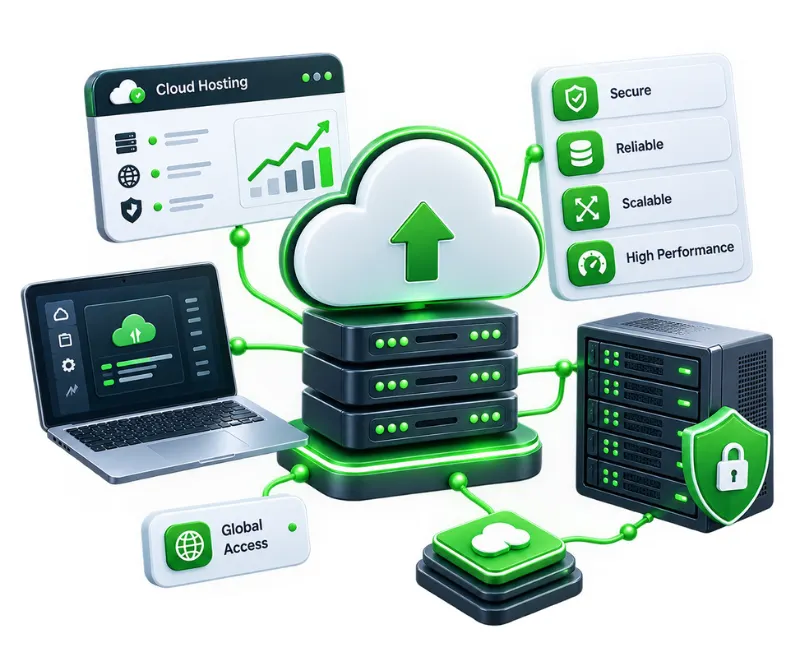
Your hosting environment should support your business, not become a recurring technical problem.
Falconics IT provides cloud hosting solutions for businesses, websites, applications and digital platforms that need reliable infrastructure, scalable resources and ongoing technical support. We combine cloud infrastructure with server management, security and DevOps expertise to create a hosting environment suited to your actual requirements.
Whether you are launching a new website, moving away from unreliable hosting or supporting a growing application, we can help you select, configure and manage the infrastructure behind it.
Need a cloud hosting solution for your website or application? Talk to Falconics IT about your requirements.
Cloud hosting uses a network of connected computing resources rather than relying entirely on a single physical server. This architecture can provide greater flexibility when your website or application needs additional computing resources, improved availability or a more adaptable infrastructure.
For businesses, the practical advantage is control over an environment that can be configured around the workload. Resources, security controls, databases, applications and supporting services can be planned according to how the system actually operates.
Cloud hosting is particularly useful when your requirements are more demanding than conventional shared hosting can comfortably support, but you still want an infrastructure approach that can evolve as your business and technology requirements change.
Different workloads require different hosting environments. A business website may prioritize reliability and performance, while an ecommerce platform may need to handle changing traffic patterns, databases and payment-related functionality.
Applications and SaaS platforms often have additional requirements around deployment, databases, APIs, security and monitoring.
Falconics approaches cloud hosting from that broader infrastructure perspective. Instead of treating hosting as simply a place to upload website files, we consider the application, technology stack, expected workload, security requirements and future growth when planning the environment.
The exact configuration depends on your website, application and infrastructure requirements. A cloud hosting engagement can include:
The objective is to build an infrastructure setup that is practical to operate and appropriate for your workload rather than adding technical components you do not need.
Cloud infrastructure still requires proper configuration and maintenance. An incorrectly configured server can create performance, security or reliability issues even when the underlying cloud platform is capable.
With managed cloud hosting, Falconics can assist with the technical administration behind your environment. This can include server configuration, updates, application deployment, database administration, security measures and ongoing troubleshooting.
This approach is useful for businesses that need cloud infrastructure but do not want their internal team spending valuable time managing routine server operations.
Hosting performance depends on more than simply choosing a cloud server.
Application architecture, server resources, database queries, caching, configuration, code efficiency and traffic patterns can all affect how quickly a website or application responds.
Falconics can evaluate these factors as part of the hosting setup and recommend infrastructure changes where appropriate. The goal is to create a technically suitable environment rather than relying on a generic hosting configuration for every project.
Your infrastructure should not become a limitation when your workload changes.
Cloud environments can make it easier to adjust resources as requirements evolve. This can be valuable for growing websites, ecommerce platforms, SaaS applications, business portals and systems that experience periodic changes in demand.
Scaling requirements differ from project to project, so Falconics focuses on understanding the workload before recommending an infrastructure configuration. Where additional resources, architecture changes or optimization are required, the hosting environment can be adjusted accordingly.
Security needs to be considered at the infrastructure level as well as within the website or application itself.
Depending on the project, cloud hosting security can involve server hardening, access management, secure credentials, firewall configuration, software updates, monitoring and backup planning.
Falconics also considers the relationship between hosting, application security and database security. This helps reduce the risk of treating infrastructure security as an isolated task.
No hosting environment can eliminate every security risk, but a properly configured and maintained environment can provide a stronger foundation for protecting your systems and data.
Cloud hosting can support a wide range of digital workloads, including:
Business Websites
For companies that need dependable hosting for corporate websites, lead-generation websites and high-value digital properties.
Ecommerce Platforms
For online stores that need infrastructure capable of supporting applications, databases and changing customer demand.
Web Applications
For applications requiring a controlled server environment, database support and technical management.
SaaS Platforms
For software businesses that need infrastructure capable of supporting application workloads and future expansion.
Business Portals & Internal Systems
For organizations running applications or systems that require controlled access and managed infrastructure.
Development & Deployment Environments
For technology teams that need cloud infrastructure for development, staging or production workloads.
We do not begin with a fixed server configuration and try to fit your project into it. We start by understanding what needs to run, how it is currently hosted and what the infrastructure needs to support.
1. Assess
We review your website, application, technology stack, traffic expectations, databases, security requirements and existing infrastructure.
2. Plan
We determine the appropriate cloud environment, resources, software configuration and supporting services for the workload.
3. Configure & Deploy
The required server environment is configured and the website, application or database is deployed according to the agreed technical requirements.
4. Secure & Optimize
We apply relevant security configurations and review the environment for performance, resource usage and operational reliability.
5. Monitor & Support
Where ongoing management is part of the engagement, we provide technical support, maintenance and infrastructure assistance as required.
A cloud hosting service should give you more than server access. It should give you a clear understanding of what is being hosted, how the environment is configured and who is responsible for maintaining it.
With Falconics, the engagement can be structured around your technical requirements rather than a one-size-fits-all hosting package. Our wider capabilities across web development, software, cloud infrastructure, DevOps and cybersecurity also allow hosting decisions to be considered alongside the systems they support.
That matters when your website or application has dependencies that go beyond basic hosting.
Depending on the selected scope, your cloud hosting engagement may include:
| Area | Typical Scope |
|---|---|
| Infrastructure | Cloud environment and server configuration |
| Deployment | Website, application and database deployment |
| Security | Hardening, access controls and security configuration |
| Performance | Resource and configuration optimization |
| Management | Server administration and technical maintenance |
| Backup | Backup strategy and recovery planning |
| Monitoring | Infrastructure and resource monitoring where included |
| Support | Technical assistance and troubleshooting |
The final scope is determined by your infrastructure requirements and the level of management your project needs.
Cloud hosting can be a practical solution when your existing infrastructure is creating technical limitations.
It can help address situations such as slow or inconsistent hosting performance, limited server resources, difficulty scaling during periods of higher demand, inadequate control over the hosting environment or the need for stronger technical management.
It can also provide a more suitable foundation for businesses moving from basic shared hosting to infrastructure designed around a website, application or software platform.
There is no universal traffic threshold at which every business needs cloud hosting.
A move may make sense when your current hosting environment cannot comfortably support your application, when you need greater control over the server environment, when resource requirements fluctuate or when your business requires a more structured infrastructure setup.
If you are unsure whether cloud hosting is appropriate, an infrastructure assessment can help determine whether the move is justified or whether your current hosting setup simply needs optimization.
The right hosting model depends on your technical requirements rather than the name of the hosting package.
Shared hosting is generally suitable for smaller websites with straightforward requirements and limited infrastructure needs. VPS hosting provides a more isolated environment and greater control over resources.
Cloud hosting is often considered when flexibility, scalability, infrastructure control or application requirements become more important.
For businesses with complex workloads, a managed cloud or dedicated infrastructure approach may be more appropriate than choosing a hosting package based only on storage or bandwidth.
Cloud hosting costs depend on the infrastructure required for your project.
Factors can include computing resources, storage, database requirements, operating system, traffic levels, security requirements, backup needs, management scope and whether ongoing technical support is required.
Rather than publishing a generic price that may not reflect your actual workload, Falconics can recommend an appropriate configuration based on your website or application requirements.
Falconics combines IT infrastructure with web development, software engineering, DevOps, cloud solutions and cybersecurity capabilities.
That means your hosting environment can be considered in the context of the systems running on it. If an application needs a particular deployment setup, a database requires optimization or a website needs infrastructure changes, the conversation can extend beyond simply increasing server resources.
Our approach is centered on understanding the technology behind your business and building infrastructure that supports it.
Falconics cloud hosting is suitable for businesses that need more control, flexibility or technical support than basic hosting can provide.
It can be a good fit for:
The most appropriate solution depends on your current environment, workload and future requirements.
Cloud hosting is a hosting model where website or application resources operate across cloud-based infrastructure rather than being dependent entirely on a single traditional server. It can provide greater flexibility, resource management and scalability for suitable workloads.
Not necessarily for every website. Shared hosting can be sufficient for smaller, straightforward websites. Cloud hosting becomes more relevant when a business needs greater infrastructure control, scalability, resource flexibility or support for more demanding applications.
Yes. Cloud hosting can be suitable for ecommerce websites that require a more controlled infrastructure environment, database support and the ability to accommodate changing workloads. The appropriate configuration depends on the platform, traffic and application requirements.
Cloud migration can be part of the engagement, depending on the existing hosting environment and technical requirements. The migration process may include preparing the new environment, transferring website and database data, configuring applications and validating the deployment.
Yes. Falconics provides cloud hosting alongside server management, database administration, DevOps, security and technical support based on project requirements.
Cloud infrastructure can generally be adjusted as workload requirements change. The exact scaling approach depends on the architecture of your website or application and the cloud environment being used.
Cloud hosting can provide a strong infrastructure foundation, but security depends on how the environment, applications, databases and access controls are configured and maintained. Falconics can incorporate security hardening and infrastructure-level security measures into the hosting setup.
Backup requirements can be incorporated into the infrastructure plan where applicable. The appropriate backup frequency, retention and recovery approach depend on the importance and type of data being hosted.
Yes. Database configuration and administration can be included where required, particularly for websites, web applications, SaaS platforms and other systems with database dependencies.
The right configuration depends on your application, technology stack, traffic, storage, database workload, security requirements and expected growth. Falconics can review these factors and recommend an appropriate infrastructure setup rather than asking you to choose technical specifications without context.
Yes. Ongoing technical support, server management, monitoring, maintenance, security and DevOps assistance can be structured around your requirements and the agreed scope of service.
Your hosting environment should match the technology and workload behind your business.
Whether you are launching a new platform, migrating an existing website or looking for a more manageable cloud infrastructure setup, Falconics IT can help you evaluate the requirements and plan the right approach.
Contact our expert team today for a tailored strategy and free consultation.
Get a Free Consultation