
Ready to transform your business with Flutter Development?
Contact our expert team today for a tailored strategy and free consultation.
Get a Free ConsultationNo services available in this category yet.
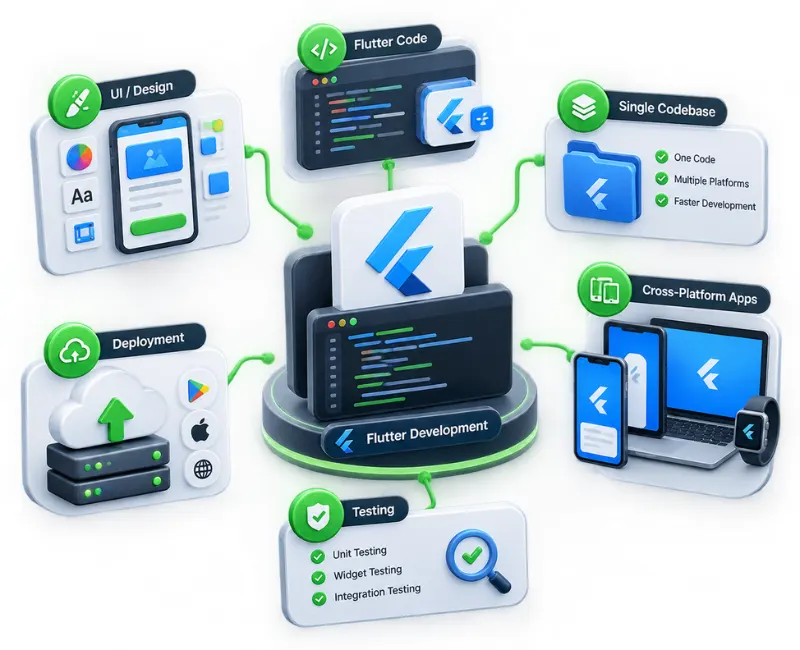
A mobile app needs more than a functional interface. It needs a clear product structure, dependable engineering, responsive performance, and an experience that makes sense to the people using it.
Falconics provides custom Flutter app development for startups, SMEs, established businesses, and product teams that want to build or modernize mobile applications across Android and iOS.
From initial product planning and interface design to development, testing, app-store deployment, and post-launch improvements, we build around your business requirements rather than forcing your idea into a fixed template.
Why Flutter can be a practical choice:
Falconics approaches Flutter development as a complete product engineering process rather than simply writing mobile code.
We can support the stages required to take an application from an early concept to a production-ready release, with the exact scope determined by your product, users, integrations, and technical requirements.
The service can include product discovery, UI/UX design, Flutter development, backend and API integration, third-party integrations, testing, deployment, maintenance, and feature enhancements.
We build Flutter applications around the workflows and functionality your business actually needs.
Whether you are developing a new customer-facing product, an internal business application, an ecommerce experience, a booking platform, or a marketplace, the architecture and feature set are planned around the intended use case.
The result is a mobile application designed to be useful today while leaving room for future features, integrations, and user growth.
Flutter allows businesses to develop applications for both major mobile platforms from a shared technology foundation.
This can be particularly useful when you need Android and iOS applications with a consistent product experience without maintaining completely separate application projects for every feature.
Platform-specific functionality can still be incorporated where the product requires it.
A technically sound application can still struggle if users cannot quickly understand what to do.
Our UI/UX process focuses on information hierarchy, navigation, interaction patterns, responsive layouts, and the practical journey users take through the application.
Designs are created with development in mind, helping reduce unnecessary rework when the approved interface moves into Flutter development.
Most business applications need to communicate with systems outside the mobile app.
We can integrate Flutter applications with APIs, databases, authentication systems, payment services, cloud platforms, analytics tools, maps, notifications, and other third-party services required by the product.
Integration planning considers data flow, authentication, error handling, and the way external services affect the user experience.
Testing is incorporated into the development process rather than treated as a final formality.
Applications can be reviewed across relevant devices, screen sizes, operating conditions, user flows, integrations, and performance scenarios. Functional issues and interface inconsistencies are identified before release wherever possible.
The testing scope depends on the application's complexity, supported platforms, integrations, and business requirements.
Launching the application is only one stage of the product lifecycle.
Falconics can assist with production preparation, release processes, app-store deployment, technical fixes, updates, performance improvements, and future feature development.
For businesses with an existing Flutter application, support can also focus on improving or extending the current product rather than rebuilding it from scratch.
Flutter can be a strong fit when a business wants to serve Android and iOS users while maintaining a shared development foundation.
Its widget-based UI system provides flexibility for creating custom interfaces, while its development workflow supports rapid iteration. Flutter can also work alongside native platform capabilities when an application requires functionality specific to Android or iOS.
The right technology decision still depends on the product. We assess the application's requirements, integrations, performance expectations, and long-term roadmap before recommending the development approach.
The value of a mobile application is not simply that it exists in an app store. It should make a business process easier, give customers a better way to interact with the company, or create a viable digital product.
A well-planned Flutter application can help businesses:
Flutter can support a broad range of business applications. The appropriate architecture and feature set depend on the product rather than the industry alone.
Common use cases include:
A structured process helps keep product decisions, technical development, and business objectives aligned.
01 — Discovery and Planning
We begin by understanding the business model, target users, application objectives, required features, integrations, and technical considerations. This stage establishes what needs to be built and what should be prioritised.
02 — Product and UI/UX Design
User flows, information architecture, wireframes, and interface designs are developed according to the product requirements. The objective is to create an experience that is intuitive for users and practical to implement.
03 — Flutter Development
The approved product is developed in Flutter with the required application logic, screens, integrations, authentication, data handling, and platform functionality.
04 — Testing and Refinement
The application is tested against defined requirements and relevant usage scenarios. Issues are resolved and the product is refined before the production release.
05 — Deployment and Continued Improvement
Once the application is ready, we support the release process and can continue with maintenance, technical improvements, monitoring, and new feature development based on your roadmap.
The exact deliverables depend on the scope of the project, but a typical Flutter development engagement may include:
| Area | Typical Deliverables |
|---|---|
| Planning | Requirements, user flows, technical planning |
| UI/UX | Wireframes, interface designs, responsive mobile screens |
| Development | Flutter application, business logic, platform functionality |
| Integrations | APIs, authentication, payments, third-party services |
| Quality | Functional testing, interface checks, issue resolution |
| Launch | Production preparation and app-store deployment support |
| Post-launch | Maintenance, updates, enhancements, and technical support |
Not every project requires every item. Scope is defined according to the application's requirements before development begins.
Many mobile projects become difficult because product requirements, design, backend systems, and development are handled independently.
Falconics can help address challenges such as unclear feature requirements, inconsistent mobile interfaces, disconnected APIs, legacy application limitations, difficult-to-maintain code, or the need to extend an existing application without disrupting core functionality.
The solution is not always adding more features. In some projects, the greater priority is simplifying the product, improving an existing workflow, or establishing a technical foundation that can support the next stage of development.
Startups and new product teams can use Flutter to develop an initial mobile product and validate the core experience before expanding the roadmap.
SMEs and established businesses can use custom applications to digitise customer services, internal processes, bookings, commerce, or operational workflows.
Ecommerce and marketplace businesses can create dedicated mobile experiences connected to their existing catalogue, customer, order, payment, and backend systems.
Businesses with existing mobile apps can use Flutter development for selected enhancements, modernization, integrations, maintenance, or a broader rebuild where appropriate.
Falconics brings mobile development together with web development, software solutions, AI and automation, analytics, and digital growth capabilities. This wider technical context can be useful when a mobile application needs to connect with an existing digital ecosystem rather than operate as an isolated product.
Our approach starts with understanding the business and application requirements before moving into execution. The same structured model is used across our technology engagements: understand and strategize, build and execute, measure and optimize, then support future growth.
The Falconics team also provides ongoing technical support and application maintenance when the project requires a longer-term development relationship.
We do not use a fixed price for every Flutter application because project requirements can vary substantially.
The final cost is influenced by factors such as:
Once the requirements are clear, the scope can be evaluated and a project-specific proposal prepared in INR (₹).
There is no reliable single timeline for every Flutter application.
A simple business application with limited integrations may require considerably less development than a marketplace, fintech platform, logistics system, or application with complex backend requirements.
The timeline is typically influenced by scope clarity, design readiness, number of features, integration dependencies, feedback cycles, testing requirements, and the availability of required business or technical information.
Meaningful progress also depends on timely decisions and access to the systems, content, credentials, APIs, and product information needed for development.
Flutter app development uses Google's Flutter framework to create applications from a shared development foundation. It is commonly used for Android and iOS applications and can also support other application environments where appropriate.
Yes. Flutter can be suitable for ecommerce, booking, marketplace, service, internal business, customer-facing, and other application types. The suitability depends on the application's functionality, integrations, performance requirements, and long-term roadmap.
Yes. Flutter is designed to support applications across Android and iOS while allowing developers to maintain a shared codebase for much of the application.
Yes. Flutter applications can connect with APIs and external services such as authentication platforms, payment systems, databases, maps, analytics, notifications, and other business systems, subject to the technical requirements of each integration.
Yes. An existing concept can be taken through requirements definition, user-flow planning, UI/UX design, development, testing, and deployment. The first step is understanding what the application needs to accomplish and who will use it.
Yes. Existing applications can be evaluated for maintenance, feature additions, UI improvements, integrations, bug fixing, modernization, or other technical requirements.
Ongoing maintenance and technical support can be provided according to project requirements. This may include fixes, updates, enhancements, performance improvements, and continued development.
There is no single price because application complexity varies considerably. Cost depends on features, screens, integrations, backend requirements, testing, design, and ongoing support. Falconics can provide a project-specific proposal after understanding the requirements.
The timeframe depends on the scope and complexity of the application. Requirements, design, integrations, development, testing, approvals, and deployment all influence the final schedule.
Useful starting information includes your application idea, target users, business objectives, key features, preferred platforms, existing designs or software, required integrations, and any technical documentation already available.
Whether you are starting a new mobile product, modernising an existing application, or connecting mobile experiences with your current business systems, the right first step is defining what the product actually needs.
Falconics can help turn those requirements into a practical Flutter development plan covering scope, technology, design, integrations, development, testing, and ongoing support.
Contact our expert team today for a tailored strategy and free consultation.
Get a Free Consultation