
Ready to transform your business with AI Automation?
Contact our expert team today for a tailored strategy and free consultation.
Get a Free ConsultationNo services available in this category yet.
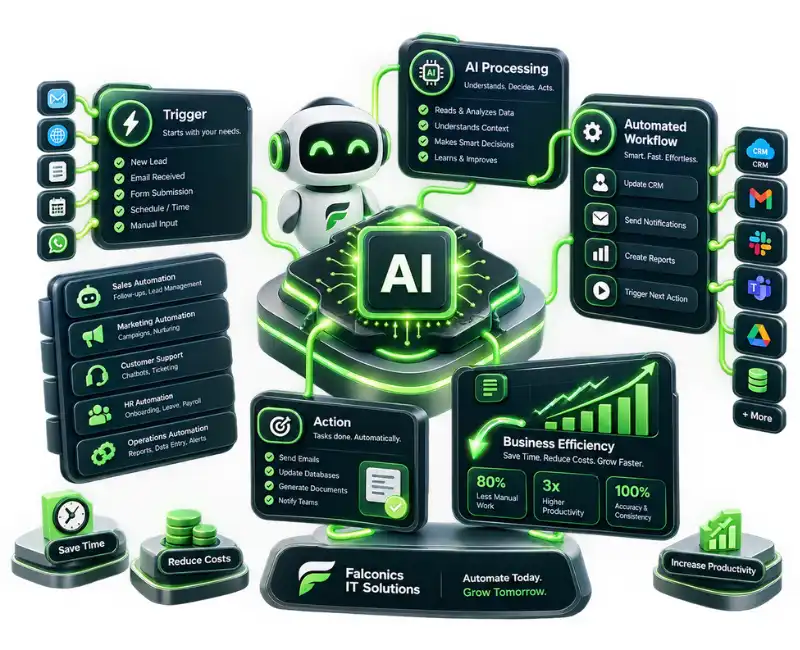
Manual processes can quietly consume hours across sales, customer support, operations, reporting and administration. Falconics IT Solutions builds AI automation systems that connect your existing tools and workflows with intelligent automation, helping your team spend less time on repetitive tasks and more time on work that requires human judgment.
From AI chatbots and lead handling to workflow automation, API integrations and AI-powered internal processes, we design solutions around how your business actually operates.
Key advantages:
AI automation combines artificial intelligence with workflow logic, applications, APIs and business rules. Instead of simply adding an AI tool to your technology stack, the objective is to create a practical system that can receive information, make appropriate decisions, trigger actions and pass work between platforms.
For example, a new enquiry can be captured automatically, classified by an AI system, added to a CRM, assigned to the appropriate team member and followed up according to predefined rules. Similar automation can be applied to customer support, internal requests, documents, reporting and other repeatable processes.
The right automation depends on the workflow rather than the technology alone. Falconics focuses on identifying where automation can create useful operational improvements before deciding how the system should be built.
Many businesses rely on repetitive sequences that involve copying information between applications, sending notifications, updating records or checking predefined conditions.
AI workflow automation can connect these steps so that routine work happens automatically. Where appropriate, AI can also handle tasks involving language, classification, summarisation, document understanding or contextual decisions.
Typical workflows can include:
The goal is not to automate everything. It is to automate the right parts of a process while keeping people involved where judgement, approval or accountability is important.
AI-powered chatbots can handle common customer questions, collect information, qualify enquiries and direct conversations to the right destination.
A properly designed chatbot can work with your business information and existing systems rather than functioning as a standalone question-and-answer tool. Depending on the requirement, it can support website enquiries, lead capture, customer assistance and internal knowledge access.
For businesses receiving a high volume of repetitive enquiries, this can create a more consistent first response while allowing staff to concentrate on conversations that require personal attention.
Automation becomes more useful when it works with the systems your business already depends on.
Falconics can connect AI-driven processes with relevant applications through APIs and workflow integrations. This may include CRM platforms, websites, databases, communication tools, business applications and other operational systems.
Rather than replacing every existing platform, the approach can focus on making your current technology work together more effectively.
Not every automation opportunity requires a chatbot. AI can also support behind-the-scenes processes where employees spend significant time reviewing, organising or processing information.
Potential applications include document processing, data classification, content workflows, customer request handling, internal knowledge systems and automated reporting.
The appropriate solution depends on factors such as data quality, process complexity, existing software and the level of human oversight required.
The exact deliverables are determined by the workflow and scope of the project. A typical AI automation engagement may include:
This flexible approach allows a simple repetitive process to remain simple while more complex automation can be developed into a connected business system.
Less manual effort
Routine tasks can be handled automatically, reducing the amount of repetitive work employees need to perform.
Faster response times
Automated workflows can trigger actions immediately instead of waiting for a team member to process each request manually.
More consistent processes
Standardised automation can help ensure recurring tasks follow the same business rules and sequence.
Better use of employee time
Teams can redirect attention from repetitive administration toward customer relationships, analysis, decision-making and higher-value work.
Connected operations
Integrations can reduce unnecessary movement of information between separate applications and departments.
Scalable workflows
A well-designed automation system can support increasing transaction or enquiry volumes without requiring every step to be handled manually.
AI automation works best when it begins with the business process rather than the AI model. Falconics follows a practical workflow from understanding the requirement through implementation and refinement.
01 — Understand the Workflow
We examine the current process, the people involved, the systems being used and the points where repetitive work or unnecessary delays occur.
02 — Identify Automation Opportunities
The workflow is broken into individual tasks to determine what should be automated, what should remain human-controlled and where AI can add genuine value.
03 — Design the Solution
We define the workflow logic, integrations, AI components, data requirements and human approval points needed for the proposed system.
04 — Build and Integrate
The automation is developed and connected with the relevant business applications, APIs, databases or communication channels.
05 — Test, Launch and Refine
The system is tested against realistic scenarios before deployment. After launch, workflows can be monitored and refined as business requirements evolve.
AI automation can be useful for businesses of different sizes when there are repeatable processes that consume significant employee time.
Startups and growing businesses can use automation to build efficient processes without adding manual overhead at every stage of growth.
SMEs can automate recurring administrative, sales and customer-facing workflows while keeping their existing systems at the centre of operations.
E-commerce businesses can apply automation to customer enquiries, order-related workflows, product information and operational processes.
B2B companies can automate lead handling, CRM workflows, follow-ups, document processing and internal coordination.
Service businesses can streamline enquiry management, scheduling, communication and other recurring customer processes.
AI automation is particularly useful when teams are spending too much time on processes such as:
The first step is usually not choosing an AI tool. It is understanding why the process is consuming time and where automation can safely remove unnecessary manual steps.
Falconics approaches AI automation as part of a wider technology and business-growth ecosystem rather than as an isolated AI implementation.
The team works across AI, software, web development, data and digital solutions, which can be useful when an automation project needs to connect with an existing website, application, CRM, database or broader digital infrastructure.
The emphasis is on building around the business requirement instead of forcing a predefined automation package onto every project. This allows the scope, integrations and level of intelligence to be matched to the workflow being improved.
The timeline for AI automation depends on the complexity of the workflow, number of integrations, data requirements, AI functionality, existing infrastructure and testing requirements.
A straightforward workflow connecting a small number of systems may require considerably less development than a multi-stage automation involving several applications, AI decision-making and custom business logic.
Meaningful progress should therefore be assessed against agreed project milestones rather than an arbitrary number of days. Clear access to the required systems, business rules and process information can also help keep implementation efficient.
AI automation should be treated as an operational improvement project, not as a guarantee of specific revenue, lead or productivity outcomes.
AI automation pricing depends on the scope and technical requirements of the solution. Key factors can include the number of workflows, integration complexity, AI functionality, existing systems, custom development requirements and ongoing support.
Falconics does not present a one-size-fits-all price because a simple workflow automation and a complex AI-integrated business system require very different levels of planning and development.
For an accurate estimate, the most useful starting point is a discussion of the process you want to automate, the systems currently involved and the outcome you want the automation to support.
AI automation uses artificial intelligence together with workflow logic and software integrations to perform tasks that would otherwise require repeated human involvement. It can support processes involving customer interactions, data, documents, decisions and system-to-system actions.
Potential use cases include lead qualification, customer support, CRM updates, document processing, reporting, notifications, data handling, internal requests and repetitive administrative workflows. The suitability of a process depends on its structure, data and required level of human oversight.
In many cases, yes. Automation can be connected to existing platforms through APIs, webhooks and other integration methods where the relevant systems support them.
Not necessarily. A well-designed automation can often work alongside existing software and connect the systems you already use.
Yes. Small and growing businesses can benefit when employees spend substantial time on repeatable tasks. The best starting point is usually a focused workflow where automation can address a clear operational problem.
There is no single timeline for every project. Complexity, integrations, data requirements, custom development and testing can all affect delivery time. A clearer estimate can be provided after understanding the workflow and technical scope.
Not necessarily, and that should not be the default objective. Effective automation often handles repetitive or structured tasks while people remain responsible for judgement, exceptions, relationships and important decisions.
Yes. Automation can be designed around specific business workflows rather than limited to a standard package. The final scope depends on the process, systems and technical requirements.
Security depends on the architecture, applications involved, data being processed, access controls and integration methods. Security requirements should be considered during solution design, particularly when automation handles confidential business or customer information.
There is no fixed price for every automation project. Cost depends on factors such as workflow complexity, integrations, AI requirements, custom development and ongoing support. A project assessment is the appropriate way to determine the required scope.
Start by identifying a repetitive process that consumes meaningful time or creates avoidable delays. Share the current workflow, the systems involved and the result you want to achieve, and Falconics can assess where AI automation may be appropriate.
The best automation is not the one with the most AI features. It is the one that removes unnecessary manual work while fitting naturally into the way your business operates.
Tell Falconics what process you want to improve, and we can explore the workflow, identify practical automation opportunities and define a solution around your requirements.
Contact our expert team today for a tailored strategy and free consultation.
Get a Free Consultation