
Ready to transform your business with Business Websites?
Contact our expert team today for a tailored strategy and free consultation.
Get a Free ConsultationNo services available in this category yet.
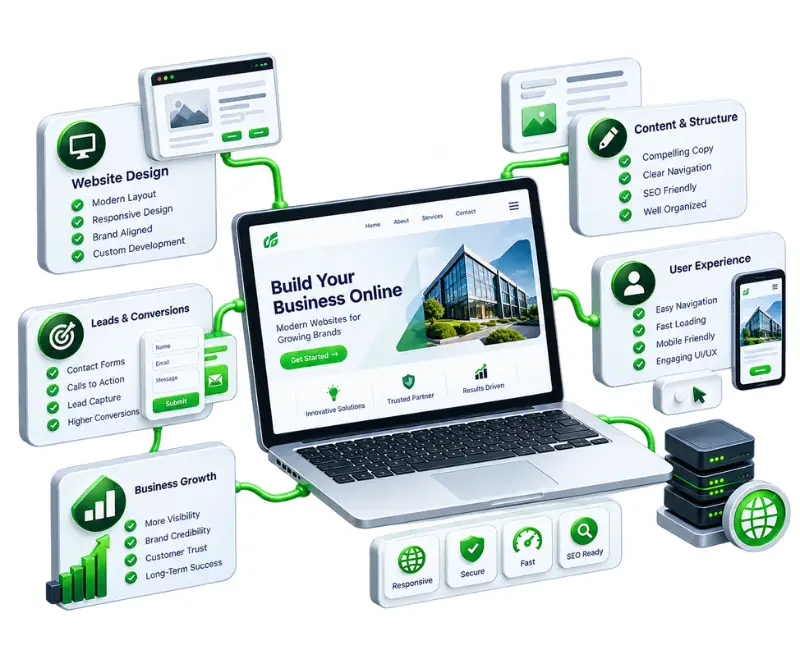
Your website should do more than display your company name and contact details. It should explain what you offer, establish credibility, make it easy for prospects to take the next step, and give your business a reliable digital presence.
Falconics IT develops business websites around the way your customers actually use them. From structure and page flow to responsive development and conversion-focused content placement, we build websites that are practical to manage, easy to navigate and aligned with your business objectives.
Whether you are launching a new company, replacing an outdated website or creating a stronger online presence for an established business, the development approach is shaped around your requirements rather than a one-size-fits-all template.
Why it matters:
Business website development brings together the structure, functionality and technical implementation required to turn your website concept into a working digital platform.
The scope can vary depending on the size and nature of the business. A straightforward company website may need carefully structured service pages, contact functionality and a content management system, while a more complex project may require integrations, custom functionality or additional administrative features.
Falconics IT can structure the development around the actual requirements of the project instead of adding unnecessary features simply because they are available.
A professional website needs a logical path from the first visit to the desired action. Visitors should be able to understand what the business does, find relevant information and know where to go next without having to work through a confusing navigation system.
The development process therefore considers information hierarchy, navigation, page relationships, calls to action and mobile usability alongside the visual design.
The result is a website built around communication and usability, not just appearance.
A significant portion of website activity can come from smartphones and tablets, so a business website needs to work comfortably beyond desktop screens.
Responsive development adapts layouts, content areas, navigation and interactive elements to different screen sizes. This helps maintain usability whether a potential customer visits from a laptop, smartphone or tablet.
Mobile responsiveness is treated as part of the core website experience rather than an afterthought.
The right functionality depends on what the website needs to accomplish. Common requirements may include:
For projects requiring additional functionality, the feature set can be defined during the planning stage so development remains aligned with the business objective.
A website cannot rely on design alone if organic search is part of its acquisition strategy. Its structure and technical foundation should make it easier for search engines to understand the site's pages while also keeping the experience useful for visitors.
Business website development can therefore account for elements such as logical page structure, crawlable content, clean navigation, mobile responsiveness, page-level metadata implementation and other foundational SEO considerations.
This does not mean promising rankings. It means avoiding preventable technical and structural issues that can make future SEO work more difficult.
A business website should reflect the actual company behind it.
A professional services firm, manufacturer, technology company, local business and B2B organisation may all need websites, but their customers do not make decisions in the same way. Their priorities, information requirements and conversion paths can be very different.
Falconics IT approaches development with those differences in mind, allowing the website's structure and functionality to support the specific business model rather than forcing every project into the same format.
A properly planned website can contribute to several parts of the customer journey.
Clearer communication
Organised content helps prospective customers quickly understand your services, capabilities and areas of expertise.
Stronger first impressions
A modern, functional website gives visitors a more credible place to evaluate your business before making contact.
More effective enquiries
Strategically placed contact options and calls to action can reduce friction for visitors who are ready to speak with your business.
Better customer experience
Responsive layouts, intuitive navigation and accessible information make the website easier to use.
A foundation for marketing
A well-structured website can support future SEO, content marketing, advertising and other digital acquisition activities.
Room for expansion
A website planned around a clear structure can accommodate additional services, pages, content and functionality as business requirements change.
The development process should be predictable without becoming unnecessarily complicated.
1. Requirement Discovery
We begin by understanding the business, target customers, website objectives, required pages, functionality and any existing website or technical considerations.
2. Planning and Structure
The website's information architecture, navigation, page requirements and functionality are mapped according to the intended user journey.
3. Design and Development
The approved direction is translated into a responsive website with the required layouts, content sections and functionality.
4. Testing and Refinement
The website is reviewed for usability, responsiveness, functionality and consistency. Issues identified during testing are addressed before launch.
5. Launch and Next Steps
Once the website is ready, it can be prepared for deployment. Future improvements can then be based on changing business requirements, content needs and performance observations.
The exact deliverables depend on the agreed scope, but a business website project may include:
Additional functionality can be discussed when the project requires something beyond the core business website.
This service can be useful for businesses at different stages.
Startups and new businesses can establish a professional digital presence from the beginning instead of relying only on social profiles or third-party platforms.
Small and medium-sized businesses can replace outdated websites with a more usable platform that better represents their current services.
Established companies can rebuild websites that no longer reflect their positioning, offerings or customer expectations.
B2B businesses and professional service providers can use a structured website to explain complex services, demonstrate capabilities and create clearer enquiry paths.
Many businesses do not need more features; they need a better-organised website.
Typical issues include an outdated design, confusing navigation, poor mobile usability, difficult-to-update content, weak service presentation, unclear calls to action or a website that does not properly communicate what the company offers.
Development should address the underlying problem rather than simply adding another layer of design. Where an existing website is still technically viable, improvements may be focused on structure and functionality; where the foundation is limiting the business, rebuilding may be the more practical direction.
There is no useful single timeline for every business website.
Project duration can depend on the number of pages, design requirements, functionality, integrations, content readiness, feedback cycles and technical complexity.
Projects generally move more efficiently when the business provides its content, branding assets, service information and required functionality early in the process. A clear scope also helps prevent avoidable changes later.
Website development pricing is determined by the scope rather than a fixed universal rate.
Key factors can include:
The practical approach is to define what the website needs to accomplish first and then determine the appropriate development scope.
The value of a website project is not only in writing code. It is in making sensible decisions about what the website needs to do for the business.
Falconics IT approaches business website development with attention to usability, business requirements and the technical foundation behind the finished website. The objective is to create something your business can actually use and build upon—not simply deliver a website that looks complete at launch.
The scope, functionality and development priorities can be discussed around your specific requirements, giving you a clearer understanding of what should be built before unnecessary complexity enters the project.
Business website development is the process of planning and building a website for a company or organisation. It covers the technical implementation, functionality, responsive behaviour and website structure required to create a usable online presence.
Website design focuses primarily on the visual direction and user experience, while development turns that structure into a functional website. A complete project often requires both design and development to work together.
Yes. A new business can start with a website structured around its services, target customers, brand identity and immediate business objectives. The structure can also leave room for future expansion.
Yes. An existing website can be assessed to determine whether it needs targeted improvements or a complete redevelopment. The appropriate approach depends on its current design, technology, usability and business requirements.
Responsive development is intended to provide a usable experience across desktop, tablet and mobile screen sizes. The final implementation should be tested across relevant screen sizes before launch.
The website can be developed with SEO fundamentals in mind, including logical structure, mobile responsiveness, crawlable content and appropriate technical implementation. SEO-friendly development provides a foundation, but it does not guarantee specific search rankings.
Yes. The pages, functionality and structure can be planned according to the business requirements. Customisation may range from page structures and forms to more specific functionality and integrations.
Typically, useful inputs include your business information, service details, branding assets, preferred website pages, images, contact information and any specific functionality you require. The exact requirements depend on the project scope.
There is no single price that applies to every business website. Cost depends on factors such as page count, functionality, customisation, integrations and technical requirements. A project scope can be discussed before determining the appropriate investment.
The timeline depends on the website's scope and complexity. Content availability, required features, revisions and integrations can also affect delivery time, so a realistic schedule is best established after the requirements are understood.
A well-planned website can be structured with future growth in mind. Additional pages, content, functionality or integrations can be considered as your business requirements evolve.
Start by sharing your business requirements, existing website if applicable, desired pages, functionality and overall objective. Falconics IT can then help define the appropriate development scope and next steps.
Your website should make it easier for people to understand your business and easier for you to manage your digital presence.
If you are starting from scratch, replacing an outdated website or planning a more capable business platform, Falconics IT can help define the right development approach around your requirements.
Contact our expert team today for a tailored strategy and free consultation.
Get a Free Consultation