
Ready to transform your business with Custom Software Development?
Contact our expert team today for a tailored strategy and free consultation.
Get a Free ConsultationNo services available in this category yet.
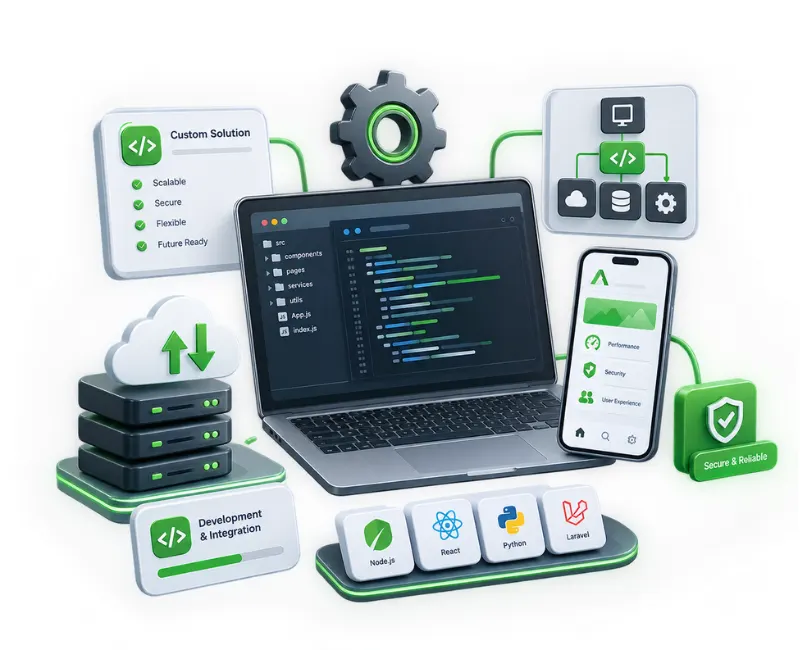
Your business should not have to change its processes simply to fit the limitations of generic software.
Falconics IT provides custom software development services designed around your workflows, users, operational requirements, and long-term business goals. We develop tailored software solutions that help businesses manage processes, connect systems, organize data, and create digital experiences that standard tools cannot always provide.
From a focused business application to a larger enterprise platform, we help turn business requirements into practical, scalable software.
Plan your software project with Falconics IT today.
Off-the-shelf software can be useful when your requirements are standard. But as a business grows, disconnected tools, manual processes, duplicate data, and limited functionality can become expensive operational problems.
Custom software gives you greater control over how technology supports your business.
Instead of adapting your workflow to a predefined product, we build the solution around your actual requirements.
Our approach considers:
The result is software developed with your business context in mind rather than a generic feature list.
Custom software development is the process of planning, designing, developing, testing, and deploying software specifically for an organization's requirements.
The software may be created for internal operations, customer-facing services, business management, data management, automation, or a combination of these functions.
A custom solution can be particularly valuable when your business has processes that are difficult to manage with standard applications.
For example, a company may need a centralized system that combines customer management, order processing, employee access, reporting, inventory information, and third-party integrations. Instead of operating several disconnected applications, these functions can be brought together within a purpose-built platform.
Custom development also gives you greater control over functionality, user roles, integrations, data structures, and future improvements.
We begin by understanding what the software needs to accomplish.
This includes identifying business processes, users, functional requirements, technical dependencies, integrations, and expected workflows.
A clear requirements foundation helps prevent unnecessary features and gives the development team a practical direction before implementation begins.
We develop web-based applications for businesses that need more functionality than a standard website can provide.
Applications can be designed for internal teams, customers, partners, administrators, or multiple user groups with different permissions.
The focus is on creating an intuitive interface backed by reliable application logic and appropriate data management.
Businesses often rely on repetitive processes that can be improved through purpose-built software.
Custom business applications can support areas such as:
The exact functionality is determined by your business requirements rather than by a fixed software package.
When customer, sales, finance, inventory, or operational information is spread across multiple systems, managing the complete business process can become difficult.
Custom CRM and ERP solutions can bring relevant information and workflows into a more connected environment.
This can help teams work from consistent data while reducing unnecessary manual movement between applications.
Your software may need to communicate with other platforms.
We can plan and develop integrations with relevant third-party services, APIs, databases, payment systems, business tools, and other applications where technically appropriate.
Integration planning is important because software should fit into your existing technology environment rather than create another isolated system.
Reliable software depends on a well-structured backend and database architecture.
We develop the underlying systems responsible for application logic, data processing, authentication, permissions, and information management.
The architecture is planned according to the software's functional requirements and anticipated growth.
Existing software can become difficult to maintain when its technology, architecture, or functionality no longer supports current business needs.
Modernization can involve improving application architecture, updating components, restructuring databases, improving interfaces, integrating newer systems, or gradually replacing outdated functionality.
The appropriate approach depends on the condition and importance of the existing system.
Software development does not end when the code is completed.
Testing helps identify functional, usability, integration, and performance issues before deployment.
After launch, ongoing maintenance may be required for updates, improvements, security, compatibility, troubleshooting, and new business requirements.
Ready-made software can be the right choice when your requirements closely match the product.
Custom development becomes more valuable when the business needs greater flexibility.
| Off-the-Shelf Software | Custom Software |
|---|---|
| Predefined functionality | Functionality built around your requirements |
| Standard workflows | Business-specific workflows |
| Limited control over features | Greater control over functionality |
| Vendor-defined integrations | Integrations planned around your systems |
| One product for many businesses | Solution designed for your organization |
| Changes depend largely on the product roadmap | Future development can follow your business priorities |
The goal is not to replace every existing tool with custom software. A good technology strategy identifies where customization provides genuine business value and where existing solutions are sufficient.
Software can be structured around the way your teams actually work. This can reduce unnecessary steps and create more consistent processes.
As requirements increase, the software can be developed with future users, data, functionality, and integrations in mind.
Integrating relevant applications and data sources can reduce the need to repeatedly move information between disconnected tools.
Automation and centralized workflows can reduce repetitive administrative work and give employees more time for higher-value activities.
When important information is organized within connected systems, businesses can make it easier for authorized users to access and analyze relevant data.
A custom platform can evolve as your business changes. New functionality can be planned according to actual requirements rather than waiting for a third-party product to introduce it.
We start by understanding the business problem, users, workflows, existing systems, and desired functionality.
The objective is to establish what the software actually needs to achieve before development begins.
The technical structure is planned around the project's requirements.
This can include application architecture, databases, integrations, user roles, security considerations, and scalability requirements.
The user experience and development roadmap are structured around the people who will use the software.
The focus is on clear navigation, appropriate functionality, and practical workflows.
The application is developed according to the agreed requirements.
Where required, external systems and services are integrated so the new software can operate within the broader technology environment.
The software is evaluated to identify functional problems, integration issues, usability concerns, and other defects before release.
Testing helps ensure the application behaves as intended under relevant usage conditions.
Once the software is ready, it can be deployed according to the project's technical requirements.
Post-launch support can include maintenance, troubleshooting, improvements, updates, and additional functionality as the business evolves.
A growing company may need software that supports a specific product, workflow, marketplace, customer journey, or internal operation without carrying unnecessary functionality.
Small and mid-sized businesses can use custom software to bring important processes together and reduce dependence on disconnected spreadsheets or multiple applications.
Custom systems can support specialized product, order, inventory, customer, reporting, or integration requirements that extend beyond a standard e-commerce platform.
Businesses with complex customer workflows, bookings, approvals, project management, reporting, or internal operations can benefit from software designed around their service model.
Larger organizations may require software that connects departments, supports complex permissions, integrates with existing systems, or handles organization-specific workflows.
When teams rely on multiple systems that do not communicate effectively, information can become fragmented. Custom software can bring selected processes and data into a more connected environment.
Repeated data entry, approvals, reporting, and administrative tasks can consume valuable employee time. Appropriate software automation can reduce unnecessary manual effort.
A business may outgrow a standard application when important workflows cannot be customized. Purpose-built software provides greater control over functionality.
When business information is distributed across different systems, getting a clear operational view can be difficult. A connected application can organize relevant information around business requirements.
Legacy systems can become expensive or difficult to maintain. Modernization can improve maintainability while preserving valuable business functionality where appropriate.
If important applications operate independently, employees may need to transfer information manually. API and system integrations can help create a more connected technology environment.
The exact deliverables depend on your project scope, but a typical custom software engagement may include:
Core Deliverables
Ongoing / Optional Deliverables
The scope should be established before development so both sides have a clear understanding of what is being built.
There is no responsible single timeline for every custom software project.
A simple application with a focused feature set can require considerably less development work than a multi-user platform involving complex workflows, integrations, databases, and administrative functionality.
Timeline can be influenced by:
A clearer timeline can be established after the requirements and technical scope have been assessed.
Custom software development does not have a universal fixed price because every application has different requirements.
The overall cost can depend on:
Rather than selecting a development package based only on price, businesses should evaluate the scope, architecture, maintainability, and long-term usefulness of the proposed solution.
Discuss your requirements with Falconics IT to determine the appropriate development scope for your project.
Custom software development involves creating an application specifically around the requirements, workflows, users, and objectives of a particular business or organization.
Custom software can be useful when standard applications cannot adequately support your workflows, integrations, functionality, or scalability requirements.
The appropriate solution depends on the business requirement. Custom applications can support business operations, customer management, workflow automation, data management, integrations, and other specialized processes.
Yes. Where technically appropriate, custom software can be designed to communicate with existing applications, databases, APIs, and third-party platforms.
It can be. Scalability should be considered during architecture and development so the application can accommodate changing requirements, users, data, and functionality.
The timeline depends on the scope and complexity of the project. Requirements, integrations, number of features, testing, and feedback cycles can all affect delivery time.
Yes. Depending on the existing application's architecture and condition, modernization may involve improving specific components, restructuring systems, adding integrations, or developing replacement functionality.
Ongoing maintenance and technical support can be included according to the project's requirements and engagement model.
Cost depends on the project's scope, functionality, technical complexity, integrations, design requirements, and support needs. A project assessment is required before providing an appropriate estimate.
Start by explaining the business problem, current process, desired functionality, users, existing systems, and expected outcome. These details provide a useful foundation for defining the project scope.
Your software should support your business processes rather than force your teams into workflows that do not fit.
Falconics IT can help you plan and develop a custom software solution around your actual requirements, from initial discovery through development, deployment, and ongoing improvement.
If you have a software idea, an inefficient business process, or an existing application that needs modernization, let's discuss what the right solution could look like.
Contact our expert team today for a tailored strategy and free consultation.
Get a Free Consultation