
Ready to transform your business with Corporate Websites?
Contact our expert team today for a tailored strategy and free consultation.
Get a Free ConsultationNo services available in this category yet.
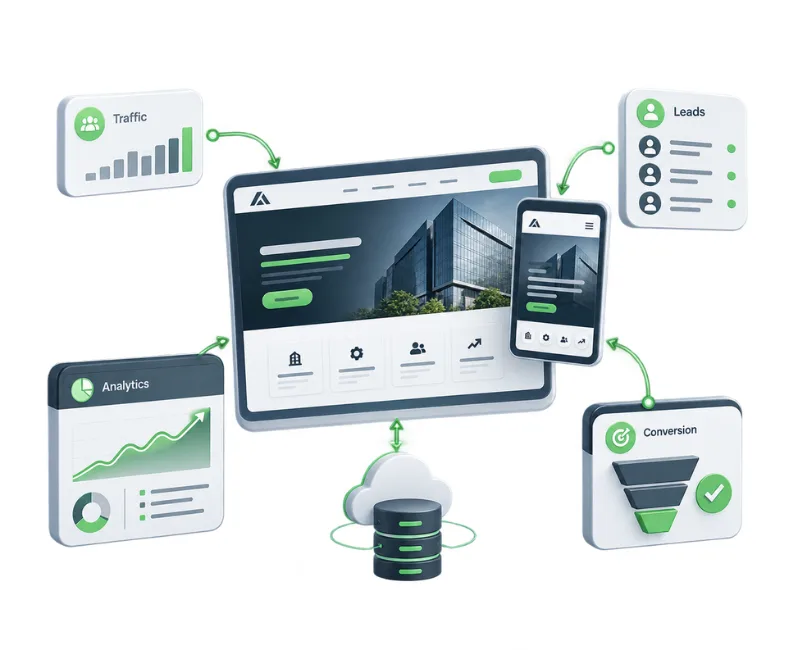
Your corporate website is often the first serious interaction a prospect has with your company. It needs to do more than look polished. It should communicate what you do clearly, establish confidence, make information easy to find, work smoothly across devices, and give visitors a clear path toward contacting your business.
Falconics IT provides corporate website development services for businesses that need a professional, responsive, and scalable digital presence built around their actual business requirements.
Whether you are launching a new company website, replacing an outdated platform, restructuring an existing website, or building a more capable corporate web presence, we focus on the things that matter after launch: usability, maintainability, performance, content management, and business relevance.
A corporate website should represent the organization behind it.
That means the website architecture, visual identity, content structure, navigation, and functionality need to work together. A strong corporate site helps different visitors quickly understand the company, its capabilities, products or services, credibility, locations, and next steps.
Our corporate website development approach brings these requirements together into one structured project rather than treating design and development as separate tasks.
Depending on your requirements, a corporate website can include company and leadership information, products and service pages, industry-specific solutions, about and corporate profile sections, contact and enquiry journeys, careers and recruitment pages, news, insights or blogs, case studies and project portfolios, downloadable resources, location or branch information, lead-generation forms, CRM, analytics or marketing integrations, content management functionality, and custom business workflows.
The objective is not to add features simply because they are available. Every feature should have a reason to exist and should make the website more useful to your customers, employees, or internal teams.
Development starts with understanding the business rather than immediately choosing a template or writing code.
We look at your business objectives, audience, existing website, content requirements, competitors, important conversion points, and future plans. This helps establish an appropriate sitemap and functional direction before development begins.
A well-planned structure also makes future expansion easier. New services, industries, locations, or content categories can be incorporated without forcing the entire website to be rebuilt.
Corporate web design needs to balance visual credibility with practical usability.
We create interfaces that support your brand identity while keeping navigation straightforward. Important information should be accessible without making visitors search through unnecessary layers of content.
The design process can cover page layouts, navigation systems, typography and visual hierarchy, brand-aligned colour systems, calls to action, forms and enquiry interfaces, mobile layouts, content presentation, service and industry sections, and trust and credibility elements.
The result should feel like your organization—not a generic website assembled from a standard template.
Your corporate website needs to function consistently across desktops, laptops, tablets, and smartphones.
Responsive development ensures that layouts, menus, forms, images, typography, and interactive elements adapt to different screen sizes. We also consider practical performance factors such as image handling, page structure, unnecessary scripts, and frontend efficiency.
A responsive website is particularly important when different audiences access your business through different devices and channels.
A corporate website should not become dependent on a developer for every minor content update.
Where a CMS is appropriate, we structure the website so authorized team members can manage relevant content without changing the underlying code.
Depending on the project, editable areas may include website pages, services, blog or news content, case studies, team profiles, careers, FAQs, images and documents, and contact information.
The CMS is selected and configured according to the website's actual requirements rather than adding unnecessary complexity.
Many corporate websites need to communicate with other systems.
Depending on your requirements, integrations may include CRM platforms, analytics tools, email systems, marketing platforms, appointment systems, business applications, payment services, maps, or other third-party tools.
The important consideration is not simply whether an integration can be connected. It is whether the connection improves an existing business process and works reliably within the website environment.
Corporate website development and SEO should not be treated as completely separate projects.
The website structure can influence how easily search engines discover, understand, and index your content. We therefore consider technical fundamentals during development, including logical URL structures, heading hierarchy, crawlable navigation, mobile responsiveness, page performance, metadata implementation, image optimization, internal linking structure, structured content, indexation considerations, and search-friendly page architecture.
This creates a stronger technical foundation for future SEO work without promising specific rankings.
A corporate website represents a business, so reliability matters.
Before launch, the website should be reviewed for functional issues, responsive behaviour, forms, navigation, browser compatibility, broken links, and important performance considerations.
Security requirements are considered according to the project's technology and functionality, with appropriate measures applied to the website and its supporting environment.
A visually attractive website can still perform poorly if the underlying experience is difficult to use.
Visitors may arrive looking for very different information. A prospective customer might want to understand your services. A potential partner may want company information. A job applicant may be looking for careers. An existing customer may need contact information or documentation.
A well-structured corporate website gives these audiences clear routes through the site.
That is why we consider four connected layers during development. The brand layer asks whether the website accurately represents the organization. The experience layer focuses on whether visitors can quickly find and understand important information. The technology layer considers whether the website is stable, maintainable, responsive, and appropriately built. The business layer looks at whether the website supports enquiries, communication, recruitment, credibility, or other defined objectives.
When these layers work together, the website becomes a practical business asset rather than simply an online brochure.
Prospects often form an initial opinion of a company from its website. Clear information, consistent branding, and a professional user experience can help establish confidence before a conversation begins.
A clear information architecture reduces the effort required to understand your company. Visitors can move from broad company information to specific services, industries, capabilities, or contact options without unnecessary friction.
A corporate website can guide visitors toward relevant actions instead of presenting a single generic contact option. Service-specific calls to action, enquiry forms, and useful supporting information can help prospects make better-informed decisions.
When the website is structured around a suitable CMS, internal teams can keep important information current without relying on developers for every routine change.
A properly structured website provides a stronger destination for search traffic, digital campaigns, social media referrals, email campaigns, and other marketing activities.
Your company may add services, enter new markets, publish new content, or introduce new digital processes. A scalable website structure makes those changes easier to accommodate.
We begin by defining what the website needs to accomplish.
This includes understanding your business, target audiences, existing digital presence, content requirements, functionality, integrations, and technical expectations.
The output is a clearer project scope and development direction.
Before individual pages are developed, we establish how information will be organized.
This includes the sitemap, navigation, page relationships, content categories, and important user journeys.
The goal is to make the website understandable for both visitors and the internal team managing it.
The approved structure is translated into interface designs that reflect the corporate identity and intended user experience.
Important pages and interactions are considered before development so that design decisions are made deliberately rather than during coding.
Once the design direction is established, the website is developed and configured according to the agreed requirements.
This may involve frontend development, backend functionality, CMS configuration, database work, forms, third-party integrations, and other project-specific components.
Before deployment, we review the website across relevant devices and browsers and test key functionality.
Forms, navigation, responsive layouts, links, content presentation, and integrations are checked before the final launch.
Launching the website is not necessarily the end of the project.
Depending on the engagement, ongoing support can cover maintenance, updates, troubleshooting, performance improvements, content changes, and further development.
Choosing a corporate website development partner is about more than finding someone who can build web pages. You need a team capable of understanding the relationship between business objectives, user experience, and technology.
Falconics IT approaches corporate websites as structured digital projects rather than one-size-fits-all design packages.
The website is planned around your objectives, audiences, and operational requirements before technical implementation begins.
Technology should serve the project. We focus on choosing and configuring solutions according to the website's requirements rather than adding technical complexity without a clear benefit.
Visual design and functionality need to support each other. A beautiful interface that creates usability problems is not a successful corporate website.
Defining pages, functionality, integrations, and responsibilities early helps reduce ambiguity as development progresses.
Corporate websites often grow after launch. We consider future content, functionality, and expansion when structuring the initial website.
When continued assistance is required, post-launch support can help keep the website functional, current, and aligned with changing business needs.
Organizations with an outdated website can use a new corporate platform to restructure information, modernize the user experience, and create a more maintainable digital presence.
Companies expanding their services, teams, or markets often need a website that can communicate a broader proposition without becoming difficult to navigate.
B2B buyers frequently research a company before initiating contact. A structured website can present capabilities, services, industries, case studies, and business information in a way that supports the evaluation process.
Consultancies, technology companies, agencies, legal businesses, financial firms, and other professional organizations can use a corporate website to communicate expertise and establish credibility.
Manufacturing companies often need more than standard service pages. Their websites may need product information, capabilities, industries served, certifications, facilities, documentation, and enquiry pathways.
Companies with multiple divisions, services, or business units need information architecture that keeps the overall website coherent while giving each area enough space.
Corporate website development can support a wide range of business models.
For a B2B organization, the website can focus on capabilities, industries, solutions, case studies, and qualified enquiries.
For a professional services company, the priority may be expertise, service clarity, team information, resources, and consultation enquiries.
For a manufacturing company, the website may require detailed product information, technical documentation, facilities, industries, and distributor or enquiry workflows.
For a technology company, the website may emphasize products, platforms, integrations, use cases, technical capabilities, and lead generation.
For a multi-location business, location-specific information can be structured without making the overall navigation confusing.
The final architecture should follow the business model rather than forcing every organization into the same page structure.
Depending on the approved scope, a corporate website project can include website strategy and requirements planning, sitemap and information architecture, custom or brand-aligned UI/UX design, responsive frontend development, backend development where required, CMS implementation, corporate service and information pages, contact and enquiry functionality, blog, news or resource sections, basic technical SEO foundations, third-party integrations included in scope, cross-device and browser testing, and website deployment.
Projects with more complex requirements may include CRM integration, API integrations, custom dashboards, advanced forms and workflows, multiple user roles, careers and recruitment functionality, resource libraries, multi-location architecture, multilingual functionality, custom databases, advanced analytics and tracking, and ongoing maintenance and development.
Final deliverables depend on the requirements agreed before development begins.
Problem: The existing website no longer reflects the company or its current services.
Approach: Rework the architecture, design, and content presentation around the current business.
Business direction: Create a platform that can support the organization's present and future communication needs.
Problem: Important services or information are buried under unclear menus.
Approach: Reorganize content around audience needs, page relationships, and logical navigation.
Business direction: Help visitors reach relevant information with fewer unnecessary steps.
Problem: The website works reasonably well on desktop but becomes difficult to use on phones.
Approach: Build responsive layouts and interactions around different screen sizes.
Business direction: Provide a consistent experience across the devices your audience uses.
Problem: Visitors reach the website but are given little direction about what to do next.
Approach: Improve calls to action, service journeys, enquiry forms, and relevant supporting information.
Business direction: Make it easier for interested prospects to initiate the appropriate conversation.
Problem: Internal teams depend on developers for routine website changes.
Approach: Introduce an appropriate content management system and manageable content structures.
Business direction: Allow authorized staff to keep the website current more efficiently.
Problem: Excessive assets, inefficient implementation, or poor technical decisions can affect website performance.
Approach: Review frontend implementation, assets, scripts, and hosting-related considerations within the project scope.
Business direction: Create a smoother experience and a more maintainable technical foundation.
Corporate website development timelines vary because a five-page corporate website and a complex platform with integrations are fundamentally different projects.
The timeline can be influenced by the number of pages, content readiness, design complexity, CMS requirements, custom functionality, integrations, data migration, number of stakeholders, approval cycles, multilingual requirements, and testing requirements.
A straightforward corporate website may move through planning, design, development, testing, and launch relatively quickly. More complex websites require additional discovery, development, and testing.
The project can progress more efficiently when the client provides brand assets, website content, technical access, and feedback within agreed review periods.
Rather than promising an arbitrary delivery date before understanding the requirements, the appropriate timeline should be established after the project scope is defined.
Corporate website development does not have a single fixed price because the scope can differ significantly from one organization to another.
The final investment may depend on the number of pages, design requirements, technology and CMS, custom functionality, integrations, content migration, security requirements, performance requirements, multilingual or multi-location functionality, ongoing maintenance, and future development needs.
A useful proposal should make the scope clear rather than offering a low headline price that excludes important requirements.
Request a consultation to discuss your website requirements and receive a scope-based proposal.
Corporate website development is the planning, design, and technical development of a professional website for an organization. It typically combines corporate branding, business information, services, content management, responsive design, lead-generation functionality, and other requirements relevant to the company.
A corporate website often has broader content and organizational requirements. It may represent multiple services, business units, locations, industries, or stakeholder groups and may require more structured content, integrations, and administrative functionality.
Yes. The appropriate level of customization depends on the project's requirements. A website can be developed around specific branding, layouts, workflows, content structures, and integrations instead of relying entirely on a pre-built template.
A professionally developed corporate website should be responsive, allowing its layout and functionality to adapt to smartphones, tablets, and desktop screens.
Yes, where a CMS is included in the project. The content management setup can be structured so authorized users can update appropriate sections without modifying the website's underlying code.
CRM integration can be considered when the selected CRM and required data workflows support it. The exact implementation depends on the CRM, API availability, data requirements, and desired workflow.
Technical SEO considerations can be incorporated into the website architecture and development process. This may include crawlable structures, headings, URLs, responsive design, metadata implementation, and other technical fundamentals. Ongoing SEO is a separate scope when a business requires continuous organic search optimization.
There is no reliable universal timeline. Project duration depends on the number of pages, content availability, design complexity, custom functionality, integrations, approvals, and testing requirements. A realistic schedule can be provided after the requirements are understood.
The cost depends on the scope and technical requirements. Page count, design, CMS, integrations, custom functionality, content migration, and ongoing support can all affect the project investment. Falconics IT can provide a scope-based proposal after reviewing your requirements.
Yes. A redesign can address visual presentation, navigation, content structure, mobile experience, technical implementation, and conversion paths while preserving useful existing content where appropriate.
Useful materials include your brand guidelines, logo and visual assets, company information, service descriptions, existing website access, preferred references, required integrations, and any existing content. If some content is not ready, this can be discussed during project planning.
Ongoing maintenance and development support can be arranged according to the project requirements. Support may include updates, troubleshooting, performance improvements, security-related maintenance, and further website changes.
Your corporate website should make it easier for the right people to understand your business, evaluate your capabilities, and take the next step.
Falconics IT can help you plan and develop a corporate website around your brand, audience, content, and technical requirements—without adding unnecessary complexity.
If you are replacing an outdated website, launching a new corporate presence, or planning a more capable digital platform, start with a conversation about what the website actually needs to achieve.
Contact our expert team today for a tailored strategy and free consultation.
Get a Free Consultation