
Ready to transform your business with Ecommerce SEO?
Contact our expert team today for a tailored strategy and free consultation.
Get a Free ConsultationNo services available in this category yet.
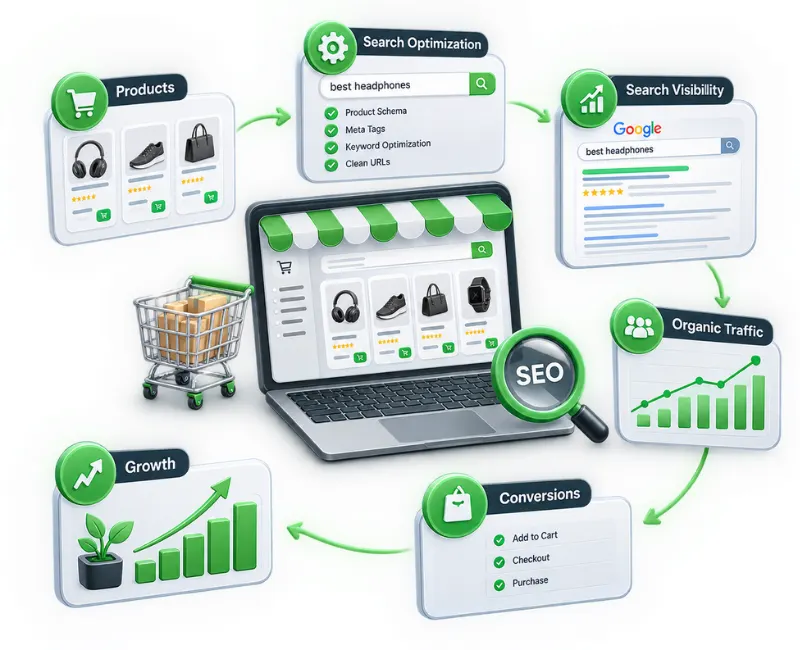
Ecommerce SEO is about more than ranking individual product pages. A strong strategy connects search demand with the right products, categories, content and technical foundations so customers can find your store at different stages of their buying journey.
Falconics helps ecommerce businesses build that foundation through product and category optimization, keyword research, technical SEO, internal linking, structured site architecture and ongoing performance analysis. The focus is on creating an organic search presence that supports real commercial objectives rather than chasing rankings in isolation.
What you can expect:
Online shoppers do not search for every product in the same way. Some use broad category terms, while others search for a specific product, brand, feature, size, material or use case.
Your SEO strategy therefore needs to reflect the structure of your store and the way customers search. We map relevant search intent to product pages, category pages and supporting content so each important part of the website has a clear role.
The result is a more purposeful organic search structure, rather than a collection of individually optimized pages competing with one another.
Keyword research for an online store needs to go beyond search volume. The important question is whether a search represents a useful opportunity for the products you actually sell.
We assess relevant commercial and informational searches, product terminology, category-level demand, variations and long-tail queries. These findings help determine which keywords belong on category pages, which should support individual products and where additional content may be useful.
This also helps avoid a common ecommerce SEO problem: targeting highly competitive terms without considering whether the resulting traffic is relevant to the catalogue or buying journey.
Product pages need to satisfy both search engines and potential buyers. Titles, descriptions, headings, URLs, image context, internal links and structured data can all influence how effectively a product page is understood and discovered.
Our ecommerce SEO work can include reviewing product-page templates, improving content structure, identifying missing search intent and creating optimization recommendations that can be applied consistently across the catalogue.
Where products have similar attributes or variations, we also consider how pages should be differentiated to reduce unnecessary duplication and improve overall site clarity.
Category pages often represent some of the most valuable organic landing pages on an ecommerce website because they can target broader commercial searches while introducing shoppers to a range of products.
We optimize category structures around meaningful search themes, relevant copy, page hierarchy and internal linking. The objective is to make category pages useful destinations in their own right rather than thin collections of product links.
A well-organized category structure can also make it easier for search engines to discover important products and understand the relationships between different parts of the catalogue.
Large ecommerce websites can develop technical SEO problems as products are added, categories change and filters create new URL combinations.
Technical reviews can cover areas such as:
The exact priorities depend on the platform, catalogue size and existing website architecture. The aim is to remove technical barriers that prevent valuable pages from being efficiently discovered, crawled and indexed.
Search performance is closely connected to how an ecommerce website is organized. Important products should not be buried several layers deep or disconnected from relevant categories and supporting pages.
We review the relationship between categories, subcategories, products and useful content to identify opportunities for a clearer information hierarchy. Internal links can then help users navigate the store while giving search engines stronger contextual signals about important pages.
This is particularly valuable for growing catalogues where the original website structure may no longer reflect the current product range.
Not every search should be targeted with another product page. Some customers need comparisons, buying guidance, product education or answers before they are ready to purchase.
Where there is a genuine content opportunity, we can identify supporting topics that complement the commercial pages of your store. The goal is not to publish content for the sake of volume, but to create useful entry points that connect naturally with relevant products and categories.
Product information can contain useful details such as price, availability, ratings and other attributes. Appropriate structured data can help search engines interpret this information more consistently.
We review relevant ecommerce schema opportunities and implementation considerations as part of the wider SEO strategy. Structured data is treated as a supporting technical layer, not a substitute for strong content, architecture or page quality.
The exact scope is shaped around your website, platform, catalogue and business objectives. Depending on the requirements, deliverables may include:
| Area | Typical Deliverables |
|---|---|
| SEO research | Keyword research, search-intent mapping and competitor opportunity analysis |
| On-page SEO | Product and category optimization recommendations |
| Technical SEO | Technical audit, crawl/indexation review and issue prioritization |
| Site architecture | Category structure and internal-linking recommendations |
| Content | Ecommerce content opportunities and optimization guidance |
| Structured data | Relevant ecommerce schema review and recommendations |
| Monitoring | Performance analysis, issue tracking and ongoing optimization priorities |
We begin by reviewing your products, categories, target customers, website platform, existing organic presence and commercial priorities. This gives the strategy a business context rather than treating SEO as an isolated marketing activity.
Search behaviour, keyword themes and competitor visibility are assessed to identify where your store has realistic opportunities. Relevant terms are mapped to appropriate page types so product, category and supporting content have clearly defined purposes.
Technical and structural issues are prioritized according to their potential impact. This can include crawlability, indexation, duplicate URLs, site architecture, internal linking and other barriers affecting organic search performance.
Priority pages and templates are improved based on the strategy. Depending on the engagement, recommendations can be implemented across product pages, category pages, content, metadata, internal links and technical elements.
SEO is reviewed as an ongoing process. Performance data helps identify what is gaining traction, where additional optimization is needed and which opportunities should be prioritized next.
Ecommerce SEO can be valuable for businesses at different stages, but the priorities change according to the store.
Growing online stores may need a stronger organic foundation, better category targeting and a scalable page structure.
Established ecommerce businesses may benefit from technical improvements, catalogue optimization and identifying search opportunities that are currently underperforming.
D2C and consumer brands can use organic search to build discoverability around both product-specific and category-level demand.
Large catalogues and multi-category stores often require greater attention to crawlability, faceted navigation, internal linking and indexation management.
Many online stores have strong products but struggle to make those products discoverable through organic search. Common issues include pages targeting the wrong search terms, poorly structured categories, duplicate content, weak internal linking and important products receiving little organic visibility.
Other stores may have reasonable rankings but lack a clear connection between SEO activity and commercial priorities. In those situations, the focus shifts toward understanding which pages and search opportunities are most valuable to the business.
The solution is not always more content. Sometimes the highest-impact improvement is fixing the architecture, consolidating competing pages or improving how existing product and category pages are optimized.
SEO results depend on factors such as your website's current condition, catalogue size, competition, authority, search demand, implementation speed and the quality of the existing content and technical foundation.
Meaningful progress generally requires consistent work rather than a one-time optimization exercise. Rankings can also fluctuate, so performance should be assessed across relevant organic visibility, qualified traffic, landing-page performance and commercial signals rather than relying on a single keyword position.
We focus on identifying practical opportunities and improving the underlying website rather than promising a fixed ranking, traffic figure or revenue outcome.
Falconics combines SEO with the wider digital and technology capabilities needed by ecommerce businesses. SEO recommendations can sit alongside web development, ecommerce technology, analytics, conversion optimization and digital marketing when the project requires a broader solution.
Our approach is structured around four principles: understand the business first, prioritize meaningful opportunities, execute against a clear strategy, and use performance data to guide the next round of improvements.
That means the work can address both the search visibility of the store and the technical or structural issues that influence how effectively that visibility turns into useful website activity.
Ecommerce SEO pricing depends on the scope and complexity of the store rather than a fixed package that works for every business.
Factors can include the number of products and categories, website platform, technical complexity, current SEO condition, competition, content requirements, implementation needs and whether ongoing optimization is required.
After understanding the website and objectives, a suitable engagement can be defined around the areas that require the most attention.
Ecommerce SEO is the process of improving an online store so its products, categories and supporting pages can be discovered more effectively through organic search. It combines keyword research, on-page optimization, technical SEO, site architecture, internal linking and other relevant activities.
Search can introduce potential customers to your products before they have chosen a specific brand or store. A well-structured SEO strategy can help your website become more discoverable for relevant commercial searches while improving how products and categories are organized for users and search engines.
Depending on the website, it can include keyword research, product-page SEO, category-page optimization, technical SEO, site architecture, internal linking, structured data, content opportunities and ongoing performance analysis.
Yes. Larger catalogues require particular attention to scalable page templates, crawlability, indexation, internal linking, category architecture and duplicate or low-value URLs. The strategy is adapted to the size and structure of the store.
Yes. Both page types can have different search intents and should be optimized accordingly. Product pages generally address more specific product-level searches, while category pages can target broader commercial themes.
There is no universal timeline because results depend on the website's starting point, competition, technical condition, authority, implementation speed and search demand. SEO should be viewed as an ongoing process, with priorities refined as performance data becomes available.
Yes, although a new store typically needs to establish its technical and content foundation before expecting substantial organic visibility. Early SEO work can focus on site architecture, keyword targeting, indexation, page templates and creating a scalable foundation for future growth.
Access requirements depend on the scope of work and what needs to be implemented. Website, analytics and relevant technical access may be required when direct implementation or detailed performance analysis is part of the engagement.
Yes. Ecommerce stores differ in catalogue structure, customer behaviour, platform, competition and commercial priorities. The strategy should therefore be based on the actual website rather than a generic checklist.
Pricing depends on factors such as catalogue size, website complexity, technical requirements, content scope, competition and the level of ongoing support required. A suitable scope can be discussed after reviewing your requirements.
Start by sharing your ecommerce website, business objectives and the areas where you believe organic search could improve. Falconics can then assess the requirements and discuss an appropriate SEO approach.
Your ecommerce website does not need more SEO activity simply for the sake of activity. It needs the right pages, structure and priorities working together.
Contact our expert team today for a tailored strategy and free consultation.
Get a Free Consultation