
Ready to transform your business with Portfolio Websites?
Contact our expert team today for a tailored strategy and free consultation.
Get a Free ConsultationNo services available in this category yet.
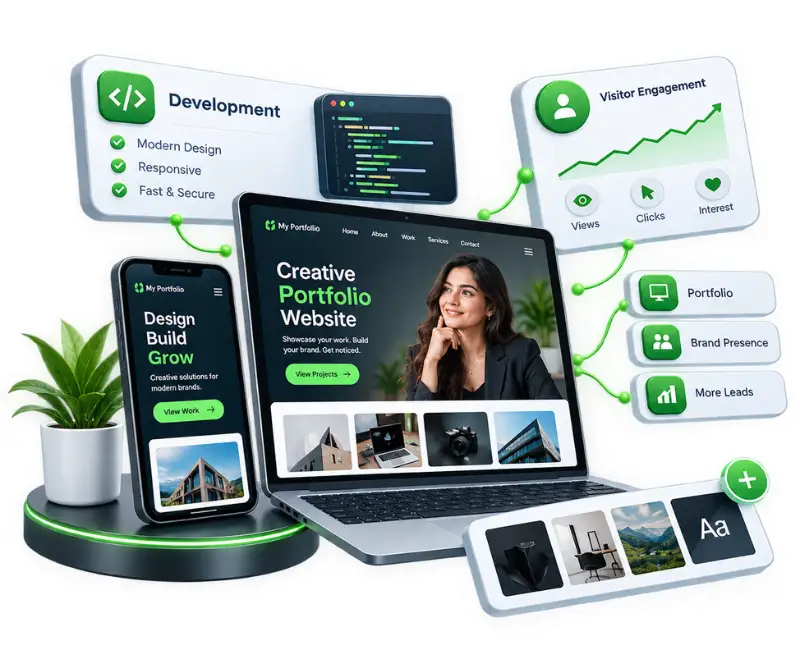
A strong portfolio website should do more than display a collection of projects. It should quickly communicate who you are, what you do, what you have accomplished and why someone should choose to work with you.
Falconics IT creates custom portfolio websites for professionals, freelancers, creatives, developers, consultants, students and businesses that need a polished digital presence. Each website is planned around your work, audience and objectives rather than forcing your content into a generic template.
Key advantages
A portfolio succeeds when visitors can understand your value without having to search for it.
The design should give your strongest work enough visual attention while keeping supporting information easy to access. Your introduction, skills, experience, projects, services and contact options should work together as one coherent professional profile.
For a freelancer, that may mean turning project examples into enquiry opportunities. For a job seeker, the emphasis may be on experience, skills and achievements. For a designer or developer, the website may need to let the work itself become the primary selling point.
Falconics IT adapts the structure according to that purpose.
The exact website structure depends on your profession and goals, but a typical portfolio can include:
Not every portfolio needs every page. A concise website with five well-planned pages can be more effective than a larger site filled with unnecessary content.
Your portfolio is part of your personal brand, so the visual direction should support the type of work you want to attract.
We can shape the interface around your preferred visual style, project types, audience and communication goals. Whether you need a restrained professional presentation or a more visual creative experience, the design should make your work easier to understand rather than compete with it.
Typography, colour, imagery, spacing, navigation and project presentation are considered as parts of the same experience.
Portfolio websites are often viewed on mobile devices, particularly when someone discovers your work through social media, a professional profile, email or a shared project link.
The website is therefore designed to adapt across screen sizes while keeping navigation, project presentation and calls to action usable. Performance is also considered during development through efficient page structures, optimized assets and clean implementation.
The goal is a website that feels polished without becoming unnecessarily heavy.
A portfolio can also become a long-term discovery channel when its content is structured properly.
Falconics IT can build the technical foundation around clean page structure, meaningful headings, descriptive metadata, search-friendly URLs, image optimization and other fundamental SEO considerations.
SEO does not guarantee rankings, particularly for competitive professional searches. The objective is to give search engines a clear understanding of your website while creating useful pages for the people who visit it.
Simply placing project screenshots in a gallery rarely tells the complete story.
Where appropriate, projects can be presented with context such as the challenge, your role, the work completed, technologies or skills involved, and the outcome. This gives visitors a better understanding of your capabilities and the thinking behind your work.
For professionals whose work is highly visual, galleries and media can take a larger role. For developers, consultants or other knowledge-based professionals, project descriptions and case-study-style presentations may carry more weight.
Portfolio websites can be particularly useful for:
The right portfolio structure depends on what the visitor needs to see before taking the next step.
A professionally structured portfolio can address several common challenges.
Your work is scattered across different platforms.
A dedicated website gives you one central destination that you control.
Your projects look impressive but lack context.
Structured project pages can explain your contribution, skills and approach instead of relying on images alone.
Your professional profile feels incomplete.
A well-organized website brings your experience, capabilities, work samples and contact information together.
Potential clients or recruiters cannot quickly understand what you offer.
Clear positioning and intuitive navigation reduce the effort required to understand your professional value.
You depend entirely on third-party profiles.
Social networks and professional platforms can support your visibility, but your own website gives you greater control over how your work is presented.
The process starts with understanding what the website needs to accomplish.
1. Discovery and planning
We review your profession, audience, objectives, existing material and preferred visual direction.
2. Structure and content planning
The pages and navigation are planned around the information visitors actually need, with priority given to your strongest work.
3. UI design and development
The approved direction is translated into a responsive website with attention to usability, visual consistency and performance.
4. Content and portfolio integration
Your project information, images, profile details, services, CV and other approved content are organized into the website.
5. Testing and refinement
The website is checked across relevant screen sizes and browsers, with attention to navigation, forms, visual presentation and functionality.
6. Launch and support
After final approval, the website is prepared for deployment. Ongoing maintenance or future improvements can be discussed according to your requirements.
The final scope depends on the agreed project, but portfolio website deliverables can include:
| Area | Typical Deliverable |
|---|---|
| Design | Custom visual direction and responsive page layouts |
| Pages | Home, About, Portfolio, Services, Contact and other agreed pages |
| Projects | Portfolio galleries or detailed project presentations |
| Content | Integration and formatting of client-provided content |
| Contact | Enquiry form and relevant contact options |
| Responsive Design | Mobile, tablet and desktop compatibility |
| SEO Foundation | Page structure, headings, metadata and other basic on-page elements |
| Performance | Lightweight implementation and asset optimization |
| Integrations | Social profiles, CV downloads, media or other agreed functionality |
| Deployment | Website launch on the selected hosting environment |
Additional functionality can be planned when the project requires it.
Falconics IT approaches portfolio websites as digital experiences rather than simple collections of pages. The website needs to represent the person or professional brand behind the work while also giving visitors a clear path toward the next action.
The wider Falconics IT team works across web development, digital marketing, branding, technology and analytics, allowing portfolio projects to be considered from both design and digital-growth perspectives. The company also describes its broader web development work as focused on performance, scalable builds and conversion-oriented user experiences.FFalconics IT Solutions
The process is designed to begin with understanding the business or professional objective, followed by planning, execution, measurement and improvement where ongoing work is required.FFalconics IT Solutions
Most importantly, the website scope can be shaped around what you actually need instead of adding pages or features simply to make the project larger.
The timeline depends on the number of pages, design complexity, content readiness, functionality and revision requirements.
A straightforward portfolio with prepared content can move considerably faster than a highly customized website requiring extensive project presentation, animations, integrations or additional functionality.
Your involvement also matters. Providing final project images, written content, CV information, branding assets and other required materials early in the process can help keep development moving smoothly.
A portfolio website is a foundation, not a guarantee of enquiries, employment opportunities or search rankings. Its effectiveness ultimately depends on the quality of the work presented, positioning, content, audience fit and how the website is promoted after launch.
Portfolio website pricing is determined after understanding the actual scope rather than applying an arbitrary one-size-fits-all figure.
Factors that can affect the investment include:
Once the requirements are clear, Falconics IT can recommend an appropriate scope for the project.
A portfolio website is a dedicated online platform for presenting your professional work, skills, experience, services and background. It can be used by freelancers, creatives, developers, students, consultants and other professionals.
There is no fixed number. A focused portfolio may only need Home, About, Portfolio and Contact, while a more detailed professional website may also include Services, Resume, Testimonials, individual project pages or a Blog.
Yes. The design can be planned around your profession, audience, existing branding, preferred visual direction and the type of work you want to showcase.
Yes. Responsive design should be part of the core website experience so that your portfolio remains usable across smartphones, tablets and desktop screens.
Yes. A CV or resume can be incorporated into the website, including a dedicated section or downloadable document where appropriate.
Yes. Individual projects can be presented with descriptions, images, your role, technologies or skills used, project context and other relevant information.
The website can be built with fundamental SEO considerations such as logical page structure, headings, metadata, descriptive URLs and optimized content. Search performance itself depends on many factors beyond website development.
Yes. Relevant professional and social profiles can be incorporated where they support your goals and provide visitors with useful ways to explore your work.
Yes. Future content changes, new projects, design improvements and additional functionality can be handled according to the website's technology and ongoing support arrangement.
Typically, we need your professional information, project details, images or media, branding assets if available, preferred contact details and an understanding of what you want the website to achieve.
Start by sharing your profession, portfolio requirements, existing content and preferred website direction. Falconics IT can then help define the appropriate structure, functionality and development scope.
Your website should make it easier for the right people to understand your expertise and remember your work.
Whether you are building your first professional portfolio or replacing an outdated website, Falconics IT can help plan and develop a portfolio experience around your goals, content and audience.
Contact our expert team today for a tailored strategy and free consultation.
Get a Free Consultation