
Ready to transform your business with Brand Identity?
Contact our expert team today for a tailored strategy and free consultation.
Get a Free ConsultationNo services available in this category yet.
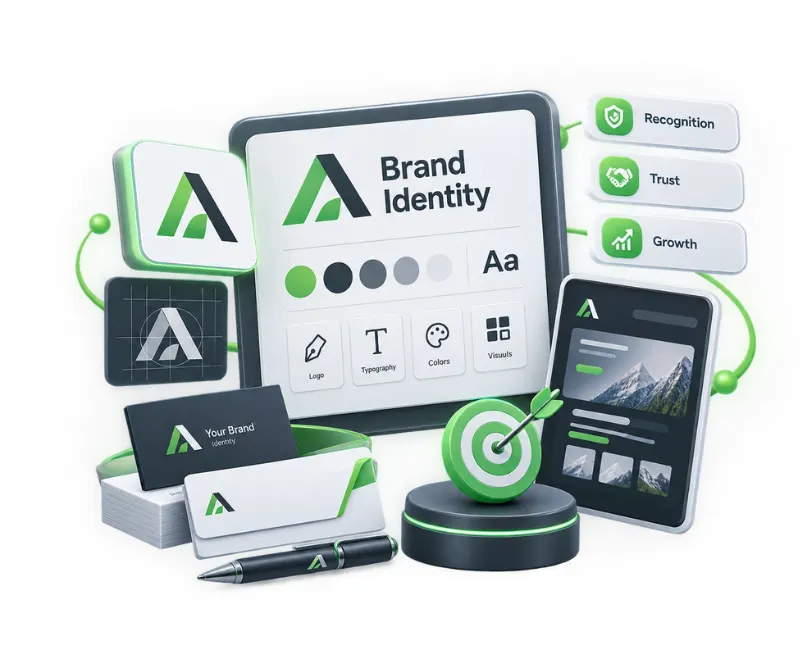
A strong brand identity gives your business a recognizable presence across every place customers encounter it.
Falconics IT creates brand identities that connect strategy with visual design, helping businesses establish a clear personality, consistent communication style, and distinctive visual presence.
From defining the foundation of your brand to developing its logo, colours, typography, visual elements, and usage guidelines, we build identity systems designed to work beyond a single logo or marketing campaign.
The goal is simple: create a brand identity that makes sense for your business, speaks clearly to your audience, and remains consistent as your business grows.
Your brand is experienced through more than your logo.
Customers encounter your business through your website, social media, advertisements, presentations, packaging, sales material, digital products, emails, and countless other touchpoints. If each interaction looks or sounds different, the brand becomes difficult to recognize and harder to remember.
Brand identity brings those touchpoints together.
A well-developed identity establishes a visual and strategic system that helps your business communicate with greater consistency. It gives designers, marketers, sales teams, developers, and other stakeholders a shared framework for presenting the brand.
Our approach combines brand thinking with practical design so your identity is not created simply to look good in a presentation. It is developed to work in real business environments.
Brand identity is the collection of strategic and visual elements that define how your business presents itself.
It can include your:
A logo is therefore only one part of the identity.
The larger objective is to create a recognizable system where individual elements work together. Colours should support the brand's personality. Typography should suit the audience and context. Visual elements should be usable across different platforms. Messaging should feel connected to the identity rather than separate from it.
This becomes particularly important when a business is growing and more people begin creating content, campaigns, documents, advertisements, websites, or customer-facing materials.
A defined brand identity gives everyone a clear standard to work from.
Before designing the visual identity, we look at the business behind it.
This includes understanding your offering, target audience, market context, competitors, existing brand perception, and the direction you want the business to take.
The purpose is to establish a meaningful foundation before visual decisions are made.
This stage helps answer questions such as:
The answers provide direction for the work that follows.
A visual identity becomes stronger when it reflects a clear strategic idea.
We can define the core characteristics that should guide the brand, including its positioning, personality, visual direction, and communication priorities.
This creates a bridge between business objectives and creative execution.
Instead of choosing colours, fonts, and visual styles in isolation, each major decision has a reason behind it.
The logo becomes an important identifier within the wider identity system.
Depending on the requirements of the project, the identity can include the primary logo, alternate versions, responsive applications, typography, colour combinations, and supporting visual elements.
The focus is on creating an identity that remains recognizable across different sizes, formats, backgrounds, and applications.
A useful logo should work on a website header as comfortably as it works on a presentation, social profile, document, advertisement, or other relevant brand touchpoint.
Typography and colour have a significant influence on how a brand feels.
We develop a considered combination of typefaces and colours that supports the personality and positioning of the business.
The system needs to work aesthetically, but it also needs to remain practical.
That means considering:
The result is a visual language that can be applied consistently rather than a collection of unrelated design choices.
A recognizable brand often needs more than a logo.
Supporting elements may include graphic shapes, patterns, icons, image direction, illustration styles, layouts, backgrounds, or other visual devices that make the identity more distinctive.
These elements help create flexibility.
Instead of placing the logo everywhere, the wider identity can communicate recognition through colour, typography, composition, imagery, and other recurring visual cues.
A brand identity becomes considerably more useful when people know how to apply it.
Brand guidelines establish practical rules for using the identity consistently.
Depending on the scope, guidelines may cover:
The purpose is not to create unnecessary restrictions. It is to make future brand implementation easier and more consistent.
Modern brands need identities that perform across digital environments.
We consider how the identity translates to websites, social media, digital advertising, presentations, landing pages, online platforms, and other relevant touchpoints.
This ensures the brand is not designed only for a static presentation but is prepared for practical digital use.
A well-defined identity can influence how people understand and remember your business.
Consistent visual characteristics make it easier for customers to identify your business across different channels.
A considered identity can create a more coherent and professional impression, particularly when customers encounter your business for the first time.
A distinctive identity helps separate your business from competitors that may offer similar products or services.
A clear system reduces the likelihood of different teams or vendors producing disconnected brand materials.
Brand identity gives visual and verbal communication a defined direction, making marketing assets easier to develop.
As your business expands into new campaigns, products, locations, platforms, or markets, a structured identity gives you a foundation to build upon.
The value is not limited to aesthetics. A strong identity creates a framework for how the business presents itself over time.
A successful identity project needs both creative thinking and a disciplined process.
We begin by understanding your business, audience, objectives, market, competitors, existing identity, and future direction.
The aim is to understand the problem before attempting to solve it visually.
The next stage establishes the strategic and creative direction.
We determine the characteristics the identity should communicate and identify the visual territory that best supports the business.
The approved direction is translated into the visual identity.
This may include logo development, typography, colour systems, supporting graphics, imagery direction, and other relevant elements.
Design decisions are made as part of a connected system rather than as isolated assets.
The identity is reviewed, tested against its intended applications, and refined where necessary.
This stage is important because an identity can look effective in isolation but behave differently when applied to real business materials.
The completed identity is organized into usable brand assets and guidelines.
Where required, the system can then be adapted across relevant digital and business touchpoints.
A new business has an opportunity to establish its identity correctly from the beginning.
A structured brand identity can provide a consistent foundation for launching a website, creating marketing material, communicating with customers, and entering the market with a clear visual presence.
Growth often creates inconsistency.
Different employees, agencies, designers, and marketing channels may gradually introduce their own interpretations of the brand.
A defined identity system brings those interpretations back into alignment.
An existing brand may still be recognizable while no longer reflecting the quality, market position, audience, or direction of the business.
A brand refresh or identity redesign can help modernize the visual system without losing the recognition that has already been established.
Technology companies, SaaS businesses, ecommerce brands, digital products, and online-first businesses often operate across many customer touchpoints.
A flexible identity helps maintain a recognizable experience across websites, applications, advertising, social channels, product interfaces, and sales material.
Approach: Establish a consistent visual system with defined rules for colours, typography, logos, layouts, and supporting elements.
Business direction: Create a brand that is easier for internal teams and external partners to implement consistently.
Approach: Reassess the existing identity against the current business, audience, market, and future direction.
Business direction: Modernize the identity where necessary while considering existing recognition and brand equity.
Approach: Examine the market and identify opportunities for a more distinctive strategic and visual position.
Business direction: Develop an identity with recognizable characteristics rather than relying on generic category conventions.
Approach: Build reusable brand rules and visual components.
Business direction: Make future creative production more consistent and efficient.
Approach: Review whether the current identity still reflects the scale, offering, audience, and positioning of the business.
Business direction: Develop a stronger identity foundation that can support the next stage of growth.
A brand identity project should result in more than a collection of attractive files.
You should have a clear understanding of how the brand is supposed to look, feel, and behave.
Depending on the project scope, the work can provide:
The exact deliverables should be determined by what your business actually needs rather than by adding unnecessary design components.
Depending on project requirements, core brand identity deliverables may include:
For broader identity projects, additional work may include:
The final scope can be shaped around the stage, size, and requirements of your business.
Your digital presence is often where customers experience your brand most frequently.
A website may introduce the company. Social media may reinforce its personality. Advertising may create the first interaction. Landing pages may support a specific campaign. Presentations and sales documents may influence a purchasing decision.
If these touchpoints use inconsistent visual language, the customer has to mentally connect them.
A strong identity makes that connection easier.
This is particularly important when brand identity is being developed alongside a website, digital marketing, social media, ecommerce, or other technology work.
The identity provides the creative foundation while digital execution turns that foundation into customer-facing experiences.
Brand identity works best when strategy, creativity, and practical implementation are considered together.
At Falconics IT, brand identity can sit within a broader digital ecosystem rather than being treated as an isolated design exercise. The wider service environment includes branding and creative capabilities alongside web, digital marketing, technology, and other digital solutions. Falconics IT Solutions
That perspective can be valuable when the identity needs to move directly into a website, digital campaign, ecommerce experience, social presence, or other business application.
Our focus is on creating identity systems that are:
The objective is to create a brand identity that remains useful after the initial project is complete.
Brand identity is the strategic and visual system a business uses to present itself. It can include the logo, colours, typography, visual elements, imagery direction, communication style, and brand guidelines.
The scope depends on the project. It can include brand discovery, positioning, logo design, typography, colour systems, supporting visual elements, digital applications, and brand guidelines.
No. A logo is one component of a brand identity. Brand identity establishes the wider system that determines how the business looks and communicates across different touchpoints.
A strategic foundation is highly useful because it gives the creative work direction. It helps ensure the visual identity reflects the business, audience, positioning, and desired perception.
Yes. A new business can benefit from establishing its identity before launching major marketing and digital activities. The identity can provide a consistent foundation for future communication.
Yes. An existing identity can be reviewed and evolved when it no longer reflects the business, audience, market position, or future direction. The appropriate approach depends on how much of the existing identity remains valuable.
The timeline depends on the scope, complexity, number of deliverables, feedback cycles, and approval process. A focused identity project generally requires less time than a broader rebranding engagement with extensive strategic and application work.
Brand guidelines can be included when the project requires them. The scope can range from practical logo, colour, and typography rules to a more comprehensive brand manual.
Yes. A properly structured identity should be designed with its intended applications in mind, including websites, social media, digital advertising, presentations, and other relevant digital channels.
Pricing depends on the scope and complexity of the project. Factors can include strategic work, number of identity elements, logo requirements, brand guidelines, applications, number of pages or assets, and the level of customization required.
Useful starting information includes your business overview, products or services, target audience, competitors, current branding if applicable, business objectives, and examples of brands or visual directions you consider relevant.
Yes. Combining brand identity with digital execution can help maintain consistency between the visual strategy and the customer-facing experience across websites, campaigns, ecommerce platforms, and other digital channels.
Your brand identity should reflect more than where your business is today.
It should provide a clear foundation for how you want the business to be perceived, remembered, and experienced as it develops.
Falconics IT can help turn that direction into a structured brand identity covering the strategic and visual elements your business needs—from the core identity system through to practical digital applications.
Build a brand that looks intentional, communicates clearly, and gives every customer touchpoint a consistent identity.
Based on the current Falconics IT site structure, these are natural internal-link opportunities. The site already presents Brand Identity, Logo Design, Brand Guidelines, and Brand Strategy as related branding services, alongside web development and digital marketing services. Falconics IT Solution
Contact our expert team today for a tailored strategy and free consultation.
Get a Free Consultation