
Ready to transform your business with Database Management?
Contact our expert team today for a tailored strategy and free consultation.
Get a Free ConsultationNo services available in this category yet.
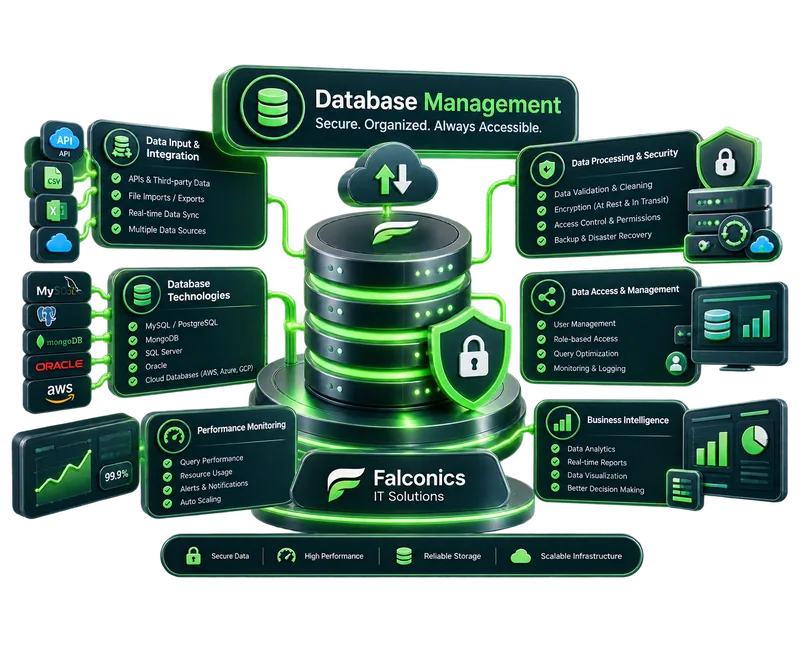
Your database supports critical business operations, from applications and websites to customer records, transactions, reporting, and internal workflows. When databases become slow, poorly maintained, vulnerable, or difficult to scale, the impact can quickly reach the rest of the business.
Falconics IT Solutions provides database management services designed to keep business databases stable, secure, monitored, and properly maintained. Our approach can cover database configuration, performance optimization, backup management, security, migration, monitoring, and ongoing administration based on your environment and requirements.
Key service areas include:
Database management is more than keeping data stored in a system. It involves maintaining the environment that allows applications and authorized users to access, update, and rely on that data consistently.
A well-managed database can help reduce avoidable downtime, identify performance issues earlier, strengthen data protection practices, and provide a more dependable foundation for business applications.
Falconics IT Solutions takes a practical approach: first understanding your database environment and operational requirements, then determining where administration, optimization, protection, migration, or ongoing support can provide the most value.
The exact scope depends on your database environment, application architecture, workload, and business requirements. Our database management service can be structured around the areas below.
Proper configuration provides the foundation for a stable database environment. We can support database setup, configuration, administration, routine maintenance, and environment-level adjustments required for reliable operation.
The objective is to keep the database aligned with the applications and workloads that depend on it rather than treating database administration as an isolated technical task.
Slow queries, inefficient database structures, resource constraints, and configuration issues can affect application responsiveness and user experience.
Performance-focused database management examines the areas contributing to slower operations and identifies practical improvements. Depending on the environment, this may involve reviewing queries, indexing, configuration, resource usage, and database workload patterns.
The goal is not simply to make a database faster on paper, but to address the underlying causes of performance problems.
Database issues are easier to manage when important conditions are monitored consistently instead of being discovered only after an application is affected.
Ongoing database monitoring can help identify unusual activity, resource pressure, performance degradation, availability concerns, and other operational issues. Routine maintenance keeps the environment organized and provides an opportunity to address developing problems before they become larger disruptions.
A backup is useful only when it is planned, maintained, and capable of supporting recovery when required.
We can help businesses establish database backup processes appropriate to their environment, including backup scheduling, storage considerations, recovery planning, and routine checks. The specific approach depends on factors such as database size, business criticality, acceptable recovery requirements, and infrastructure.
Business databases may contain sensitive customer, operational, financial, or application data. Security therefore needs to be considered as part of database administration rather than treated as a separate afterthought.
Database security management can include appropriate access controls, permission management, configuration reviews, and measures intended to reduce unnecessary exposure. The objective is to help authorized users access the information they need while limiting inappropriate access.
Moving a database to a newer environment requires more than transferring data from one location to another. Compatibility, application dependencies, database configuration, data integrity, performance, and downtime considerations all need to be evaluated.
Our database management service can support database migrations and upgrades where required, with planning focused on reducing operational disruption and maintaining consistency throughout the transition.
As data becomes more central to business applications, database problems can become application problems. A slow database can affect response times; inadequate backups can increase recovery risk; poor access controls can expose sensitive information; and unmanaged growth can make future changes more difficult.
A structured database management approach helps businesses address these concerns systematically.
The value can include:
Every database environment has different workloads, dependencies, risks, and maintenance requirements. We therefore begin with the environment rather than applying the same checklist to every project.
We review the existing database setup, applications connected to it, operational requirements, known issues, and areas that require attention.
Performance concerns, backup requirements, security considerations, maintenance gaps, and migration requirements are assessed according to their business impact.
The service scope is defined around the actual requirements. This may involve one-time optimization or migration work, ongoing administration, monitoring, or a combination of database management activities.
Required configuration, maintenance, optimization, backup, security, or migration activities are carried out with attention to application compatibility and data integrity.
Where ongoing management is required, database health and performance can be monitored continuously so that emerging issues can be identified and addressed as the environment changes.
Database requirements vary considerably between businesses. A growing application may need performance and scalability attention, while an established business may be more concerned with maintenance, backup, security, or migration.
Our service can be relevant to:
Database management becomes particularly valuable when technical issues begin affecting everyday operations.
Common situations include:
The right solution depends on the underlying cause. Rather than assuming every problem requires the same intervention, the database environment should be assessed before deciding whether optimization, configuration changes, maintenance, migration, or ongoing management is appropriate.
Falconics IT Solutions approaches database management as part of the wider technology environment supporting your business.
Our broader technology capabilities span IT infrastructure, software, web and mobile development, AI and automation, digital marketing, and data-focused solutions. This wider perspective can be useful when database requirements are closely connected with an application, website, infrastructure, or business system.
We focus on clear scope, practical recommendations, and service requirements that match the actual database environment rather than promising a one-size-fits-all solution.
Depending on the agreed scope, deliverables may include:
The final deliverables are determined during project scoping so that the service reflects your database architecture and business priorities.
Database management timelines vary according to the complexity of the environment and the work involved.
A focused optimization or configuration requirement may have a different timeline from a database migration involving multiple applications, large datasets, or infrastructure dependencies. Ongoing management is naturally structured differently from a one-time database project.
Before implementation, the scope, dependencies, required access, technical requirements, and expected deliverables should be established. This provides a clearer basis for planning the work without relying on unrealistic fixed timelines.
Database management pricing is determined by the scope and complexity of the engagement rather than a standard fixed rate.
Factors that can influence the cost include:
Once the requirements are understood, the engagement can be scoped around the work your business actually needs.
Database management is the administration and maintenance of a database environment to keep data accessible, secure, organized, and operationally reliable. It can include configuration, monitoring, optimization, backups, security, migration, upgrades, and ongoing maintenance.
The service can include database configuration, administration, monitoring, performance optimization, backup and recovery management, security, migration, upgrades, and ongoing maintenance. The exact scope is customized according to the database environment and business requirements.
Yes. Database management does not necessarily require building a new database. Existing environments can be assessed and supported based on requirements such as performance, security, maintenance, monitoring, backup, or migration.
It can, particularly when database-related bottlenecks are contributing to application performance problems. Query behavior, indexing, configuration, resource usage, and workload patterns may be reviewed to identify appropriate optimization opportunities.
Yes, backup and recovery management can be included within the service. The appropriate approach depends on factors such as database criticality, data volume, recovery requirements, infrastructure, and operational needs.
Yes. Database migration and upgrade support can be included when an organization needs to move or modernize its database environment. Migration planning should account for application dependencies, compatibility, data integrity, performance, and potential downtime.
Database security can involve access controls, permissions, configuration practices, and measures designed to reduce unnecessary exposure of business data. The appropriate controls depend on the database environment and the sensitivity of the information being managed.
Yes. Database requirements can be handled as an ongoing management engagement when regular monitoring, maintenance, administration, optimization, or technical support is required.
There is no single timeline for every database project. The duration depends on the number and complexity of databases, the required work, application dependencies, migration requirements, and whether the engagement is one-time or ongoing.
The scope is based on your existing database environment, applications, operational requirements, technical issues, and priorities. This allows the service to focus on the database activities that are actually relevant to your business.
Start by sharing your database requirements, current challenges, environment details, and the type of support you need. The next step is to review the requirements and determine an appropriate scope of work.
A dependable database should support your applications and business operations rather than become a source of avoidable technical problems.
Whether you need database optimization, monitoring, backup management, security support, migration, or ongoing administration, Falconics IT Solutions can help define a practical service scope around your requirements.
Contact our expert team today for a tailored strategy and free consultation.
Get a Free Consultation