
Ready to transform your business with Conversion Optimization?
Contact our expert team today for a tailored strategy and free consultation.
Get a Free ConsultationNo services available in this category yet.
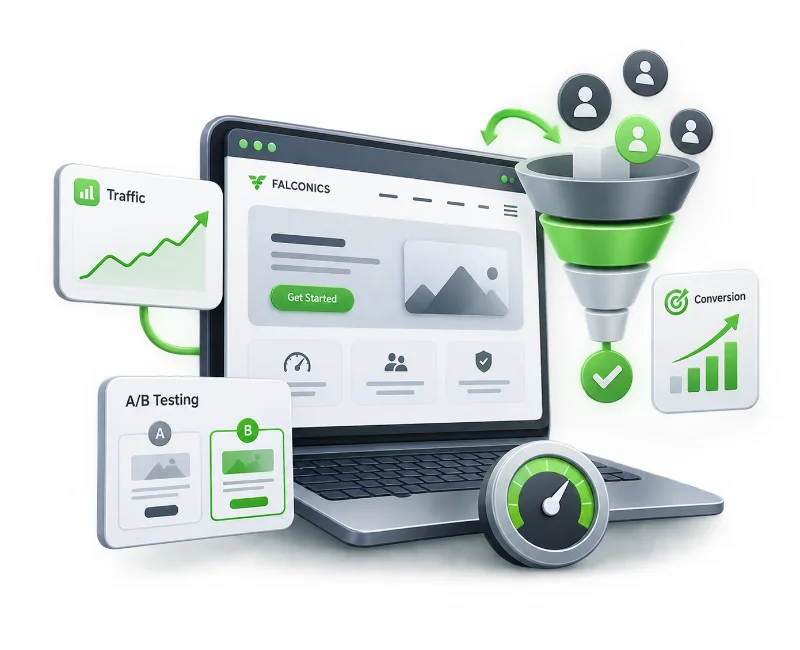
Getting visitors to your website is only part of the job. If users leave without submitting an enquiry, booking a call, starting a checkout, requesting a quote, or making a purchase, there may be friction in the journey that your traffic reports cannot explain on their own.
Falconics IT approaches Conversion Optimization by examining the complete path from first interaction to desired action. We use analytics, user behaviour, funnel analysis, UX review, and structured testing to identify practical opportunities for improvement.
Whether you operate a B2B website, ecommerce store, SaaS platform, lead-generation website, or service business, the goal is straightforward: make the digital experience easier to understand, easier to navigate, and more effective at moving the right users toward action.
Conversion optimization is the systematic improvement of a digital experience so that a higher proportion of relevant visitors complete a valuable action.
That action is not always a purchase. Depending on the business, it could be a qualified enquiry, demo request, phone call, appointment, registration, quotation request, subscription, product purchase, or another measurable business goal.
Effective optimization therefore goes beyond changing button colours or adding more calls to action. It requires understanding where users encounter friction, what information they need, what prevents them from acting, and which changes are most worth testing.
Falconics IT combines marketing, web, UX, analytics, and technology capabilities to investigate conversion problems from multiple angles.
Website and Conversion Audit
We review important pages, user journeys, calls to action, forms, navigation, messaging, page structure, mobile experience, and other conversion-related elements. The objective is to identify obstacles that may be preventing users from progressing.
User Behaviour and CRO Analysis
Analytics and behaviour data can reveal what visitors do, but the useful part is understanding what those patterns mean. We examine relevant engagement and conversion signals to identify pages, steps, or interactions that deserve closer attention.
Conversion Funnel Analysis
A user may arrive through search, advertising, social media, email, or another channel and then move through several stages before converting. We map those journeys to identify where potential customers are dropping out and where the experience needs improvement.
Landing Page Optimization
Landing pages need to answer the visitor's questions quickly and give them a clear reason to continue. We assess messaging, content hierarchy, trust elements, page structure, forms, CTAs, and distractions to create a more focused conversion path.
UX and Usability Improvements
Confusing navigation, unclear information, unnecessary steps, weak mobile experiences, slow interactions, or poorly structured pages can create avoidable friction. Conversion optimization addresses these issues from the user's perspective while keeping the business objective in view.
A/B Testing and Experimentation
Where traffic and measurement conditions make testing appropriate, we can compare alternative page elements, messaging, layouts, CTAs, or user journeys. Testing helps replace assumptions with evidence and creates a structured basis for deciding what to retain.
Tracking and Measurement
Reliable optimization depends on reliable measurement. Relevant events, goals, funnels, and conversion actions should be properly tracked so that changes can be evaluated against meaningful business metrics rather than surface-level engagement alone.
A website does not necessarily need a complete redesign to perform better. Often, the larger opportunity is hidden within specific stages of the customer journey.
Conversion optimization can help investigate issues such as:
Conversion optimization helps businesses make better use of the traffic and marketing investment they already have.
Instead of treating more traffic as the only route to growth, the focus shifts toward improving the percentage of relevant visitors who take the next meaningful step.
It can also provide useful insight into customer behaviour. Patterns found through analytics, testing, and funnel analysis can inform website design, advertising, content, product presentation, and broader marketing decisions.
For ecommerce businesses, this may mean improving product discovery, product-page clarity, cart progression, or checkout. For B2B companies, it may involve improving enquiry journeys, lead forms, service pages, or demo requests.
Falconics follows a practical four-stage process that keeps research, implementation, measurement, and improvement connected.
01 — Understand & Audit
We begin by understanding your business model, target audience, conversion goals, existing traffic sources, website structure, and current challenges. Relevant analytics and user behaviour data are reviewed alongside the actual customer journey.
02 — Identify & Prioritize
Not every possible website change deserves development time. We identify conversion barriers and prioritize opportunities according to factors might involve messaging, page structure, technical performance, tracking, mobile usability, form design, or the relationship between an advertisement and its landing page. Having access to multiple digital capabilities such as potential business impact, user friction, available evidence, and implementation practicality.
03 — Implement & Test
Selected improvements are implemented across relevant pages or funnel stages. Where suitable, experiments and A/B tests are used to compare alternatives and determine which changes have stronger evidence behind them.
04 — Measure & Optimize
Performance is reviewed against agreed conversion objectives and supporting metrics. The findings inform the next round of improvements, allowing optimization to become an ongoing process rather than a one-time website exercise.
Every conversion project should have a clear connection between the work being performed and the business problem being addressed.
Depending on your requirements, an engagement may include:
| Area | Typical Output |
|---|---|
| CRO analysis | Conversion barriers, opportunities, and prioritized findings |
| Funnel review | Key drop-off points and journey improvements |
| UX review | Usability and friction observations |
| Landing page optimization | Messaging, layout, CTA, and content recommendations |
| Testing | A/B testing opportunities and experiment recommendations |
| Analytics | Conversion tracking and performance insights |
| Optimization | Implemented improvements and ongoing refinement |
The exact scope can be adapted according to your website, traffic volume, conversion model, technology stack, and business objectives.
B2B Companies
Useful for businesses where a website needs to generate qualified enquiries, consultation requests, demo bookings, or sales conversations.
Ecommerce Businesses
Particularly relevant when visitors reach product pages or carts but do not complete purchases. Optimization can focus on discovery, product information, trust, cart progression, and checkout friction.
SaaS and Technology Businesses
Conversion optimization can improve journeys involving trials, registrations, demos, product enquiries, or subscription decisions.
Service Businesses
Professional services, education providers, agencies, real estate businesses, healthcare organizations, and other service-led companies can use CRO to make enquiry and booking journeys more effective.
Businesses Running Paid Campaigns
When advertising is already generating traffic, improving the destination experience can help ensure that clicks have a stronger path toward the intended action.
Falconics IT brings digital marketing, web development, analytics, UX, and technology capabilities together. That matters because conversion problems do not always originate in one discipline.
A weak conversion path might involve messaging, page structure, technical performance, tracking, mobile usability, form design, or the relationship between an advertisement and its landing page. Having access to multiple digital capabilities allows these areas to be considered as part of the same customer journey.
Our broader working approach is built around four principles: understand the business first, focus on measurable objectives, prioritize changes based on evidence, and keep improving after implementation.
We also avoid treating every website as a template. The right optimization depends on the audience, offer, buying process, existing data, traffic sources, and technical environment.
A redesign can change how a website looks. Conversion optimization asks a different question: does the new experience help users complete the actions that matter to the business?
Some opportunities can be identified during an initial audit, while others become clearer after implementation and testing. User behaviour also changes as products, campaigns, audiences, competitors, and business priorities change.
For that reason, CRO is most useful when treated as a continuous cycle of research, prioritization, testing, learning, and refinement.
The time required for conversion optimization depends on the size and complexity of the website, the number of journeys being analyzed, available tracking, traffic levels, technical requirements, and the scope of implementation.
Meaningful findings can sometimes emerge during the initial analysis, while statistically useful testing may require sufficient traffic and an appropriate testing period.
Conversion optimization should not be approached with guaranteed rankings, revenue, leads, or a predetermined percentage increase. The objective is to create a stronger decision-making process based on evidence and to improve the parts of the customer journey where genuine opportunities exist.
There is no responsible one-size-fits-all price for CRO because the scope can vary significantly between businesses.
Project cost may depend on:
After understanding your website and objectives, the engagement can be scoped around the areas that have the greatest practical value rather than adding unnecessary activities.
Conversion optimization is the process of improving a website, landing page, ecommerce store, or digital funnel so that more relevant visitors complete a desired action. It combines user behaviour analysis, UX improvements, funnel analysis, measurement, and testing.
SEO primarily helps the right people discover your website through search. Conversion optimization focuses on what happens after visitors arrive. The two disciplines work well together because increased visibility is more valuable when the resulting traffic encounters a clear and effective conversion journey.
Yes. CRO does not automatically require a complete redesign. Depending on the findings, improvements may involve specific pages, content, CTAs, forms, navigation, mobile usability, checkout steps, tracking, or other parts of the existing experience.
The appropriate metrics depend on the business model and conversion goal. They may include conversion rate, form submissions, qualified enquiries, purchases, checkout progression, CTA interactions, bounce or engagement signals, average order value, and other relevant funnel metrics.
A/B testing can be included when the website has suitable traffic, tracking, and testing conditions. Not every change needs an experiment, so testing priorities are determined according to the available evidence and business context.
There is no universal timeline. The scope, website complexity, traffic volume, number of conversion journeys, technical requirements, and testing approach all affect the duration.
Access to relevant website, analytics, advertising, or ecommerce data may be required depending on the project. Business objectives, target audience information, existing conversion goals, and any known challenges also help establish a useful starting point.
Yes. B2B CRO can focus on actions such as enquiry submissions, demo requests, consultation bookings, quote requests, downloads, or other steps that contribute to a sales pipeline.
Yes. Conversion optimization can be structured as an ongoing process involving performance monitoring, new hypotheses, testing, implementation, and periodic review.
Start with a conversation about your website, business model, primary conversion goals, and current challenges. Falconics can then assess the appropriate scope and identify where conversion analysis is most likely to provide useful insight.
Your website should do more than attract visitors. It should give the right visitors a clear, credible, and friction-free path toward taking action.
If you are seeing traffic but believe your website or funnel is leaving opportunities on the table, Falconics IT can help identify where the journey can be improved and what should be tested next.
Contact our expert team today for a tailored strategy and free consultation.
Get a Free Consultation