
Ready to transform your business with GA4 Migration?
Contact our expert team today for a tailored strategy and free consultation.
Get a Free ConsultationNo services available in this category yet.
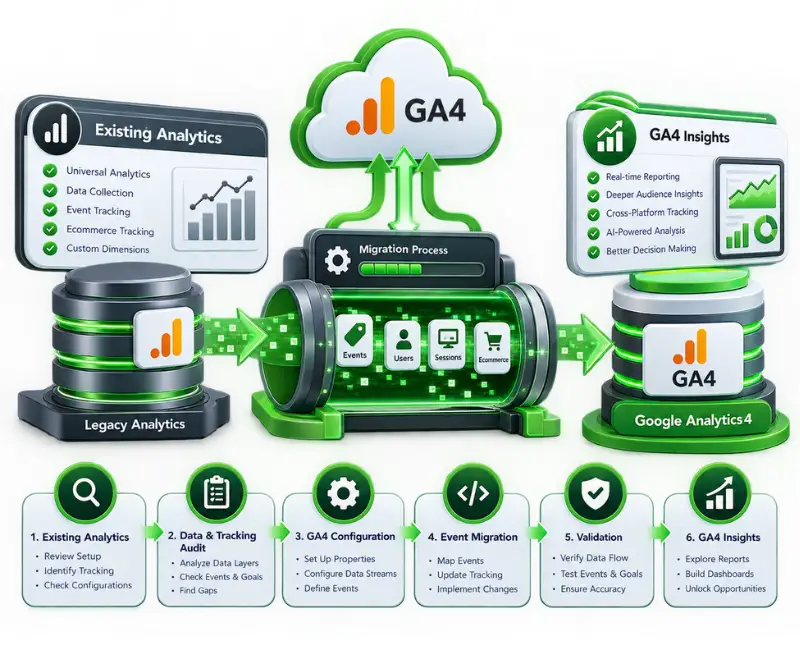
A GA4 migration is more than replacing one tracking code with another. The move can affect events, conversions, audiences, ecommerce measurement, reporting, attribution, and the way your business interprets customer activity.
Falconicsit approaches GA4 migration as a measurement project rather than a simple platform change. We review your existing analytics setup, identify what needs to be retained or redesigned, map relevant tracking into GA4's event-based structure, implement the required configuration, and validate the resulting data.
The objective is a GA4 setup that reflects how your business actually operates—not simply a newly created property with basic tracking enabled.
A proper migration starts by understanding what your current analytics setup is measuring and which parts of that measurement are important to the business.
Existing goals, events, dimensions, metrics, ecommerce actions, campaign tracking, and other measurement requirements are reviewed before implementation. Where the old tracking structure does not translate directly to GA4, it can be redesigned around GA4's event-based model.
This approach helps reduce the risk of carrying outdated tracking logic into the new property or losing important business signals during the transition.
Before changing the implementation, we review the current measurement environment and identify what should be migrated, rebuilt, consolidated, or removed.
The audit can cover existing analytics configurations, Google Tag Manager, event tracking, conversion actions, ecommerce measurement, campaign parameters, and other relevant tracking dependencies.
The result is a clearer migration plan based on your actual measurement requirements rather than assumptions about what your existing setup contains.
GA4 uses an event-based measurement model, so existing goals and interactions may need to be rethought rather than copied directly.
We map important business actions to an appropriate GA4 event structure and identify the conversions that should remain central to reporting. This can include actions such as form submissions, purchases, sign-ups, enquiries, downloads, bookings, or other meaningful interactions.
Where custom parameters or dimensions are required, the migration plan accounts for them before implementation.
Once the measurement structure is defined, the required GA4 configuration can be implemented through the appropriate tagging setup.
Depending on the website and tracking requirements, this may involve Google Tag Manager, Google tags, data layer variables, custom events, conversion configuration, or ecommerce tracking.
The implementation is tailored to the existing technology stack and the level of measurement your business requires.
For ecommerce businesses, migration may involve more than basic page and purchase tracking. Product interactions, cart activity, checkout steps, purchases, revenue, and other ecommerce events need to be considered as part of the measurement structure.
For lead-generation businesses, the focus may instead be on enquiry forms, calls, bookings, downloads, registrations, and other actions that indicate commercial intent.
The tracking plan is therefore built around the customer journey and the actions that matter to the business.
Migration is not complete when the tags have been published.
We validate whether important events are firing correctly, whether parameters are being passed as intended, and whether conversions and other key measurements are being recorded consistently.
Where applicable, testing can involve GA4 debugging tools, Google Tag Manager previews, browser-level checks, and comparison against the expected tracking behaviour.
This validation stage is important because a technically installed tag does not automatically mean that the resulting data is useful or accurate.
The exact deliverables depend on the complexity of your existing analytics environment, but a GA4 migration engagement can include:
The scope can be adapted according to your website, platform, existing setup, and measurement requirements.
1. Discovery and Measurement Review
We begin by understanding your website, business objectives, existing analytics implementation, important conversion actions, and reporting requirements.
2. Audit and Migration Planning
The existing setup is reviewed to determine what should be retained, recreated, redesigned, or removed. Important events and conversions are mapped to their GA4 equivalents.
3. Configuration and Implementation
The GA4 property, data streams, events, conversions, parameters, and required tagging components are configured according to the approved measurement structure.
4. Testing and Validation
The implementation is tested before and after deployment to identify missing events, incorrect parameters, duplicate tracking, or other configuration issues.
5. Handover and Support
The completed setup is documented where appropriate, with clarification on key tracking elements and support for issues identified after migration.
Many migration problems originate from treating GA4 as a direct replacement rather than a different analytics framework.
Falconicsit can help address situations such as:
The appropriate solution depends on the underlying implementation, so migration begins with assessment rather than assumptions.
Businesses moving from an older analytics setup
Useful when an existing analytics implementation needs to be transitioned to GA4 without losing sight of important business measurements.
Ecommerce businesses
Suitable for businesses that need reliable measurement across product discovery, cart activity, checkout, purchases, and revenue-related interactions.
Lead-generation businesses
Helpful when enquiries, registrations, bookings, calls, downloads, or other lead actions need to be measured more effectively.
SaaS and technology companies
Useful when customer journeys involve multiple interactions, platforms, authentication states, or more complex event structures.
Businesses with an existing GA4 property
Migration does not always mean starting from scratch. An existing property can be reviewed and restructured when the original implementation is incomplete or poorly aligned with business requirements.
A migration should be judged by the quality of the resulting measurement system, not simply by whether GA4 has been installed.
Falconicsit focuses on the connection between implementation and business reporting. That means identifying the actions worth measuring, defining the tracking structure before deployment, and validating whether the implementation behaves as expected.
The approach also leaves room for the reality that every website has a different technology stack, customer journey, and reporting requirement. A straightforward lead-generation website does not need the same migration architecture as a large ecommerce platform.
A well-planned migration can create a cleaner foundation for future measurement, but it does not automatically make historical analytics data identical between platforms.
GA4 uses its own event-based data model, reporting logic, dimensions, metrics, and attribution approach. As a result, some historical reports and current GA4 reports may not be directly comparable on a one-to-one basis.
The practical goal is to establish reliable measurement going forward, preserve important business definitions where appropriate, and clearly identify changes introduced by the new analytics model.
The migration timeline depends on factors such as the number of tracked interactions, website complexity, ecommerce requirements, existing tag management, integrations, and the amount of testing required.
GA4 migration pricing depends on the scope and complexity of the implementation rather than a fixed one-size-fits-all package.
Factors can include the number of websites or properties, existing tracking quality, event and conversion volume, ecommerce requirements, Google Tag Manager complexity, integrations, custom tracking requirements, and post-migration support.
After reviewing the existing setup, the required scope can be defined more accurately before implementation begins.
GA4 migration is the process of moving an existing analytics measurement setup to Google Analytics 4. It can involve auditing existing tracking, mapping events and conversions, configuring GA4, implementing tags, and validating the resulting data.
Yes. An existing Universal Analytics implementation can be reviewed and mapped to GA4 where the underlying measurements are still relevant. Some elements may need to be redesigned because GA4 uses a different event-based data model.
Not necessarily. A migration primarily establishes the new GA4 measurement environment. Historical data from another analytics platform may not transfer into GA4 in an identical, report-compatible format, so historical reporting and future measurement should be planned separately.
Yes. Important events and conversion actions can be reviewed and mapped to the GA4 structure. Where an existing goal or event does not have a direct equivalent, the tracking requirement can be redesigned around the underlying business action.
Yes, when ecommerce measurement is part of the project scope. The migration can account for product interactions, cart activity, checkout steps, purchases, revenue, and other relevant ecommerce events based on the platform and existing implementation.
GA4 migrations can involve Google Tag Manager when it is part of the existing or recommended tracking architecture. The setup can be reviewed for unnecessary tags, trigger issues, event configuration, and other implementation dependencies.
There is no universal timeline. A basic website with limited tracking can require substantially less work than a complex ecommerce, SaaS, or multi-platform implementation. The number of events, integrations, tracking dependencies, and testing requirements are major factors.
Yes. If GA4 is already installed but the tracking is incomplete, inconsistent, or unreliable, the appropriate approach may be an audit and restructuring project rather than a new migration.
Typically, access to the relevant analytics property, website or tag-management environment, existing tracking documentation if available, and information about your key business goals and conversion actions. The exact access requirements depend on the implementation.
Yes. The migration should reflect how your business measures leads, sales, engagement, or other important customer actions. Tracking requirements can therefore be adapted to the website, platform, business model, and reporting needs.
After implementation, the tracking should be monitored and validated to identify issues that become apparent in the live environment. Ongoing analytics support can also be considered when the business requires continued tracking changes, reporting improvements, or measurement assistance.
A successful GA4 migration begins with knowing what needs to be measured—not simply installing a new analytics property.
Falconicsit can review your current setup, identify the migration requirements, and build a practical path toward a cleaner GA4 implementation.
Contact our expert team today for a tailored strategy and free consultation.
Get a Free Consultation