
Ready to transform your business with Custom Websites?
Contact our expert team today for a tailored strategy and free consultation.
Get a Free ConsultationNo services available in this category yet.
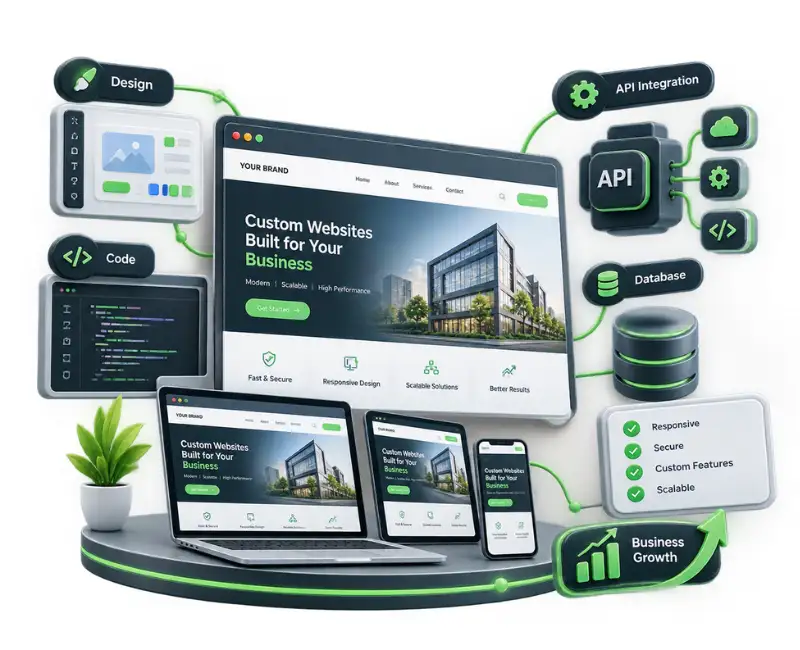
Your website should do more than present information. It should make your business easier to understand, give visitors confidence in your brand, and provide a clear path toward enquiry, purchase, booking or another meaningful action.
Felconics builds custom websites around the way your business actually works. From structure and UI/UX to development, content presentation and technical foundations, each part is planned according to your objectives rather than forced into a standard template.
Whether you are launching a new business website, replacing an outdated site or building a more capable digital platform, the focus is on creating something that is useful today and flexible enough to evolve with your business.
What you can expect:
Off-the-shelf templates can be useful for straightforward requirements, but they can also impose limitations on structure, functionality, branding and future development.
A custom website gives you greater control over how your business is represented and how users move through the experience. Page structure, features, interactions and integrations can be planned around your specific requirements.
Felconics approaches the website as a business asset rather than simply a collection of pages. That means design decisions are considered alongside usability, content, technical performance and the actions you want visitors to take.
The exact scope depends on your requirements, but a typical custom website project can cover the following areas:
Not every project needs every component. The scope is defined around what your business actually needs.
A visually attractive website is only useful when visitors can understand it and navigate it easily.
The design process considers your brand identity, target audience, information hierarchy and desired actions. Important information is given appropriate prominence, navigation is kept logical, and pages are structured to reduce unnecessary friction.
For businesses generating enquiries, for example, the website can be structured around service discovery, credibility and contact actions. For product-led businesses, the experience may instead prioritize product information, comparison, purchasing or account-related journeys.
A large proportion of website interactions happen on mobile devices, so responsive behaviour needs to be considered from the beginning rather than added as an afterthought.
Custom websites developed by Felconics are planned to provide a consistent experience across phones, tablets and desktop screens. Layouts, navigation, media and interactive elements are adapted to different screen sizes while maintaining usability.
Responsive development also gives you a stronger foundation for maintaining one website experience rather than managing separate desktop and mobile versions.
A website cannot guarantee search rankings simply because it has been technically developed. Search visibility depends on many factors, including content, competition, authority and ongoing SEO work.
What development can do is provide a sound technical foundation.
The website structure can be planned with logical page hierarchy, clean URLs, crawlability, responsive design, appropriate metadata implementation and performance considerations in mind. This makes the website easier for users to navigate and gives future SEO activity a stronger technical base.
For businesses investing in ongoing SEO, building the website with search requirements in mind from the start can also reduce the need for avoidable structural changes later.
Every business has different website requirements.
A professional services company may need detailed service pages and lead-generation forms. A B2B company may require multiple solution sections, resource content and enquiry workflows. A growing business may need integrations or functionality that a basic brochure website cannot comfortably support.
Custom development allows these requirements to be considered as part of the architecture rather than treated as limitations of a pre-existing template.
Depending on the project, this may include third-party integrations, custom forms, API connections, content management functionality, database-driven features or other business-specific requirements.
The website itself is not the business outcome. It is the digital environment through which customers interact with your business.
A properly planned custom website can help you:
The value depends on how well the website aligns with the business model, audience and wider marketing strategy.
We keep the process structured without making it unnecessarily complicated.
01 — Understand
We start with your business, audience, objectives, existing digital presence and functional requirements. This helps establish what the website needs to accomplish before design or development begins.
02 — Plan
The website structure, page hierarchy, content requirements and key user journeys are mapped out. Technical requirements and integrations are also considered at this stage.
03 — Design
The interface is designed around your brand and users. Rather than designing pages in isolation, we consider how visitors move between sections and where important actions should happen.
04 — Develop
Approved designs are translated into a responsive website using appropriate technologies and development practices. Required functionality and integrations are implemented according to the agreed scope.
05 — Test & Launch
The website is reviewed across relevant devices and key user journeys. Functional issues are addressed before launch, followed by the final deployment process.
06 — Improve
After launch, the website can be supported through maintenance, SEO, analytics, content updates or further development as your requirements evolve.
Custom website development can be particularly useful for businesses that have outgrown a basic template or have requirements that need more control over design and functionality.
It can suit:
The final deliverables depend on the agreed project scope, but may include:
Additional services such as ongoing SEO, content creation, analytics, maintenance or further development can be considered separately where relevant.
A website project often starts because the existing website is no longer supporting the business effectively.
Common issues include an outdated visual experience, confusing navigation, poor mobile usability, limited control over content, slow or inconsistent experiences, weak conversion paths, or a structure that makes future expansion difficult.
Rather than simply redesigning the appearance, the project can address the underlying structure and user experience as well. The objective is to create a website that is easier for your customers to use and easier for your business to develop over time.
There is no single technology stack that is appropriate for every website.
The choice depends on factors such as website complexity, functionality, content management requirements, integrations, scalability and your internal team.
Depending on the project, suitable technologies may include modern front-end frameworks, backend technologies, databases, CMS platforms and cloud infrastructure. The priority is to select technology that supports the requirements rather than choosing a platform simply because it is popular.
The development timeline depends on the size and complexity of the website.
A straightforward business website will generally require less planning and development than a larger website with extensive content, custom functionality, integrations or complex user journeys.
The availability of content, feedback and approvals can also affect the schedule. A clear scope and timely collaboration from the client side help keep the project moving efficiently.
Website development should also be viewed as a staged process. Meaningful improvements can be assessed at different points, but outcomes such as search visibility, organic traffic and conversions depend on factors beyond development alone.
There is no responsible single price for every custom website because the scope can vary significantly between projects.
The cost is typically influenced by:
Once the requirements are understood, the scope can be defined more accurately and the engagement can be planned around the actual work involved rather than an arbitrary package.
Felconics combines web development with digital marketing, technology and growth expertise. This broader perspective is useful when the website needs to work as part of a larger digital strategy rather than operate as an isolated project.
The approach is centered on understanding the business first, choosing appropriate technology, and building around practical user and business requirements.
Because Felconics also works across SEO, digital marketing, analytics, ecommerce, AI and technology solutions, the website can be considered in the context of what happens before and after a visitor reaches it.
Most importantly, the scope remains tied to the project requirements. The goal is not to add technology or functionality for its own sake, but to build what the business actually needs.
A custom website is designed and developed around a specific business's brand, audience, structure and functionality requirements rather than being limited to a standard pre-designed template.
A template website generally starts with a predefined design and structure. A custom website provides greater control over the user experience, page architecture, visual identity, functionality and future development.
Yes. Responsive behaviour should be considered throughout the design and development process so the website can provide a usable experience across smartphones, tablets and desktop devices.
Yes. The website can be developed with SEO fundamentals such as logical architecture, crawlability, responsive design, clean URLs and appropriate technical implementation in mind. However, development alone does not guarantee search rankings.
Where a CMS is included in the project, your team can manage supported content without requiring developers for every routine update. The appropriate CMS depends on the website's requirements.
Yes. Custom functionality can be considered when it is relevant to the project, including business-specific features, forms, integrations, API connections and other technical requirements.
The timeline varies according to the website's scope, number of pages, design requirements, functionality, integrations, content readiness and approval cycles. A clearer timeline can be established after the requirements are defined.
Post-launch maintenance and further development can be included or arranged according to the project's requirements. Ongoing SEO, analytics, content and technical support can also be considered separately.
Content requirements depend on the project scope. Website content can be planned as part of the overall website structure, while dedicated content creation can be included where required.
Custom website pricing depends on the scope, design complexity, functionality, technology, integrations, content requirements and support needed. A requirement-based proposal is more accurate than using a fixed price for every project.
Typically, the project benefits from information about your business, target audience, services or products, brand assets, existing content, website references you like, required functionality and your primary business objectives.
Start by sharing your business requirements, current website if you have one, preferred functionality and the main purpose of the new website. Felconics can then assess the requirements and define an appropriate project scope.
Your website should reflect the way your business sells, communicates and serves its customers—not the limitations of a generic template.
If you are planning a new website or replacing an existing one, Felconics can help define the right structure, design and technology for the project.
Contact our expert team today for a tailored strategy and free consultation.
Get a Free Consultation