
Ready to transform your business with Radio Advertising?
Contact our expert team today for a tailored strategy and free consultation.
Get a Free ConsultationNo services available in this category yet.
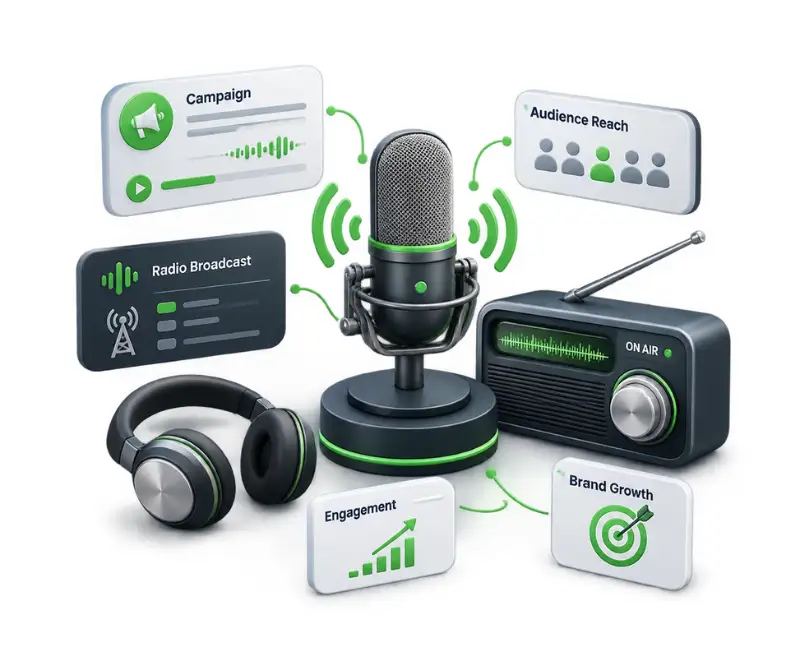
Radio advertising gives businesses a practical way to build awareness and stay present in the daily routines of their target audience. The right campaign is not simply about buying airtime—it is about choosing the right market, station, language, audience, format and frequency for the objective.
Falconics IT Solutions helps businesses plan and execute radio advertising campaigns as part of a broader media and marketing strategy. From campaign planning and station selection to ad placement and execution coordination, we help turn your media budget into a structured radio campaign.
Why consider radio advertising?
Radio works particularly well when a business needs consistent awareness within a defined market. A well-planned campaign can keep a brand, offer, launch or event in front of listeners across relevant commuting, working and leisure periods.
It can be especially useful for businesses promoting products, retail locations, services, seasonal offers, events or launches where local and regional awareness matters.
The effectiveness of a campaign depends on more than the number of spots purchased. Audience relevance, station selection, timing, creative quality, repetition and the relationship between the radio campaign and the wider marketing strategy all influence how the campaign performs.
Falconics approaches radio advertising as a planning and execution exercise rather than simply an airtime purchase.
Depending on your campaign requirements, the service can include:
The exact mix depends on your objective, target market, budget and selected media inventory.
A radio campaign should begin with the audience rather than the station.
For a city-focused campaign, the priority may be reaching listeners within a particular urban market. For a regional campaign, language preferences and geographic coverage can become more important. A broader campaign may require a combination of markets and stations rather than relying on one broadcaster.
Falconics can help structure these decisions around the audience you are trying to reach, the business area you want to promote and the role radio needs to play within your overall advertising plan.
This makes radio advertising relevant for both established brands and businesses testing offline media for the first time.
Different campaign objectives call for different ways of using radio.
Standard Radio Spots
Short recorded advertisements are suitable for communicating a focused message repeatedly across selected stations and time bands. They can work well for offers, products, services, launches and brand awareness.
Jingle Advertising
A memorable audio identity can help a campaign become easier to recognize and recall. Jingles can be particularly useful when the brand needs a distinctive sound associated with its message.
RJ Mentions
Presenter-led mentions can introduce a more conversational element to a campaign. They may be considered when the brand wants the message integrated into relevant programming rather than relying only on recorded spots.
Sponsorships and Integrations
Depending on broadcaster availability, brands may explore sponsorship tags or programme integrations to associate themselves with a particular show or content environment.
Contests and Special Activations
For suitable campaigns, radio contests or promotional activations can create additional audience interaction around a product, launch or event.
The appropriate format should be selected according to the campaign objective rather than simply choosing the most prominent advertising option.
A structured planning process helps avoid spending the media budget without a clear reason for each placement.
1. Understand the campaign objective
We begin by identifying what the campaign needs to accomplish—such as awareness, a product launch, promotion of an offer, event visibility or support for a broader marketing campaign.
2. Define the audience and market
The campaign is mapped against relevant locations, audience characteristics, language preferences and consumption patterns.
3. Evaluate media opportunities
Potential stations, markets, formats and time bands are considered against the campaign requirements and available budget.
4. Build the campaign plan
The selected media mix is organized into a practical campaign schedule, including the required creative formats and placement requirements.
5. Coordinate execution
Once the campaign is approved, the advertising requirements are coordinated with the relevant media inventory and execution process.
6. Review campaign activity
Available scheduling or execution information is reviewed to maintain visibility into the campaign and provide useful direction for future planning.
Radio can serve a different role from performance advertising channels such as search and social media. Instead of depending entirely on users actively searching for a product, radio allows a brand message to reach people while they are listening to programming.
For businesses with a strong local or regional customer base, geographic targeting can make radio particularly relevant. Repetition can also help maintain familiarity when the same core message is delivered consistently over an appropriate campaign period.
Radio can additionally complement digital advertising. A listener who hears a brand on air may later encounter the same brand through search, social media or its website. Coordinating the message across channels can create a more connected customer journey.
Radio advertising can be considered by a range of businesses, particularly when audience location and awareness are important.
Local and regional businesses can use radio to build recognition within specific markets.
Retail and D2C brands can promote products, seasonal campaigns, store launches and special offers.
Real estate and property businesses can use radio to create awareness around projects, locations and sales campaigns.
Education and professional services can use targeted campaigns to communicate programmes, admissions, services or local offerings.
Events and entertainment brands can use radio to build awareness before launches, openings, promotions and public events.
Established brands can incorporate radio into a broader media mix when they want another channel for consistent audience exposure.
The scope of each engagement is determined by the campaign rather than a fixed package. Depending on requirements, the engagement may include:
If you already have a completed radio commercial, the campaign can focus primarily on media planning and placement. If the creative is still being developed, production requirements can be incorporated into the planning discussion.
Many businesses know they want radio exposure but are unsure where to begin.
You may be comparing stations without knowing which audience is most relevant, trying to determine whether radio fits your budget, deciding between standard spots and presenter integrations, or planning a campaign across multiple cities.
The bigger challenge is often connecting the media purchase to the actual business objective.
Falconics helps bring those decisions into one campaign framework so that station selection, timing, creative requirements and campaign execution are considered together rather than as disconnected purchases.
There is no single radio advertising price that applies to every campaign.
The cost can vary according to factors such as:
Prime listening periods and premium formats can carry different commercial terms from standard placements. For this reason, a useful media recommendation should consider the campaign objective and available budget rather than focusing only on the headline rate.
Falconics can help you evaluate the available options and build a campaign around your requirements.
The timeline depends on the campaign size, selected markets, creative readiness, station availability and approval process.
Campaigns with an existing, approved radio commercial can generally move more quickly than campaigns that also require creative development and production.
Radio advertising should also be viewed as a planned media activity rather than a guaranteed source of a specific number of leads, sales or conversions. Results can vary based on the offer, creative, audience, frequency, market conditions and the effectiveness of the wider marketing funnel.
Falconics brings media advertising into a wider digital and technology ecosystem. That matters when radio is only one part of how a customer discovers and evaluates a business.
The team can approach the campaign from both a media and marketing perspective, helping connect the radio message with other channels such as digital advertising, SEO, branding, web experiences and analytics where relevant.
The approach is built around understanding the business objective first, selecting an appropriate strategy, executing the campaign and using available performance information to inform future decisions.
Rather than treating every radio campaign as a standard media booking, the focus is on creating a plan that fits the business, audience and intended outcome.
Radio advertising is paid promotion delivered through radio stations in the form of recorded commercials, jingles, presenter mentions, sponsorships, contests, integrations and other available formats.
Yes. Radio can be suitable for smaller businesses when the campaign is focused on a relevant geographic market and the media plan is matched carefully to the available budget and objective.
Radio campaigns can often be planned around specific markets and stations, subject to broadcaster availability. City-level planning can be useful for businesses whose customers are concentrated in particular locations.
Common options include recorded radio spots, jingles, RJ mentions, sponsorship integrations, contests and other station-specific promotional formats. Availability and commercial terms vary by broadcaster.
There is no universal price. Cost depends on the market, station, ad duration, number of spots, time band, format, campaign duration. If your commercial is already produced, it can be incorporated into the media plan. If it is not ready, creative and production requirements can be considered as part of the campaign and available inventory. A campaign-specific media plan is therefore more useful than relying on a generic rate.
Not necessarily. If your commercial is already produced, it can be incorporated into the media plan. If it is not ready, creative and production requirements can be considered as part of the campaign planning process.
There is no single ideal duration. The appropriate campaign length depends on the objective, audience, budget, frequency requirements, market and media availability. The campaign should be long enough to support its communication objective without creating unnecessary media spend.
Yes. Radio can complement search, social media, display advertising, SEO and other channels. Consistent messaging across channels can make it easier for audiences to recognize and engage with the brand after hearing the radio campaign.
Yes. Falconics can help with campaign planning, market and station selection, format considerations, scheduling coordination and related media requirements based on your campaign objectives.
Useful starting information includes your business objective, target audience, preferred locations, campaign period, approximate budget, key offer or message and whether the radio creative is already available.
The right radio campaign starts with a clear audience and a sensible media plan—not simply with buying more airtime.
Tell Falconics what you want to promote, where you want to reach customers and what you want the campaign to achieve. We can help you assess the appropriate radio advertising approach and define the next steps.
Contact our expert team today for a tailored strategy and free consultation.
Get a Free Consultation