
Ready to transform your business with Hybrid App Development?
Contact our expert team today for a tailored strategy and free consultation.
Get a Free ConsultationNo services available in this category yet.
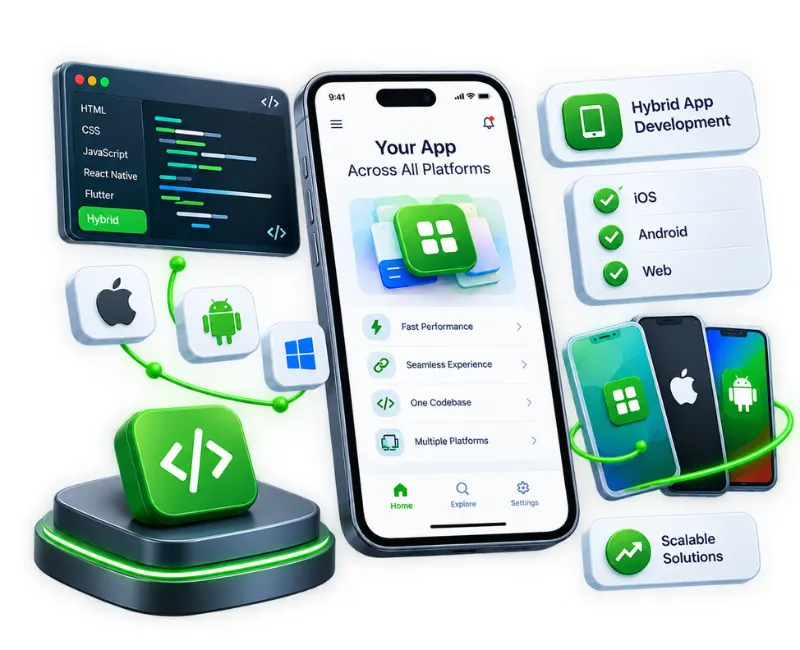
Build one mobile product for multiple platforms without maintaining completely separate application codebases. Falconics IT Solutions develops custom hybrid and cross-platform applications designed around your business requirements, user experience, integrations, and long-term product roadmap.
Whether you are launching an MVP, extending an existing digital product, or building a customer-facing mobile application, we help you choose an appropriate technical approach and take the product from planning through deployment and ongoing improvement.
Key advantages:
A hybrid application should be built around the product—not around the limitations of a particular framework. We start by understanding your users, business workflows, required features, integrations, and platform requirements before defining the development approach.
The result is a purpose-built mobile application rather than a basic website wrapped inside an app. Depending on the project, the solution can include user accounts, dashboards, payments, notifications, location features, media, API integrations, offline functionality, administrative systems, and other business-specific capabilities.
For businesses targeting both Android and iOS, cross-platform development can reduce duplicated development effort while keeping the product experience aligned across platforms.
We work with modern technologies such as Flutter and React Native, selecting the approach according to the application's functionality, performance requirements, integrations, development roadmap, and existing technology environment.
The objective is not simply to reuse code. It is to create an application architecture that remains practical to maintain as features, users, and business requirements evolve.
A technically capable application can still fail if users find it confusing or difficult to navigate. Our UI/UX approach focuses on clear information architecture, intuitive navigation, responsive layouts, and interfaces that make sense across different screen sizes and devices.
Design decisions are considered alongside development requirements so that the final interface is both usable and technically practical to implement.
Most business applications need to communicate with systems outside the mobile app. We can structure integrations with the APIs, databases, cloud services, payment systems, authentication tools, analytics platforms, and other third-party services required by the product.
Integration requirements are considered during architecture and development rather than treated as an afterthought. This helps reduce compatibility issues and creates a clearer foundation for future functionality.
Before launch, the application needs to work reliably across relevant devices, operating-system versions, screen sizes, network conditions, and user flows.
Our development workflow includes functional testing, interface checks, integration testing, bug resolution, and release preparation. We can also support deployment requirements for the relevant app distribution platforms.
Launching an app is not the end of development. Operating-system updates, third-party API changes, security requirements, user feedback, and new business priorities can all require changes after release.
Ongoing support can include application updates, bug fixes, performance improvements, feature enhancements, technical monitoring, and maintenance according to the scope of the engagement.
The exact scope depends on your product, but a typical engagement may include:
Hybrid development is particularly useful when a business needs to support multiple mobile platforms without treating each platform as an entirely separate product.
Efficient development: A shared development approach can reduce duplicated engineering work when compared with building independent native applications.
Consistent product experience: Shared application logic makes it easier to maintain common features, workflows, and product behaviour across platforms.
Simpler maintenance: Changes to shared functionality can often be managed within the same development environment, making ongoing product maintenance more straightforward.
Faster product iteration: A unified development workflow can make it easier to introduce, test, and refine features across supported platforms.
Flexible integration: Hybrid applications can connect with APIs, cloud systems, payment services, databases, analytics tools, and other business technologies.
Scalable foundation: When the architecture is planned correctly from the beginning, the application can be extended as the product gains features and users.
We keep the development process structured without forcing every project into the same technical blueprint.
1. Discovery & Requirements
We begin by understanding the product idea, target users, business objectives, required features, existing systems, integrations, and platform requirements. This gives the project a defined technical and functional scope.
2. Technology & Architecture Planning
The appropriate development approach is selected based on the application's requirements. We define the application structure, integrations, data flow, and technical considerations before substantial development begins.
3. UI/UX Design
User journeys, navigation, screens, and interaction patterns are planned before implementation. The design is reviewed in the context of different devices and application requirements.
4. Development & Integration
Developers build the application and connect the required APIs, backend systems, databases, authentication services, payment systems, and other integrations.
5. Testing & Refinement
The application is tested against the agreed functionality and supported environments. Issues are identified, corrected, and retested before release.
6. Deployment & Ongoing Support
Once the application is ready, we assist with deployment and can continue supporting maintenance, updates, performance improvements, and future feature development.
Hybrid development can be a practical option for different types of businesses, particularly where Android and iOS coverage is important.
Startups and MVPs can use cross-platform development to validate a product idea across multiple mobile platforms without immediately maintaining separate application projects.
SMEs and growing businesses can build customer-facing applications, internal tools, booking platforms, ecommerce experiences, or service applications around their specific workflows.
Ecommerce and D2C businesses can use mobile applications for product discovery, accounts, orders, payments, notifications, and customer engagement.
B2B businesses can build applications for customers, sales teams, field staff, partners, dashboards, workflow management, or service delivery.
Businesses with existing web or software systems can extend those systems into a mobile experience through appropriate APIs and integrations.
Many businesses come to app development with a clear problem rather than simply a desire to "have an app."
We can help when you need to:
The appropriate solution depends on the underlying business and technical requirements. If native development is more suitable for a particular use case, that should be considered during the planning stage rather than forcing the project into a hybrid model.
Falconics IT Solutions brings mobile development into a wider technology environment that also includes web development, software solutions, AI and automation, IT infrastructure, analytics, and digital growth services.
That broader capability can be useful when a mobile application needs to work alongside an existing website, backend system, CRM, ecommerce platform, analytics setup, automation workflow, or other business technology.
Our approach begins with understanding the business requirement before moving into technology and execution. The goal is to keep the application aligned with the product's actual purpose rather than adding complexity that does not serve the user or business.
The timeline for a hybrid application depends on its scope rather than simply the number of screens.
An MVP with a focused feature set will generally require a different development effort from a mature application involving complex workflows, multiple integrations, payments, real-time functionality, advanced security requirements, or extensive backend infrastructure.
Project timing can also be affected by design approvals, third-party integrations, content and data availability, testing requirements, and changes to scope during development.
A clear feature list and technical discussion at the beginning of the project make it easier to establish a realistic delivery plan.
There is no meaningful single price for hybrid app development because the development effort varies considerably from one application to another.
The cost of your project may depend on:
For an accurate estimate, the best starting point is a discussion of the product requirements and desired scope.
Hybrid app development is an approach to building mobile applications that can operate across multiple platforms using a shared development strategy. Modern cross-platform frameworks can provide access to native device capabilities while allowing businesses to maintain a common application codebase for many features.
Yes. Supporting Android and iOS is one of the primary reasons businesses consider hybrid or cross-platform development. The suitability depends on the application's functionality, performance requirements, device features, and technical constraints.
The technology depends on the project. Falconics works with technologies including Flutter and React Native, with the final choice based on application requirements, existing systems, integrations, performance considerations, and the development roadmap.
Yes. Applications can be designed and developed around specific business workflows, user requirements, integrations, and functionality rather than relying on a fixed template.
Yes. A hybrid mobile application can communicate with existing systems through suitable APIs and backend services. The integration approach depends on your current technology stack and the data or functionality the app needs to access.
There is no universal timeline. A focused MVP may have a considerably smaller scope than a feature-rich commercial application. Requirements, design, integrations, testing, and backend complexity all influence the development schedule.
Yes. Ongoing support can cover bug fixes, updates, performance improvements, compatibility changes, maintenance, and additional feature development depending on your support requirements.
The cost depends on the application's scope, complexity, design, integrations, backend requirements, testing needs, and ongoing support. Falconics can determine the appropriate development scope before providing a project-specific estimate.
No. Hybrid or cross-platform development is useful for many products, but it is not automatically the right choice for every application. Applications with highly specialized platform requirements or demanding native functionality may benefit from native development. The technology choice should follow the product requirements.
Start by sharing your application idea, target users, key features, preferred platforms, existing technology systems, and business objectives. Falconics can then help define the appropriate scope, technical approach, and development roadmap.
A successful mobile application starts with the right scope and technical decisions—not simply with writing code.
Share your idea, existing application, or business requirement with Falconics IT Solutions. We can discuss the functionality, platforms, integrations, and development approach needed for your project.
Contact our expert team today for a tailored strategy and free consultation.
Get a Free Consultation