
Ready to transform your business with React Native Development?
Contact our expert team today for a tailored strategy and free consultation.
Get a Free ConsultationNo services available in this category yet.
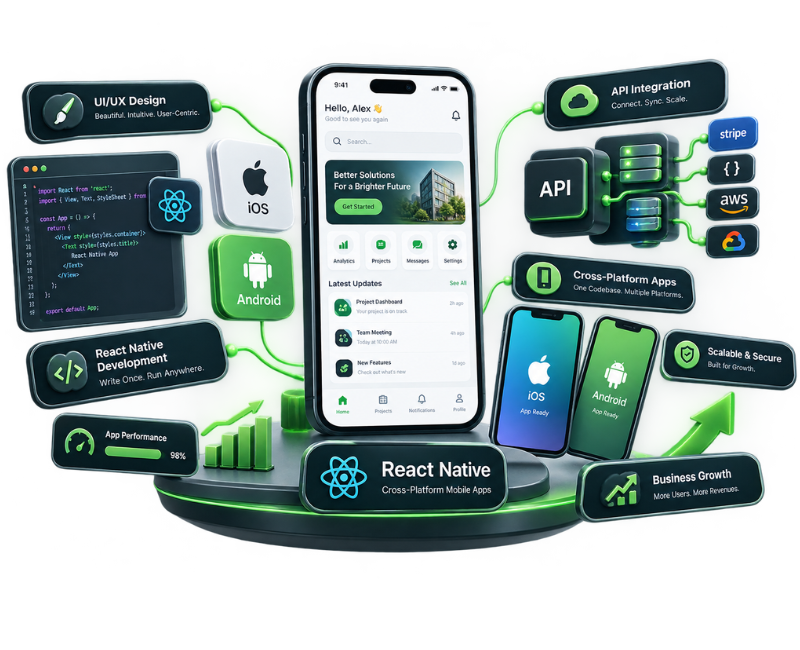
Build a mobile product without treating Android and iOS as two completely separate projects. Falconics IT provides React Native development for businesses that need modern, reliable mobile applications with a shared development foundation and a user experience tailored to real business requirements.
Whether you are starting a new application, extending an existing product or moving from an early MVP toward a more mature platform, we plan the technology and development approach around the product—not around a fixed template.
React Native is a framework for building native mobile applications using React and JavaScript while allowing substantial code sharing between platforms. It can be a practical choice when a business wants to maintain a common product foundation across Android and iOS without designing two entirely independent applications.
The right implementation still requires platform awareness. Some functionality, integrations or user-interface behaviours may need platform-specific treatment, so the objective is not simply to reuse as much code as possible. It is to reuse intelligently while preserving the experience and capabilities expected from each platform.
For businesses, that means the technology can support faster iteration and a more manageable development structure while leaving room for native capabilities where the product requires them.
Every mobile product has different requirements. A customer-facing marketplace needs a different architecture from an internal business application, while a real-time communication product has very different technical considerations from a content or booking platform.
Falconics IT approaches React Native application development around your product goals, user journeys, integrations and operational requirements.
Depending on the project, development can cover application architecture, interface implementation, authentication, APIs, databases, notifications, third-party services, device capabilities and administrative workflows.
The result is a mobile application built around how your business actually operates rather than a generic collection of screens.
A technically functional application can still fail if users find it confusing or slow to navigate.
Our development process gives attention to the relationship between interface design, navigation, interaction patterns and application behaviour. Designs are translated into responsive mobile experiences with attention to consistency across screen sizes and platforms.
Where Android and iOS require different interaction patterns, the implementation can account for those differences instead of forcing an identical experience everywhere.
Most business applications need to communicate with systems outside the mobile app itself.
React Native applications can be connected with existing backend systems, APIs, databases and third-party services according to the project's architecture. This may include authentication systems, payment services, maps, analytics, communication tools, cloud services or other business platforms.
Integration is planned as part of the application architecture so that the mobile interface and supporting systems work together reliably.
If the immediate goal is to validate an idea rather than build every possible feature, an MVP approach can help keep the first release focused.
We can help define the essential user journeys, prioritise the initial feature set and establish a technical foundation that leaves room for future development. This allows a business to test the product with a focused release before committing resources to a larger feature roadmap.
An MVP should be deliberately limited—not simply a smaller version of an unfinished product.
React Native development is not limited to new applications.
If you already have a mobile product, we can work on feature additions, interface improvements, bug resolution, performance-related work, API integrations and ongoing development. Existing applications require an assessment of their current architecture before new functionality is introduced.
This helps reduce the risk of adding new features to an increasingly difficult-to-maintain codebase.
The exact deliverables depend on your project scope, but a typical engagement may include:
| Area | Typical Deliverables |
|---|---|
| Planning | Requirements, feature priorities and technical direction |
| Application | React Native mobile application for relevant platforms |
| UI implementation | Responsive screens, navigation and interaction flows |
| Integration | APIs, backend services and selected third-party integrations |
| Quality assurance | Functional, usability and device-level testing |
| Deployment | Production build preparation and release assistance |
| Ongoing development | Bug fixes, enhancements and feature updates |
Additional requirements can be incorporated when they are relevant to the application.
The value of React Native is not simply that one technology can serve multiple platforms. Its usefulness depends on how well the architecture matches the product.
A shared development foundation
A substantial portion of the application can be maintained across platforms, which can simplify development and future changes.
Faster product iteration
A shared codebase and development tooling can make it easier to implement, review and refine features during active product development.
Consistent product experience
Core application behaviour and business logic can remain aligned across Android and iOS while allowing appropriate platform-specific differences.
Easier ongoing maintenance
A well-structured application gives the development team a clearer foundation for fixing issues and introducing future functionality.
Room for product growth
The architecture can be planned around the expected roadmap rather than only the requirements of the first release.
Access to native capabilities
React Native applications can work with native platform functionality when the product requires capabilities beyond basic interfaces.
A good mobile application starts before the first screen is coded. Our approach focuses on understanding the product, establishing the technical foundation and validating the implementation throughout development.
1. Discovery and requirements
We begin by understanding the business objective, target users, essential workflows, existing technology and desired platforms. This helps separate must-have functionality from features that can be introduced later.
2. Technical planning
The application structure, integrations, data requirements and development approach are considered before implementation begins. Where appropriate, the architecture accounts for future features rather than solving only the immediate requirement.
3. UI implementation and development
The approved product flows and designs are translated into React Native components and application functionality. Development is organised around usable product increments rather than waiting until the end to reveal the complete application.
4. Integration and testing
Features are connected with required APIs and external systems, followed by testing across relevant devices and use cases. Functional behaviour, usability and platform-specific issues are reviewed before release.
5. Deployment and continued improvement
Once the application is ready, the release process is supported according to the project requirements. Post-launch work can include maintenance, fixes, new features and iterative improvements.
React Native can be suitable for a range of businesses, particularly when Android and iOS are both important to the product roadmap.
Startups and new products can use it to develop a focused MVP and establish a foundation for subsequent releases.
SMEs and growing businesses can use custom mobile applications to extend customer services, internal operations or digital products.
E-commerce and D2C businesses can build mobile shopping experiences connected to existing commerce and backend systems.
B2B companies can create customer portals, field applications, workflow tools or mobile extensions of existing business platforms.
Established businesses can enhance an existing mobile product or develop new functionality without necessarily maintaining completely separate application teams.
The suitability of React Native ultimately depends on the product's technical requirements. During planning, those requirements should be assessed before the framework is finalised.
Businesses often come to development with more than just an idea. They may already have a product, designs, technical limitations or an application that has become difficult to extend.
Typical challenges include:
The appropriate solution depends on the condition of the existing product, its technical architecture and the business priorities behind the project.
There is no reliable single timeline for every React Native project.
The schedule can change based on the number and complexity of screens, integrations, backend requirements, design readiness, authentication and payment requirements, device capabilities, testing requirements and the amount of functionality planned for the first release.
A clearly defined MVP can generally be planned differently from a large application with multiple user roles, complex workflows and extensive integrations.
During discovery, the scope can be broken into practical development stages so that priorities and dependencies are easier to understand.
React Native development pricing depends on the actual scope of the application rather than the framework alone.
Key factors include the number of platforms, application complexity, UI/UX requirements, backend and API work, third-party integrations, authentication, payments, device functionality, testing requirements, ongoing maintenance and the level of development support required.
Falconics IT can assess the requirements and define a project scope before providing a suitable engagement proposal. This approach avoids presenting an arbitrary package price for applications that may have very different technical needs.
Falconics IT combines mobile application development with broader web, software and technology capabilities. That matters when a mobile application needs to interact with websites, APIs, business software, cloud infrastructure or other digital systems.
The focus is on building a solution around the business requirement rather than forcing every project into the same development model.
You also retain a clear view of what is being developed, why particular technical decisions are being made and what the next stage of the product should involve.
React Native development involves building mobile applications using React Native, allowing developers to share substantial application code across platforms such as Android and iOS while still working with native platform capabilities.
Yes. React Native is designed for mobile development across platforms, making it possible to build applications for Android and iOS from a shared development foundation. Some platform-specific implementation may still be appropriate depending on the application's requirements.
Yes. A project can start from product requirements and move through planning, interface implementation, development, integration, testing and deployment.
Yes. Existing applications can be assessed for feature development, fixes, integrations, improvements or ongoing maintenance. The existing codebase and architecture should be reviewed before planning substantial changes.
Yes. React Native applications can communicate with backend systems and APIs required by the product. The exact integration approach depends on the existing architecture and the services involved.
Yes. React Native can be used for focused MVP development when the product requirements are appropriate for the technology. The first release can prioritise essential user journeys while leaving room for future features.
The timeline depends on scope, complexity, design readiness, integrations, backend requirements, testing and the number of features planned for the release. A small focused application and a feature-rich business platform should not be expected to follow the same schedule.
There is no fixed price for every application. Cost is influenced by functionality, complexity, integrations, UI/UX requirements, testing, backend work and ongoing support. Falconics IT can determine the appropriate scope before preparing a proposal.
Ongoing support can include bug fixes, application updates, enhancements and additional development, depending on the engagement.
Useful starting information includes your product idea or existing application, target users, required platforms, key features, available designs or references, existing technical systems and your preferred project objectives.
Start by sharing your application requirements with Falconics IT. We can discuss the product, understand the technical scope and determine the most practical next step for development.
A successful mobile application needs more than a framework and a collection of screens. It needs a sensible product scope, reliable architecture, thoughtful implementation and a development process that can accommodate what comes after launch.
If you have a new mobile product, an MVP idea or an existing application that needs further development, Falconics IT can help you evaluate the requirements and plan the right React Native development approach.
Contact our expert team today for a tailored strategy and free consultation.
Get a Free Consultation