
Ready to transform your business with AI Solutions?
Contact our expert team today for a tailored strategy and free consultation.
Get a Free ConsultationNo services available in this category yet.
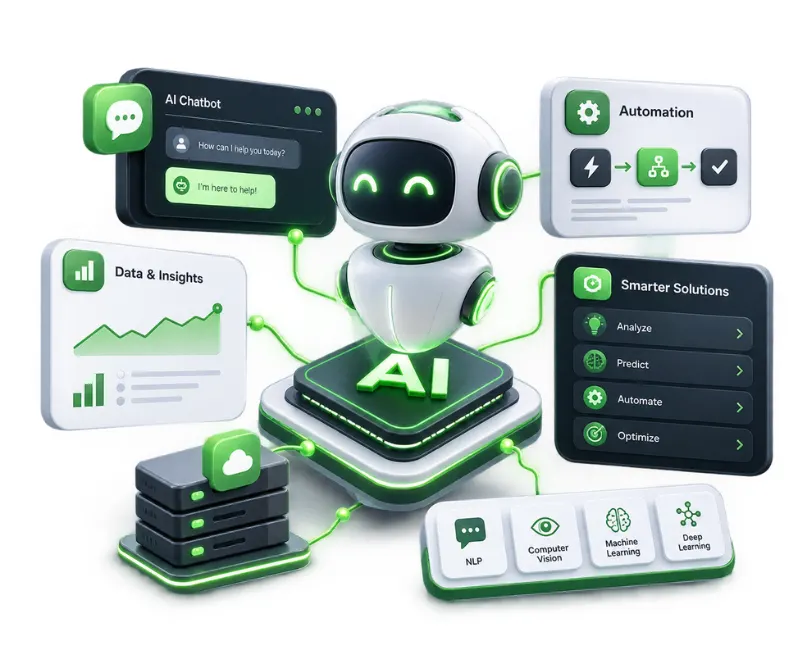
AI should solve a real business problem—not become another technology project to manage.
Falconics IT develops practical, customized AI solutions around your workflows, systems, customers, and business objectives. From intelligent automation and AI assistants to workflow integrations and generative AI applications, we help businesses identify where AI can create meaningful operational value and then turn that opportunity into a working solution.
Whether you want to automate repetitive processes, make information easier to access, improve customer support, or connect AI with your existing technology, our approach starts with your business need rather than a predefined AI product.
Ready to explore what AI could do for your business?
[Get a Free AI Consultation]
AI solutions are business applications that use artificial intelligence to perform, support, or improve tasks that traditionally require significant manual effort or human decision-making.
The right solution might be relatively simple, such as an AI-powered customer assistant, or more integrated, such as an intelligent workflow that connects your CRM, internal knowledge, documents, and business applications.
The important question is not simply whether AI can be added to your business. It is where AI can create a useful improvement without introducing unnecessary complexity, security concerns, or operational disruption.
Falconics approaches AI implementation from that perspective: understand the process first, identify the appropriate technology, then build a solution that fits the way your organization actually works.
The scope of an AI project depends on the problem being solved, the systems involved, and the level of automation required. We can combine different AI capabilities into a solution designed around your specific requirements.
Many businesses spend valuable time moving information between systems, responding to repetitive requests, processing documents, or performing routine administrative tasks.
AI automation can reduce this manual workload by allowing software to interpret information, make defined decisions, trigger actions, and route tasks according to established business rules.
The goal is not to automate everything. It is to automate the right parts of a process while keeping appropriate human oversight where judgment, approval, or accountability is required.
AI-powered assistants can help customers, employees, or internal teams find information and complete common tasks through natural-language conversations.
Depending on the use case, an AI assistant can be connected to approved business information, knowledge bases, documents, websites, or internal systems. This creates a more useful experience than a basic scripted chatbot because the system can respond based on relevant context.
Common applications include customer support, internal knowledge assistance, product information, lead qualification, service enquiries, and employee support.
Generative AI can support businesses with tasks involving text better approach is to connect AI capabilities to the tools already supporting your business. This may involve APIs, databases, CRM platforms, websites,, and digital business expertise within one technology partner. That broader technical perspective, documents, information retrieval, summarization, classification, and content generation.
Falconics can help businesses evaluate where generative AI makes practical sense and integrate it into controlled workflows rather than treating it as a standalone experiment.
For organizations already using AI tools, this can also mean creating more structured workflows around them—improving consistency, access control, review processes, and integration with existing applications.
AI becomes particularly useful when it is connected to the systems employees already use.
We can design workflows that connect AI capabilities with business applications, APIs, databases, CRM platforms, websites, communication tools, and other digital systems.
For example, an incoming enquiry could be interpreted by an AI system, categorized, enriched with relevant information, entered into a CRM, and routed to the appropriate team.
The exact workflow depends on your operation. The objective is to remove unnecessary manual steps while keeping the process transparent and manageable.
A new AI system does not always need to replace your existing technology.
In many cases, the better approach is to connect AI capabilities to the tools already supporting your business. This may involve APIs, databases, CRM platforms, websites, internal applications, or cloud services.
Integration allows AI to become part of an existing operational process instead of creating another isolated application that employees have to maintain separately.
A useful AI project begins with the workflow—not the technology.
We first examine how a process currently works, where time is being lost, what information is involved, and where decisions or repetitive actions occur. From there, we determine whether AI, conventional automation, software development, or a combination of technologies is the appropriate answer.
This prevents a common problem with AI projects: introducing sophisticated technology where a simpler solution would have been more effective.
Our process is designed to move from business requirement to practical implementation without unnecessary technical complexity.
1. Understand the business requirement
We start by understanding your objectives, current processes, technology environment, users, data, and operational challenges. This helps define the actual problem before selecting a solution.
2. Identify AI opportunities
We assess where artificial intelligence or automation can create a meaningful improvement. Not every process needs AI, so we focus on opportunities where the technology can provide a clear functional advantage.
3. Design the solution
The next step is to define the workflow, AI capabilities, integrations, user experience, data requirements, and appropriate controls. The result is a practical solution architecture aligned with the intended business use.
4. Build and integrate
We develop the required AI functionality and connect it with relevant systems. Depending on the project, this may include AI models, APIs, databases, applications, automation workflows, chat interfaces, or business software.
5. Test and refine
AI systems need to be evaluated against real use cases. We test outputs, workflows, integrations, edge cases, and user interactions before moving toward broader deployment.
6. Deploy and improve
Once the solution is operational, performance and usage can be reviewed to identify improvements. AI implementation is often an evolving process as business requirements, data, and workflows change.
The exact deliverables depend on the scope of the engagement, but an AI project may include:
The project scope should be agreed before development begins so that everyone understands what is being built, which systems are involved, and what successful implementation looks like.
AI is particularly valuable when a business has processes involving large amounts of information, repetitive decisions, frequent customer interactions, or manual movement of data.
Depending on your organization, AI may help address challenges such as:
The right solution depends on the underlying process. Falconics focuses on understanding that process before recommending an implementation.
AI solutions can be useful for startups, growing companies, established businesses, and organizations with complex operational processes.
They are particularly relevant when teams are spending significant time on repetitive tasks, customer interactions require fast responses, or employees need to work with large volumes of business information.
AI can also support businesses that already have strong software infrastructure but want to introduce intelligent capabilities into existing applications and workflows.
Falconics combines AI, software development, automation, web technology, and digital business expertise within one technology partner. That broader technical perspective matters because effective AI implementation often involves more than selecting an AI model.
An AI application may need to communicate with a website, CRM, database, API, cloud environment, internal application, or automation platform. Having development and technology capabilities alongside AI expertise allows the solution to be considered as part of the wider business system.
Our approach is also intentionally practical. We do not recommend AI simply because it is available. We focus on identifying worthwhile use cases, defining the workflow, selecting suitable technology, and building something that can actually be used.
For businesses operating in India, AI can support teams dealing with growing customer volumes, distributed operations, multilingual communication, repetitive administrative work, and increasingly complex digital processes.
Falconics IT works with businesses looking to incorporate AI into their existing technology environment rather than adopting disconnected tools without a clear operational purpose.
Whether the requirement is an AI assistant, intelligent automation, custom AI application, or an integrated business workflow, the starting point is the same: understand the business requirement and build around it.
Not every business problem is an AI problem.
A strong candidate usually has a clearly defined process, meaningful volumes of repetitive work, accessible data, and a measurable reason for improving the existing approach.
It is also important to consider accuracy, security, human oversight, integration requirements, and the consequences of incorrect AI output.
A responsible AI solution therefore considers both what the technology can do and where it should not be allowed to operate without human review.
AI solutions are software systems or integrated workflows that use artificial intelligence to help businesses perform, automate, or improve specific tasks. They can include AI assistants, document processing, intelligent automation, recommendation systems, generative AI applications, and AI-enabled business workflows.
Falconics can develop customized AI solutions involving AI automation, intelligent assistants, generative AI, workflow automation, system integrations, and AI-enabled software functionality. The exact solution is determined by your business requirements and existing technology environment.
Yes. AI can often be integrated with existing websites, CRM systems, databases, APIs, business applications, and other software. Integration requirements are assessed during the planning stage to determine the most appropriate technical approach.
Yes. When existing tools do not adequately address a business requirement, a custom AI solution can be designed around the organization's workflow, data, users, and systems.
We begin by examining the underlying business process. If conventional software or automation is a better fit, there is no reason to introduce unnecessary AI complexity. Where AI provides a meaningful advantage, we can design an appropriate implementation.
Some workflows can be highly automated, while others require human review or approval. The appropriate level of automation depends on the process, the type of decisions involved, data quality, risk, and the consequences of an incorrect output.
There is no single timeline for every AI project. A relatively focused assistant or automation workflow may be considerably simpler than a custom AI application involving multiple integrations, complex data, or extensive testing. Scope and technical requirements determine the development timeline.
AI project pricing depends on factors such as functionality, integrations, data requirements, AI model usage, interface requirements, security considerations, and ongoing support. Falconics can define the scope and provide an appropriate proposal after understanding the project requirements.
Potentially, yes. Existing business data can often be incorporated into AI workflows, provided it is accessible, appropriately structured, and suitable for the intended use. Data quality, permissions, privacy, and security should be considered before implementation.
For many business applications, yes. Human oversight can be important when AI outputs affect customers, financial decisions, sensitive information, compliance, or other high-impact processes. The level of review should be designed according to the specific use case.
You do not need to have the technical solution already defined. It is more useful to identify the business problem, current workflow, users involved, systems being used, and the outcome you want to improve. Falconics can help translate those requirements into an appropriate AI solution.
The best AI implementation is not necessarily the most complicated one. It is the one that solves a meaningful problem, fits your existing environment, and can be adopted by the people who use it.
If you have an AI idea, an inefficient workflow, or a business process you believe could be automated, Falconics IT can help evaluate the opportunity and define a practical path forward.
Contact our expert team today for a tailored strategy and free consultation.
Get a Free Consultation