
Ready to transform your business with AI Chatbots?
Contact our expert team today for a tailored strategy and free consultation.
Get a Free ConsultationNo services available in this category yet.
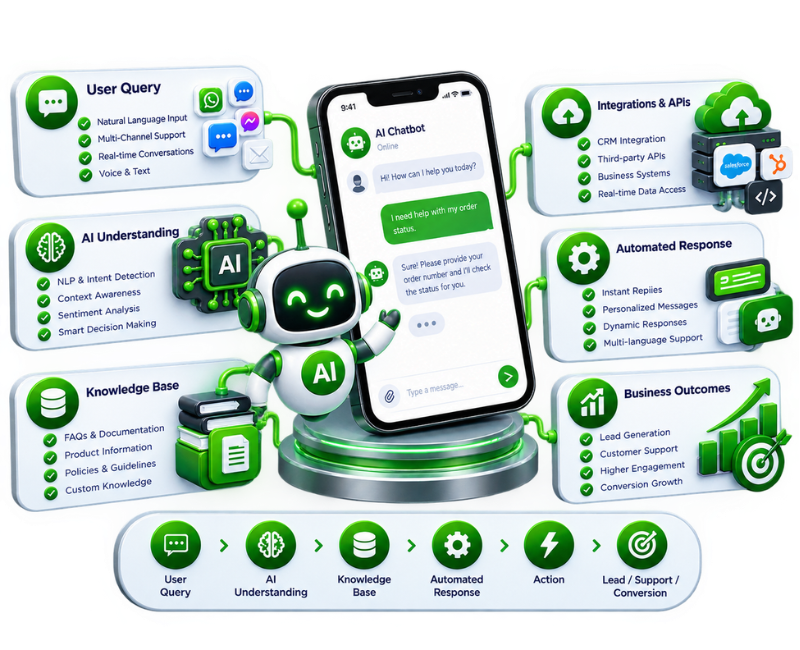
AI chatbots help businesses manage conversations more efficiently by combining artificial intelligence with business information, workflows and automation.
Falconics IT develops custom AI chatbot solutions for businesses that want to improve customer support, qualify leads, assist sales teams, answer recurring questions or automate internal processes.
Whether you need a website chatbot, customer service assistant, sales chatbot or internal AI assistant, the solution can be designed around the way your business actually operates.
AI chatbots are software applications that use artificial intelligence to understand natural-language conversations and provide relevant responses.
Unlike basic rule-based bots that depend on fixed questions and predefined paths, AI-powered chatbots can interpret different ways of asking the same question and respond using configured business knowledge and context.
For businesses, their value goes beyond answering questions. A well-designed chatbot can guide users, collect information, support employees, qualify enquiries and connect conversations with existing business processes.
Falconics IT approaches chatbot development around the specific business requirement rather than using a standard feature checklist.
The scope can include conversation design, AI configuration, knowledge integration, interface development, backend functionality, system integrations, testing and deployment.
The chatbot's capabilities are defined according to who will use it, what information it needs, what actions it should perform and when a human should take over.
Every business has its own terminology, customer questions, processes and information sources. A custom AI chatbot can be designed around those requirements instead of forcing the business into a generic conversation flow.
The development process can cover user intents, conversation journeys, knowledge sources, response rules, escalation logic and integration requirements.
This makes the chatbot more useful for real business situations, particularly when conversations need to move beyond simple FAQs.
Support teams often spend considerable time responding to repetitive questions. An AI chatbot can handle suitable recurring conversations while allowing human representatives to focus on issues that require judgement or specialised assistance.
A customer support chatbot can help with product information, service queries, troubleshooting guidance, policies, order-related questions and other frequently requested information.
When a conversation falls outside the chatbot's defined scope, escalation to a human support channel can be incorporated into the workflow.
An AI chatbot can engage website visitors when they have questions about your products or services but are not yet ready to contact a salesperson.
Depending on the sales process, the chatbot can explain offerings, understand requirements, collect contact information, qualify prospects and guide suitable visitors toward an enquiry or consultation.
This can create a smoother transition between website engagement and the sales process while reducing repetitive pre-sales conversations.
AI chatbots are not limited to customer-facing applications.
An internal AI assistant can help employees find information from approved company resources, answer routine operational questions and support selected internal workflows.
This can be useful for organisations where employees frequently need information from policies, documentation, product knowledge bases, operational resources or other internal content.
A chatbot becomes significantly more useful when it can interact with the systems already used by your business.
Depending on requirements, integrations may involve:
Integration requirements are considered during planning so that data access, permissions and chatbot actions are clearly defined.
The exact capabilities depend on the use case, but an AI chatbot can be configured to support features such as:
The objective is to select capabilities that solve a real business requirement rather than adding AI features simply for the sake of technology.
AI chatbot development can create value in several areas of business operations.
Faster customer responses
Customers can receive immediate assistance for suitable questions without waiting for a support representative.
Reduced repetitive workload
Routine enquiries can be handled automatically, giving employees more time for complex or higher-value work.
Better lead qualification
The chatbot can collect relevant information before a prospect reaches the sales team.
More accessible business information
Customers and employees can interact with information through a conversational interface rather than navigating multiple resources.
Consistent communication
Approved information and conversation logic can help provide more consistent responses to recurring questions.
Scalable customer engagement
A chatbot can handle multiple conversations simultaneously, making it easier to support growing volumes of enquiries.
Discovery & Requirement Analysis
We begin by understanding the business objective, target users, existing workflows and expected chatbot functionality.
Conversation & Knowledge Planning
Important user journeys, common questions, knowledge sources, intents, response boundaries and escalation scenarios are mapped before development.
Development & Integration
The chatbot is developed according to the approved scope and integrated with the required website, application, API or business system.
Testing & Refinement
Realistic conversation scenarios are tested to identify gaps in responses, workflow behaviour, integrations and fallback handling.
Deployment & Optimisation
After launch, the chatbot can be reviewed based on actual conversations and business feedback. Improvements can then be made as new requirements or usage patterns emerge.
Depending on the agreed scope, an AI chatbot project may include:
| Area | Deliverables |
|---|---|
| Strategy | Business requirements and chatbot use-case definition |
| Conversation Design | User journeys, intents, conversation flows and fallback logic |
| AI Configuration | AI model integration and business knowledge setup |
| Development | Chatbot interface and application functionality |
| Integration | APIs, CRM, databases or other required systems |
| Testing | Functional and conversation testing |
| Deployment | Production setup and launch support |
| Optimisation | Performance review and ongoing improvements where included |
The final deliverables are defined before development begins so expectations remain clear.
AI chatbots are particularly useful when businesses face repetitive communication or information-access challenges.
Common situations include:
The solution should be built around the specific operational problem rather than treating chatbot implementation as a standalone technology exercise.
B2B businesses can use AI chatbots to answer service questions, qualify enquiries and support sales conversations.
Ecommerce businesses can assist customers with product discovery, common questions, order information and pre-purchase support.
Service businesses can handle initial enquiries, explain services, collect requirements and guide potential customers toward the next step.
Startups and growing businesses can automate recurring conversations while keeping their teams focused on higher-priority activities.
Larger organisations can use conversational AI for customer support, internal knowledge access and more complex integrated workflows.
Falconics IT focuses on building AI chatbot solutions around business requirements rather than treating the chatbot as a standalone website feature.
The approach considers the complete environment around the chatbot, including the information it needs, the users interacting with it, existing workflows and the systems it may need to connect with.
The development process also emphasises clear requirements, practical implementation, testing and refinement. This helps create a solution that is useful beyond the initial launch and can evolve as the business's needs change.
An AI chatbot should have clearly defined responsibilities.
It may be highly effective at answering approved questions, guiding users through specific processes or automating repetitive interactions. It should not be expected to reliably handle every possible question without appropriate knowledge, testing and safeguards.
The quality of the underlying information, conversation design, integrations and ongoing refinement can all influence the usefulness of the final solution.
Project timelines can also vary. A straightforward website chatbot will generally have a different scope from a system-integrated assistant that works with databases, APIs or business workflows.
AI chatbot development does not have one standard price because every implementation can have a different level of complexity.
Pricing can be influenced by:
Falconics IT can determine the appropriate scope after understanding your requirements and recommend an implementation that matches the intended business outcome.
An AI chatbot is a software application that uses artificial intelligence to understand and respond to user messages. It can be designed for customer support, sales, lead generation, internal assistance and business automation.
Traditional chatbots typically rely on predefined rules and fixed conversation paths. AI chatbots can interpret natural-language questions and, when properly configured, use business knowledge and context to generate more relevant responses.
Yes. A custom chatbot can be designed around your business objectives, audience, information sources, workflows and technical environment.
Yes, where. Internal AI technically appropriate. CRM, APIs, databases and other business systems can be integrated based on the requirements and access permissions of the project.
Yes. A chatbot can engage visitors, answer pre-sales questions, collect enquiry information and qualify prospects according to criteria defined by the business.
Yes. They can handle suitable recurring support conversations and provide information from approved knowledge sources. More complex cases can be transferred to human support.
Yes. Internal AI assistants can help employees access approved information and support selected operational workflows.
Not necessarily. A well-designed chatbot typically handles repetitive or straightforward interactions while human employees manage situations requiring judgement, empathy or specialised expertise.
The timeline depends on the chatbot's functionality, integrations, data requirements, testing needs and deployment environment. A simple chatbot can have a very different scope from an integrated enterprise solution.
The cost depends on the functionality, AI requirements, integrations, custom development, testing and ongoing support required. An accurate price can be provided after the project scope is understood.
Share your intended use case, target users, current challenges and any systems the chatbot needs to connect with. Falconics IT can then help define the appropriate solution and development scope.
The most effective AI chatbot is not necessarily the one with the longest feature list. It is the one that handles the right conversations, uses reliable information and fits naturally into your existing business processes.
If you want to automate customer conversations, support your sales process, improve internal information access or explore a specific AI use case, Falconics IT can help turn the requirement into a practical chatbot solution.
Contact our expert team today for a tailored strategy and free consultation.
Get a Free Consultation