
Ready to transform your business with Performance Marketing?
Contact our expert team today for a tailored strategy and free consultation.
Get a Free ConsultationNo services available in this category yet.
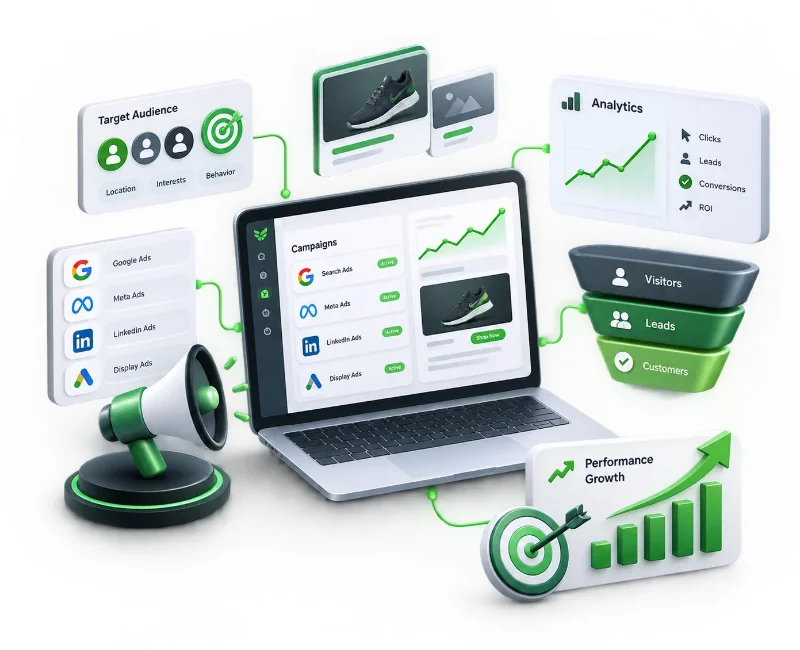
Performance marketing is not simply about running advertisements. It is about understanding what the business needs from its marketing investment, reaching the right audience, tracking meaningful actions, and using campaign data to improve performance over time.
Falconics IT approaches performance marketing with a business-first mindset. Campaign strategy, advertising channels, creative direction, audience targeting, landing-page experience, conversion tracking, and optimization work together rather than operating as isolated activities.
Whether the objective is generating enquiries, acquiring customers, increasing online sales, or improving the efficiency of paid campaigns, the focus remains on measurable actions and informed decisions.
Start a conversation about your performance marketing requirements.
Every campaign begins with a different commercial requirement. A B2B company may need qualified enquiries, an e-commerce brand may focus on purchases, while a local service business may prioritize calls or form submissions.
The campaign structure should therefore be determined by the business objective rather than by a fixed advertising formula.
Falconics IT can help establish the campaign objective, identify the relevant audience, select suitable channels, define conversion events, and create a measurement framework before scaling advertising activity.
A performance campaign is most effective when the complete customer journey is considered—from the first advertisement to the final conversion.
Depending on the project scope, performance marketing can include:
The exact combination depends on the business model, audience, available data, advertising budget, and campaign objectives.
Search advertising can connect businesses with users who are actively looking for relevant products or services. Effective campaign management requires more than selecting keywords and publishing ads.
Campaign structure, search intent, keyword relevance, ad messaging, bidding, geographic targeting, landing pages, and conversion tracking all influence how effectively advertising spend is used.
Falconics IT can structure search campaigns around relevant commercial intent and continuously review performance data to identify opportunities for refinement.
Platforms such as Facebook and Instagram can help businesses reach potential customers based on audience characteristics, interests, behaviours, and previous interactions.
The challenge is turning audience reach into meaningful actions. Campaign objectives, creative variations, audience segmentation, retargeting, and conversion signals need to work together.
Performance-focused social campaigns can therefore be tested and refined according to measurable engagement and conversion behaviour rather than relying only on impressions or likes.
Without reliable tracking, campaign optimization becomes difficult.
A performance marketing setup should identify the actions that matter to the business and establish appropriate measurement around them. Depending on the campaign, these may include form submissions, calls, purchases, registrations, enquiries, or other defined conversion events.
Tracking also creates a clearer connection between advertising activity and business outcomes, allowing campaign decisions to be based on evidence rather than assumptions.
Generating relevant traffic is only part of the equation. If visitors reach a website or landing page but do not take the intended action, increasing advertising spend alone may not solve the problem.
Conversion rate optimization examines the experience after the click. Page messaging, layout, calls to action, forms, trust elements, mobile usability, loading experience, and the relationship between advertisement and landing page can all influence conversion behaviour.
Where appropriate, Falconics IT can identify conversion barriers and recommend practical improvements to help campaigns make better use of existing traffic.
Performance marketing should not be treated as a set-and-forget activity.
Campaign data can reveal which audiences, messages, keywords, creatives, placements, and conversion paths are producing meaningful results. These insights can then inform ongoing adjustments.
Testing may involve different ad messages, creative concepts, audience groups, landing-page elements, bidding approaches, or campaign structures. The objective is to learn from actual campaign behaviour and progressively improve efficiency.
The right performance indicators depend on the business model and campaign objective.
Common metrics include:
A strong reporting framework separates activity metrics from business metrics so that the numbers provide useful context for decision-making.
The process starts by understanding the business, offer, target audience, existing marketing activity, competitive environment, conversion journey, and desired outcome.
This creates the foundation for deciding what the campaign should accomplish.
The next step is determining where paid marketing can realistically contribute. Search, social advertising, remarketing, or other relevant channels can be considered according to audience behaviour and business objectives.
The campaign structure, targeting approach, budget allocation, and measurement requirements are then defined.
Campaigns are structured around clearly defined objectives and conversion actions. This stage can include audience configuration, keyword research where relevant, ad copy, creative requirements, landing-page alignment, tracking, and campaign settings.
Once campaigns are launched, initial performance data provides insight into audience response and campaign behaviour.
Early data should be interpreted carefully rather than used to make premature conclusions.
Campaign performance is reviewed against relevant KPIs. Underperforming elements can be refined while promising opportunities are tested further.
Optimization may involve targeting, creative, keywords, bidding, landing-page experience, budget allocation, or campaign structure.
Performance reporting should explain more than what happened. It should help answer why performance changed and what should happen next.
Insights from one campaign can also inform future creative, targeting, landing-page, and budget decisions.
Paid advertising can generate clicks quickly, but clicks alone do not represent business success.
A campaign may have strong traffic but weak conversions. Another may generate inexpensive leads that are poorly qualified. An e-commerce campaign may generate sales while still producing an unsustainable acquisition cost.
That is why performance marketing needs to consider the complete path from audience → advertisement → landing experience → conversion → business value.
This broader view helps identify whether the problem is with targeting, messaging, the offer, the website experience, tracking, or campaign execution.
Performance marketing can be useful for businesses with a clearly defined offer and a measurable customer action.
It can be particularly relevant for:
E-commerce businesses — where purchases and revenue can provide direct conversion signals.
B2B companies — where campaigns can be structured around enquiries, demo requests, consultations, or other qualified actions.
Service businesses — where calls, forms, bookings, or enquiries are important conversion points.
Startups and growing businesses — where controlled testing can help identify viable acquisition channels before increasing investment.
D2C brands — where paid search and social campaigns can support customer acquisition and product sales.
The suitability of a campaign depends on factors such as market demand, offer quality, competition, budget, website experience, and the ability to measure meaningful conversions.
High advertising spend with limited conversions
Campaign and conversion data can be examined to identify where users are dropping out and which parts of the campaign require attention.
Traffic without meaningful enquiries or sales
The issue may extend beyond advertising. Audience intent, offer positioning, landing-page messaging, or conversion friction may need to be reviewed.
Unclear campaign performance
A structured measurement framework can make it easier to distinguish useful business outcomes from surface-level engagement metrics.
Campaigns that stop improving
Testing new audiences, messaging, creative, bidding approaches, or landing experiences can create additional learning opportunities.
Difficulty scaling paid campaigns
Scaling requires attention to efficiency, conversion capacity, audience size, creative fatigue, budget allocation, and the economics of customer acquisition.
Performance marketing requires a clear understanding of both advertising platforms and the business behind the campaigns.
Falconics IT focuses on creating a structured connection between campaign activity and measurable objectives rather than treating paid advertising as an isolated service.
Depending on the engagement, the work can cover strategy, campaign setup, advertising management, tracking, conversion-focused recommendations, testing, optimization, and reporting.
The objective is to create a marketing system where campaign data becomes useful for making better advertising and business decisions.
Depending on the agreed scope, deliverables may include:
| Area | Typical Deliverable |
|---|---|
| Strategy | Campaign objectives, audience and channel direction |
| Paid Advertising | Search and/or social campaign setup and management |
| Creative | Ad messaging and creative requirements |
| Tracking | Conversion measurement and campaign tracking setup |
| Optimization | Ongoing campaign review, testing and refinement |
| Reporting | Performance reporting with actionable observations |
| CRO | Conversion-focused recommendations where relevant |
There is no single price that applies to every performance marketing engagement.
The overall investment can depend on the number of advertising channels, campaign complexity, advertising spend, number of campaigns or products, creative requirements, tracking setup, landing-page requirements, competition, reporting needs, and the level of ongoing management required.
The advertising budget and service fee should also be considered separately when evaluating the total marketing investment.
A suitable engagement can be defined after understanding the business objectives, current marketing setup, and scope of work.
Performance marketing provides measurable data, but it does not remove the variables that influence campaign outcomes.
Results can be affected by market demand, competition, pricing, product-market fit, website performance, creative quality, audience behaviour, seasonality, budget, tracking quality, and the effectiveness of the offer.
For that reason, responsible performance marketing focuses on measurement, testing, learning, and optimization rather than promising a fixed number of leads, sales, revenue, or return on advertising spend.
Performance marketing is a measurable form of digital marketing where campaigns are planned and optimized around specific actions or business outcomes, such as leads, enquiries, purchases, registrations, or other conversions.
Performance marketing places stronger emphasis on measurable actions and campaign economics. Instead of evaluating activity primarily through reach or visibility, performance campaigns connect advertising activity with defined conversion metrics and business objectives.
The appropriate platforms depend on the audience and business model. Search advertising and social advertising are common options, while other channels may be considered when they provide a relevant opportunity to reach the target audience and measure meaningful actions.
It can be, provided there is a suitable offer, identifiable audience, realistic advertising budget, and measurable conversion action. The campaign should be structured according to the business's ability to acquire and serve customers profitably.
Yes. B2B campaigns can be designed around actions such as enquiry forms, consultation requests, demo bookings, calls, or other defined lead-generation events. Lead quality should be considered alongside lead volume.
Yes. E-commerce campaigns can be structured around product discovery, purchases, remarketing, customer acquisition, and other measurable stages of the buying journey.
Measurement depends on the campaign objective. Common indicators include conversions, conversion rate, cost per acquisition, cost per lead, click-through rate, cost per click, sales, customer acquisition cost, and return on ad spend.
There is no universal timeline. Campaign performance depends on factors such as budget, competition, conversion volume, audience size, offer, website experience, and the amount of data available for optimization. Initial data can support early learning, while more reliable conclusions generally require sufficient campaign activity over time.
Not always, but the post-click experience is important. A dedicated landing page can be useful when the campaign requires a focused message and a clear conversion path. Existing website pages may also be suitable depending on the objective.
Campaigns can potentially be scaled when the underlying economics, conversion capacity, audience opportunity, and campaign performance support additional investment. Scaling should be based on evidence rather than simply increasing the budget.
Start by discussing your business, target audience, current marketing activity, desired conversions, and campaign objectives. Falconics IT can then determine the appropriate scope, channels, measurement requirements, and next steps for the engagement.
Your advertising budget should be connected to a clear business objective, measurable conversion actions, and an optimization process that learns from campaign data.
Whether you are planning your first paid campaign or looking to improve an existing advertising setup, Falconics IT can help you build a more structured approach to performance marketing.
Contact our expert team today for a tailored strategy and free consultation.
Get a Free Consultation