
Ready to transform your business with CRM Solutions?
Contact our expert team today for a tailored strategy and free consultation.
Get a Free ConsultationNo services available in this category yet.
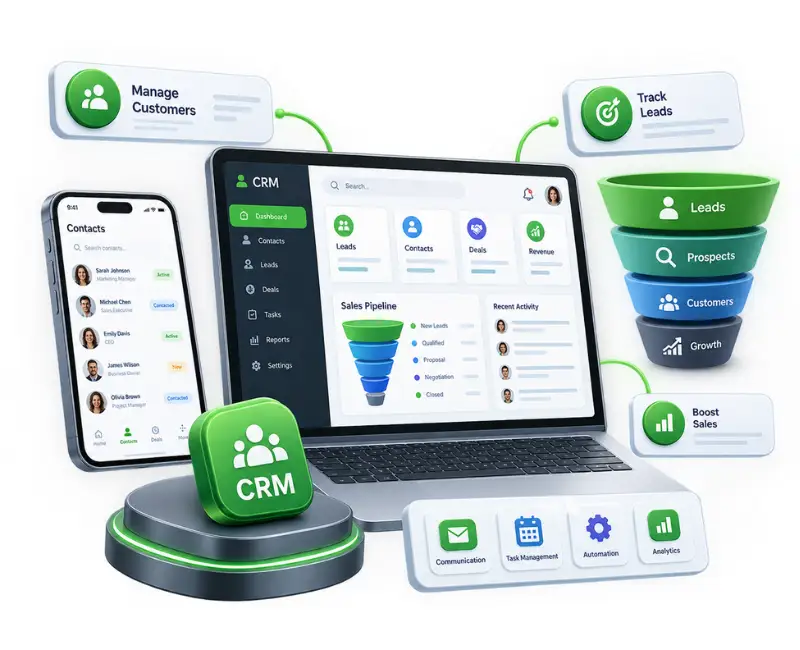
A CRM should do more than store customer information. It should help your teams understand prospects, manage opportunities, follow up consistently, and move customers through the sales process with less manual effort.
Falconics IT provides CRM solutions designed around your business processes, customer journey, and operational requirements. Whether you are introducing a CRM for the first time, replacing spreadsheets, improving an existing platform, or connecting your CRM with other business systems, we help create a setup that is practical, scalable, and easier for your team to use.
Key focus areas:
A useful CRM starts with understanding how your business actually operates. Different companies have different sales cycles, approval processes, customer touchpoints, and reporting requirements, so the system should support those workflows rather than forcing your team into an unsuitable process.
Our CRM solutions can cover the planning, configuration, customization, integration, and ongoing management required to make your CRM useful as part of your wider business technology stack.
We help establish a CRM structure around the information your business needs to capture and the way your teams work with it.
This can include configuring customer records, lead stages, sales pipelines, activities, user access, fields, dashboards, and workflow rules. The objective is to create a system that gives users a clear process to follow without making everyday data entry unnecessarily complicated.
A well-organized CRM gives sales and customer-facing teams a consistent view of their interactions with prospects and customers.
Lead sources, contact information, communication history, follow-up activities, opportunities, and customer status can be structured so important information is easier to find and act upon. This is particularly useful when multiple team members handle different stages of the customer lifecycle.
CRM Solutions can bring greater structure to the sales process by showing where each opportunity stands and what needs attention next.
We can help organize pipeline stages around your actual sales cycle, establish relevant qualification criteria, and create a clearer system for tracking opportunities from initial enquiry through conversion and beyond.
The result is a more consistent sales workflow and better visibility into active opportunities.
Repetitive CRM tasks can consume significant time when they are handled manually. Automation can help reduce unnecessary administrative work while keeping important processes consistent.
Depending on your requirements, workflows may be used for activities such as lead assignment, follow-up reminders, notifications, status changes, approvals, and other recurring actions.
Automation is planned around business logic rather than added simply for the sake of adding features.
Your CRM rarely operates in isolation. Sales, marketing, customer support, finance, websites, communication platforms, and other business applications may all need to exchange information.
We can help assess integration requirements and create a connected flow between relevant systems. This can reduce duplicate data entry and give teams more useful information without requiring them to constantly switch between disconnected platforms.
Implementing a CRM is only the beginning. As your business changes, your workflows, users, reporting requirements, and customer processes may also change.
CRM Management can include system maintenance, workflow improvements, data organization, user support, performance reviews, reporting adjustments, and ongoing enhancements based on how the platform is being used.
This helps keep the CRM aligned with the business instead of allowing it to become another system that teams gradually stop using.
A CRM becomes significantly more valuable when the information inside it can support business decisions.
Relevant dashboards and reports can help teams monitor pipeline activity, lead movement, sales performance, customer activity, and other operational indicators. Reporting requirements are defined according to the questions your management and sales teams actually need answered.
The value of CRM implementation is not simply having another software platform. The real benefit comes from creating a more reliable way to manage customer information and business processes.
A properly structured CRM can help your organization:
We start with the business process rather than the software.
1. Understand
We review your business model, customer journey, sales process, existing tools, pain points, and CRM requirements.
2. Plan
The required CRM structure, workflows, integrations, user roles, data requirements, and reporting needs are mapped before implementation.
3. Configure & Build
The CRM is configured or customized according to the agreed requirements, with attention to usability and process consistency.
4. Integrate & Test
Relevant systems and workflows are connected where required, followed by testing to identify process or data issues before wider adoption.
5. Optimize & Support
After implementation, the system can be refined as your team uses it and new operational requirements emerge.
CRM technology can support businesses at different stages, provided the system is designed around their actual workflow.
Growing businesses can use CRM to replace scattered customer records and establish a more structured sales process.
B2B companies can benefit from organized lead qualification, opportunity tracking, account management, and longer sales-cycle visibility.
Service businesses can centralize enquiries, customer information, follow-ups, and ongoing interactions.
E-commerce and D2C businesses can use CRM capabilities to organize customer information and connect relevant customer-facing processes.
Established organizations can use CRM Management and integration to improve existing systems, reduce process gaps, and support more complex workflows.
Many CRM challenges are not caused by a lack of software. They are caused by a mismatch between the software and the way the business operates.
We can help address situations such as:
The exact scope depends on your existing systems, business requirements, CRM platform, number of users, integrations, data complexity, and desired level of customization.
Depending on the project, deliverables may include:
The final scope is defined after understanding the business requirements rather than applying the same package to every organization.
Falconics IT approaches CRM as part of the wider business technology environment rather than treating it as an isolated software deployment.
Our broader capabilities across software, AI and automation, web development, data and analytics, and IT solutions can also be relevant when a CRM needs to connect with other business systems.
The focus is on building a CRM setup that your team can understand, use, maintain, and improve over time. Requirements are considered before implementation so the technology supports the business process instead of creating unnecessary complexity.
A CRM does not become better simply because it has more features.
The right solution is one that captures the information your business actually needs, supports the workflows your teams actually follow, and provides useful visibility without making everyday operations harder.
For that reason, CRM planning should consider adoption, data quality, process design, integration requirements, and future scalability alongside software functionality.
CRM project timelines vary according to the size and complexity of the implementation.
A straightforward setup with limited customization may require significantly less work than a CRM project involving multiple integrations, historical data, custom workflows, several user groups, or complex approval processes.
The quality of the existing data and the availability of business requirements can also affect the project.
Meaningful progress should therefore be evaluated against defined implementation milestones rather than an arbitrary promise of a specific outcome within a fixed number of days.
CRM pricing is determined by the requirements of the project rather than a one-size-fits-all rate.
Factors that can influence the overall engagement include:
After understanding your requirements, the scope can be defined around the work your business actually needs.
CRM Solutions are systems and services designed to help businesses manage customer information, leads, sales opportunities, interactions, workflows, and related business processes from a more centralized environment.
The solution can include CRM implementation, customization, integration, automation, reporting, and ongoing management depending on the business requirement.
CRM Management can involve maintaining customer and sales data structures, improving workflows, managing automation, updating reports, supporting users, reviewing processes, and making ongoing system improvements.
The exact responsibilities depend on the CRM platform and the level of support required.
Yes. CRM configuration and customization can be planned around your sales process, customer journey, internal workflows, reporting requirements, user roles, and integration needs.
The appropriate level of customization depends on the platform and project scope.
CRM integration can connect relevant business systems so information can move between them more efficiently.
The feasibility and approach depend on the CRM platform, the systems involved, available APIs or integration methods, and the type of data that needs to be exchanged.
Yes. A CRM can be useful for a small business when customer information, enquiries, and sales activities are becoming difficult to manage manually.
The important consideration is choosing a solution with an appropriate level of complexity rather than implementing features the business does not need.
Yes. Existing CRM environments can be reviewed for workflow issues, unnecessary complexity, data organization problems, reporting gaps, integration requirements, and other opportunities for improvement.
Optimization can often be more practical than replacing the entire system.
Ongoing support can be structured around the requirements of the business. This may include system management, workflow changes, troubleshooting, reporting updates, optimization, and technical assistance.
The starting point is understanding your business process, customer journey, team structure, current technology, data requirements, and operational goals.
From there, the CRM setup can be planned around the actual requirements rather than selecting features without a clear business purpose.
Useful inputs may include information about your existing sales process, customer data, current software, user roles, reporting requirements, integrations, and the problems you want the CRM to solve.
The more clearly these requirements are understood, the easier it is to design an appropriate solution.
Start with a discussion about your current CRM situation and what you want to improve.
Whether you need a new implementation, CRM Management, integration, automation, or optimization, Falconics IT can assess the requirements and define the appropriate next steps.
Your CRM should support your people and processes—not create another layer of complexity.
Tell us what you currently use, where your workflow breaks down, and what you want your CRM to accomplish. Falconics IT can help you define a practical CRM approach built around your business requirements.
Contact our expert team today for a tailored strategy and free consultation.
Get a Free Consultation