
Ready to transform your business with AI Voice Agents?
Contact our expert team today for a tailored strategy and free consultation.
Get a Free ConsultationNo services available in this category yet.
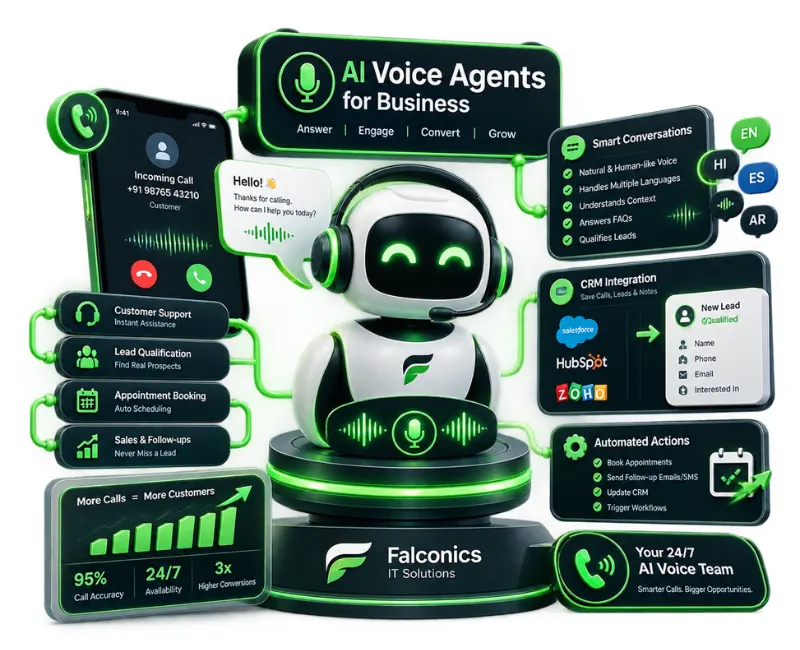
Turn routine phone interactions into intelligent, automated conversations with AI Voice Agents built around the way your business actually operates.
falconicsIt develops voice AI solutions that can engage customers, qualify leads, answer common questions, schedule appointments, follow up with prospects and support internal workflows. The objective is not simply to make automated calls, but to create useful conversations that can complete defined business tasks.
Key capabilities:
CTA: Discuss Your AI Voice Agent Requirements
AI Voice Agents are software systems that use artificial intelligence to understand spoken language and respond through natural voice conversations. Unlike traditional IVR systems that depend heavily on fixed menus and keypad inputs, an AI agent can interpret what a caller says and respond according to the context of the conversation.
For businesses, this creates an additional layer of automation between customers and human teams. A voice agent can handle defined conversations independently and escalate situations to people when human intervention is more appropriate.
The technology typically combines speech recognition, language understanding, AI reasoning and text-to-speech to listen, interpret, decide and respond in real time.
The right use case depends on your workflow, customer journey and call volume. Rather than deploying a generic bot, the conversation can be structured around the specific information and actions your business needs.
Lead qualification and sales follow-ups
AI agents can contact new or existing leads, ask qualifying questions, capture responses and route promising opportunities to your sales team.
Customer support
Routine questions, service information, order-related queries and other predefined support interactions can be automated, allowing human representatives to focus on issues that require judgment or personal attention.
Appointment scheduling
Voice agents can handle appointment requests, confirmations, reminders and rescheduling conversations where the underlying workflow supports automation.
Outbound campaigns
Businesses can automate structured calling campaigns for follow-ups, surveys, re-engagement, reminders and other repetitive outreach activities.
Inbound call handling
An AI agent can answer calls, understand the caller's intent, provide relevant information and transfer the interaction when the request falls outside its defined scope.
An effective AI Voice Agent should understand more than a script. It needs access to the right information, clear rules for what it can do and a defined path for situations it cannot resolve.
falconicsIt can structure voice automation around your existing processes, including the information the agent needs to collect, the responses it should provide and the actions that should happen after a conversation.
Where required, voice solutions can be connected with relevant business systems, APIs, CRMs or other workflow tools so that conversations are connected to the underlying process rather than operating as an isolated calling system.
AI Voice Agents can be particularly valuable when your team spends significant time handling repetitive conversations.
The business value depends on the use case, conversation quality, integration depth and the percentage of interactions that can realistically be automated.
Voice automation needs to account for the way people actually communicate. Customers may switch between English and Indian languages, use informal phrasing or explain the same requirement in different ways.
For businesses serving diverse customer groups, language support and conversational flexibility can therefore be more important than simply having a synthetic voice.
The right implementation should consider language requirements, pronunciation, customer terminology, call context and the level of human support required when an automated conversation reaches its limits.
01 — Understand the Use Case
We start with your business objective, customer journey, call types, existing workflow and the tasks you want to automate. This helps determine whether voice automation is appropriate and where with human involvement should remain.
02 — Design the Conversation
We map the conversation flow, intents, questions, responses, business rules and escalation paths. The aim is to make the interaction useful rather than simply conversational.
03 — Build & Integrate
The AI Voice Agent is configured around the agreed workflow and connected with relevant systems where required. This may include CRM data, APIs, telephony infrastructure or other business applications.
04 — Test Real Scenarios
Before deployment, conversations should be tested against common questions, variations in customer responses, unexpected inputs and escalation conditions. This helps identify gaps before the system handles live interactions.
05 — Monitor & Improve
After launch, conversation data can reveal where users are getting confused, where the agent needs better instructions and which workflows can be improved. Ongoing refinement helps the system remain aligned with changing business requirements.
Many businesses do not need to replace their entire calling operation. They need to remove specific bottlenecks.
An AI Voice Agent can help when sales teams are spending too much time on initial qualification, support teams are repeatedly answering the same questions, follow-ups are inconsistent, or high call volumes are difficult to manage manually.
It can also be useful when a business wants to extend basic customer availability without immediately expanding its human calling team.
The most suitable automation opportunities are usually repetitive, clearly defined and measurable. Complex conversations that require extensive judgment may still be better handled by trained employees.
Startups and growing businesses can automate selected customer and sales workflows without building a large calling operation around every repetitive task.
E-commerce businesses can use voice automation for order-related interactions, customer follow-ups, abandoned-lead re-engagement and support workflows where appropriate.
B2B companies can automate initial outreach, qualification and scheduled follow-ups while keeping sales representatives focused on qualified prospects.
Local and service businesses can use voice agents for enquiries, appointment requests, confirmations and routine customer communication.
Larger organizations can use AI Voice Agents as part of broader contact-centre and workflow automation initiatives, particularly where call volumes and repetitive interactions are significant.
The exact scope depends on the workflow being automated, but an engagement can include:
Advanced requirements such as complex integrations, multiple workflows, additional languages or specialized business logic can be scoped separately.
AI Voice Agents work best when they are treated as part of a business system rather than as a standalone technology experiment.
falconicsIt brings AI automation together with software development, APIs, cloud technology and digital business solutions. This allows voice automation to be considered alongside the systems and workflows it needs to interact with.
Our approach starts with understanding the business requirement, followed by solution design, implementation, testing and performance improvement. The focus is on creating an automation workflow that is practical to deploy and maintain—not adding AI simply because it is available.
The timeline and implementation effort depend on the complexity of the use case.
A straightforward workflow with limited integrations can generally be planned and implemented more simply than a solution involving multiple systems, complex business rules, several languages or a large number of conversation paths.
Performance should also be evaluated against the right operational measures. Depending on the use case, these may include successful call completion, qualification quality, transfer rates, appointment completion, response accuracy or the percentage of interactions resolved without human intervention.
AI Voice Agents should not be evaluated solely on whether they sound human. The more important question is whether they reliably complete the business task they were designed to handle.
There is no single price that applies to every AI Voice Agent project.
The investment can vary based on factors such as:
falconicsIt can scope the solution according to your actual requirements rather than applying an unsuitable fixed package.
An AI Voice Agent is an AI-powered system that communicates with people through spoken conversations. It can understand customer requests, respond using natural language and perform defined tasks without requiring a human representative for every interaction.
Traditional IVR systems generally guide callers through predefined menus and options. AI Voice Agents can understand natural spoken requests and respond based on the context, allowing more flexible conversations.
Yes. They can be designed for outbound use cases such as lead qualification, follow-ups, reminders, surveys, re-engagement and other structured calling workflows.
Yes. An AI Voice Agent can answer inbound calls, identify the caller's intent, provide information and transfer the conversation to a human when required.
Potentially, yes. Integration requirements depend on the CRM and the actions the agent needs to perform. APIs and other integration methods can be used where technically appropriate.
Voice solutions can be designed around the language requirements of the target audience. The exact language coverage and conversational quality should be evaluated according to the specific deployment and use case.
Yes. Human escalation can be incorporated into the conversation design for situations that require personal assistance, specialized knowledge or additional judgment.
There is no universal timeline. A focused workflow with limited integrations is usually simpler to deploy than a multi-workflow system involving complex integrations, multiple languages and extensive business logic.
Not necessarily. AI Voice Agents can work alongside human teams by handling repetitive interactions and transferring more complex conversations to employees.
Pricing depends on factors such as workflow complexity, call volume, integrations, languages,, your current workflow, approximate call volume and any systems you need the agent to connect with. falconicsIt can then help determine the appropriate solution AI and voice requirements, customization and ongoing support. A suitable scope needs to be defined before accurate pricing can be provided.
Start by sharing the type of calls you want to automate, your current workflow, approximate call volume and any systems you need the agent to connect with. falconicsIt can then help determine the appropriate solution and implementation scope.
The strongest AI Voice Agent implementation is not the one that automates the most calls. It is the one that automates the right conversations reliably and fits naturally into your existing business process.
Tell us what you want to automate, and falconicsIt can help define the workflow, technology requirements and next steps.
Contact our expert team today for a tailored strategy and free consultation.
Get a Free Consultation