
Ready to transform your business with ERP Solutions?
Contact our expert team today for a tailored strategy and free consultation.
Get a Free ConsultationNo services available in this category yet.
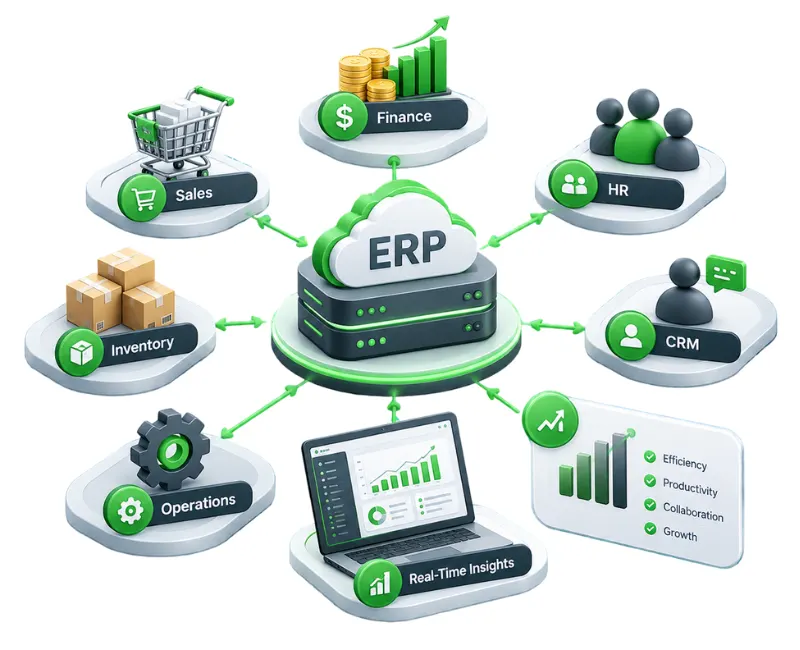
An ERP system should do more than store business data. It should connect the processes, teams, and information your organization relies on every day.
Falconics provides ERP solutions designed around your actual workflows, operational requirements, and growth plans. Whether you need a new ERP platform, customization of an existing system, integrations, automation, or ongoing technical support, we focus on building a practical system your teams can use and your business can extend over time.
What you can expect:
Enterprise Resource Planning (ERP) solutions connect different areas of a business through a shared technology environment. Instead of relying on disconnected spreadsheets, applications, and manually transferred information, an ERP system can bring relevant processes and data into a coordinated workflow.
The right ERP setup depends heavily on how a business operates. A trading company, manufacturer, distributor, ecommerce business, and professional services firm may all need very different workflows, permissions, reports, and integrations.
That is why Falconics approaches ERP as a business-system project rather than simply installing software. The objective is to create a solution that supports the way your organization actually works.
The scope of an ERP project depends on your business processes and existing technology environment. A solution can combine core modules with custom workflows, integrations, reporting, and automation.
Common functional areas include:
Not every organization needs every module. A well-planned ERP implementation prioritizes the processes that create the most operational value.
Standard ERP products can provide a strong foundation, but businesses often have processes that do not fit neatly into predefined workflows.
Falconics can develop and customize ERP functionality around those requirements. This may include custom modules, business rules, approval workflows, dashboards, role-based access, automated notifications, or specialized operational features.
The focus is not customization for its own sake. Custom development should solve a genuine business requirement while keeping the overall system maintainable and scalable.
An ERP system rarely operates in isolation. Businesses may already use ecommerce platforms, CRM systems, payment services, accounting applications, HR tools, logistics software, marketplaces, or internal applications.
ERP integration connects these systems so information can move between them without unnecessary manual intervention.
Depending on the project, integrations can involve:
The goal is a more consistent flow of information across the technology environment rather than another isolated application.
Successful ERP implementation involves more than configuring software. Business processes, data, user roles, integrations, testing, and adoption all need to be considered before the system becomes part of day-to-day operations.
Falconics can structure implementation around the requirements of the project, from initial assessment and configuration through testing, deployment, and post-launch support.
Where an existing system is involved, the implementation plan can also address data migration, process changes, integration requirements, and compatibility considerations.
ERP becomes particularly valuable when operational complexity starts creating friction.
For example, a business may be dealing with:
The appropriate response depends on the underlying problem. Sometimes the right solution is a new ERP platform; in other cases, customization, integration, modernization, or workflow automation may be more appropriate.
Every ERP engagement begins with understanding the business before defining the technology.
01 — Discovery & Process Assessment
We examine your business structure, existing systems, workflows, users, operational challenges, and objectives. This establishes what the ERP needs to accomplish.
02 — Solution Planning
The requirements are translated into a practical solution structure covering modules, workflows, integrations, permissions, reporting, and technical requirements.
03 — Development & Configuration
The ERP environment is configured and, where required, extended with custom modules, automation, integrations, and business-specific functionality.
04 — Testing & Deployment
Workflows and integrations are tested against practical business scenarios before deployment. The objective is to identify issues before they affect normal operations.
05 — Support & Optimization
After deployment, the system can be supported and refined as users adopt it and new business requirements emerge.
ERP projects affect multiple parts of an organization, so the quality of the technology solution is only one part of the equation.
Falconics approaches ERP through a combination of business understanding, software development, integration, automation, and ongoing technical support. This allows the solution to be considered as part of the wider technology environment rather than as a standalone application.
Our broader technology capabilities also make it possible to connect ERP initiatives with related systems such as custom software, CRM, APIs, cloud infrastructure, analytics, and automation when the project requires it.
Most importantly, the scope is shaped around the business requirement. We do not recommend unnecessary functionality simply because it is available within an ERP platform.
ERP solutions can support organizations at different stages of operational complexity.
Growing SMEs can use ERP to replace disconnected processes with a more structured operating environment as teams and transaction volumes increase.
Manufacturing and distribution businesses can connect procurement, inventory, production-related workflows, sales, and financial processes.
Ecommerce and retail businesses can integrate orders, inventory, customer information, purchasing, and financial workflows across their operations.
B2B organizations can coordinate customer management, quotations, orders, procurement, invoicing, and internal approvals.
Service-based businesses can use ERP functionality to connect finance, employees, projects, customers, and internal workflows where appropriate.
The right ERP scope should be determined by operational needs rather than company size alone.
The exact deliverables depend on the selected ERP approach and project scope. A typical engagement may include:
The final scope is defined before development begins so both sides have a clear understanding of what is being delivered.
ERP pricing cannot be responsibly reduced to a single standard figure because the scope can vary substantially from one business to another.
The investment typically depends on factors such as the number of users and business functions involved, system complexity, customization requirements, integrations, data migration, reporting requirements, deployment environment, and ongoing support.
For that reason, Falconics recommends defining the business requirements first and then preparing a project scope around those requirements rather than choosing an ERP package based solely on its initial price.
An ERP project can range from a relatively focused implementation to a substantial business-system transformation.
The timeline depends on the number of modules, degree of customization, integration complexity, data quality, stakeholder availability, testing requirements, and whether the project involves replacing an existing system.
Clients can help keep the project moving by providing timely access to existing systems,Not necessarily process documentation, relevant business data, key stakeholders, and clear feedback during testing.
ERP should also be viewed as an operational change, not simply a software installation. User adoption, process alignment, and post-launch refinement can influence the long-term value of the system.
ERP solutions are used to connect and manage core business processes through a centralized technology environment. Depending on the organization, this can include finance, inventory, procurement, sales, CRM, HR, operations, reporting, and workflow automation.
Yes. ERP functionality can be customized or developed around specific business requirements, including custom workflows, modules, integrations, dashboards, permissions, and automation.
Not necessarily. An existing ERP may be improved through customization, integration, modernization, configuration changes, or additional automation. The appropriate approach depends on the limitations of the current system and your business requirements.
Yes. ERP systems can be integrated with compatible third-party platforms and internal applications through APIs, connectors, middleware, or other integration approaches depending on the technical environment.
There is no single timeline that applies to every ERP project. Scope, number of modules, customization, integrations, data migration, testing, and organizational readiness all influence the implementation schedule.
Yes, provided the solution is appropriately scoped. An SME does not necessarily need the same ERP complexity as a large enterprise. The system should match the company's current processes while allowing room for future requirements.
Data migration can be included where the existing system and data structure allow it. The process generally involves assessing the source data, mapping fields, cleaning information where necessary, and validating the migrated data.
Yes. ERP automation can handle appropriate repetitive processes such as approvals, notifications, task routing, data synchronization, and other rule-based activities.
Ongoing technical support and maintenance can be included according to project requirements. Support may cover application maintenance, troubleshooting, updates, integrations, performance, and further improvements.
Pricing depends on factors such as scope, customization, integrations, number of users or departments, migration requirements, reporting, technical complexity, and ongoing support. A project-specific scope is needed before providing an accurate proposal.
Start by discussing your current systems, business processes, operational challenges, and desired outcomes with the Falconics team. These requirements can then be assessed to determine the appropriate ERP approach and project scope.
Your ERP should support your processes—not force your teams to work around the limitations of a system.
Falconics can help you assess your requirements, define the right solution, develop or customize the necessary functionality, and connect the ERP with the systems your business already depends on.
Contact our expert team today for a tailored strategy and free consultation.
Get a Free Consultation