
Ready to transform your business with Ecommerce Development?
Contact our expert team today for a tailored strategy and free consultation.
Get a Free ConsultationNo services available in this category yet.
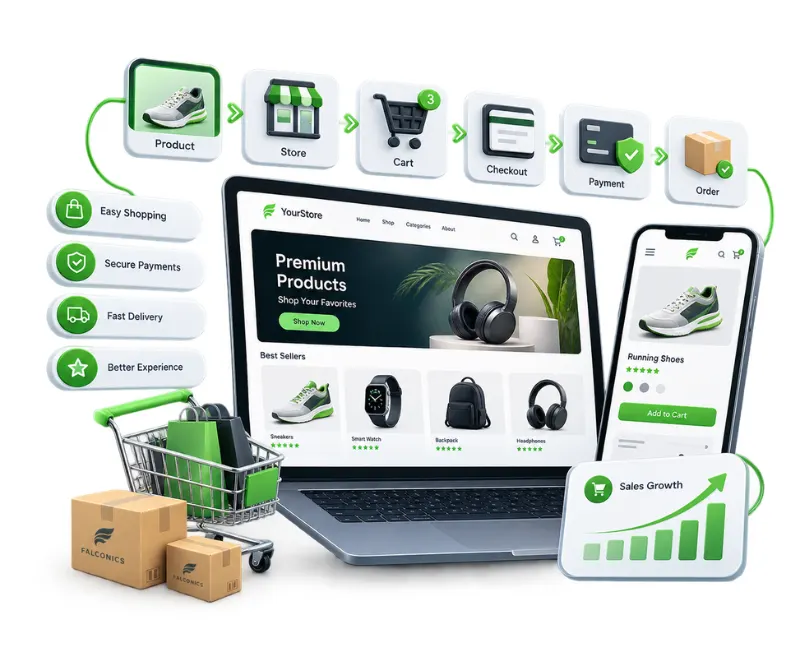
A successful ecommerce website needs to do more than display products. It needs to make shopping simple, support your business operations, handle transactions reliably, and give your customers a clear path from product discovery to checkout.
Falconics IT provides ecommerce development services for businesses that need a new online store, an improved existing website, or a more customized ecommerce solution. We focus on creating practical digital storefronts that align technology, user experience, product management, and business requirements.
What you can expect:
Every online store has different requirements. A D2C brand may need a streamlined shopping journey and strong product merchandising, while a B2B business may require account-based pricing, bulk ordering, approval workflows, or integration with existing business systems.
Our ecommerce development approach starts with understanding those requirements before deciding how the store should be structured. The objective is not simply to launch another website, but to build an ecommerce platform that fits the way your business actually sells and operates.
Launching an online business requires more than installing an ecommerce platform and adding products. Your store needs a logical structure, clear navigation, product discovery, customer-friendly checkout, and an administration system that your team can manage.
We can help structure and develop the core components of a new ecommerce store, including product catalogues, categories, product pages, shopping carts, checkout flows, customer accounts, order management, and other functionality relevant to your business.
Standard ecommerce features work well for many businesses, but some requirements cannot be handled effectively through default functionality.
Custom ecommerce development can address business-specific workflows, specialized product structures, custom pricing, advanced filtering, personalized experiences, unique checkout requirements, or integrations with other systems.
The focus is on adding functionality that solves a real business requirement rather than introducing unnecessary complexity.
Customers should be able to understand what you sell, find the right product, evaluate their options, and complete an order without unnecessary friction.
Ecommerce design therefore needs to balance visual presentation with usability. Product information, navigation, search, filters, calls to action, mobile layouts, and checkout interactions all contribute to the overall shopping experience.
Falconics IT can structure ecommerce interfaces around the way customers browse and buy, while keeping the experience consistent across different screen sizes.
The right technology depends on the business rather than on a universal definition of the "best" ecommerce platform.
Platform selection can depend on factors such as catalogue size, customization requirements, expected traffic, internal resources, integrations, content needs, budget, and future expansion.
Depending on the project, ecommerce development may involve platforms such as Shopify, WooCommerce, Magento/Adobe Commerce, or a custom technology stack. The appropriate option should be determined by your actual requirements and operational priorities.
An ecommerce store rarely operates in isolation. Orders, customer information, inventory, payments, shipping, accounting, marketing, and business operations may need to communicate with other systems.
Where required, ecommerce development can include integrations with relevant third-party platforms and business tools through available APIs or other suitable integration methods.
Typical integration requirements may include:
The exact integration scope depends on the systems already used by your business.
A significant part of ecommerce activity can take place on mobile devices, making responsive design an essential part of store development.
The website should remain easy to browse and use on smaller screens, from product discovery and filtering through to cart and checkout. Mobile usability is considered as part of the overall ecommerce experience rather than treated as an afterthought.
An existing store may become difficult to maintain, slow to manage, visually outdated, or unable to support new business requirements.
A redesign or migration can provide an opportunity to improve the customer experience while addressing technical and operational limitations. Depending on the project, this may involve restructuring the store, moving to another platform, improving functionality, transferring product information, or rebuilding selected components.
Migration planning is particularly important when existing product, customer, order, URL, and SEO data needs to be preserved.
The right features depend on what customers need and how the business operates. Common functionality can include product search and filtering, customer accounts, wishlists, product variations, coupons, reviews, stock management, order tracking, and flexible checkout options.
For businesses with more complex requirements, features can be extended to support custom workflows, customer-specific pricing, bulk ordering, product customization, subscriptions, marketplaces, or other ecommerce models.
Features should serve a clear purpose. A technically impressive store is not necessarily a better store if its functionality makes shopping or administration more complicated.
A thoughtfully developed ecommerce platform can create value beyond simply enabling online transactions.
Simpler customer journeys
Clear navigation, product presentation, search, and checkout can make it easier for visitors to move through the buying process.
Better operational control
Structured product, inventory, order, and customer management can reduce unnecessary manual work and give teams a more consistent way to manage online sales.
Flexible business functionality
Custom features and integrations can help the store accommodate business processes that standard templates may not support.
Improved mobile usability
Responsive interfaces allow customers to interact with the store across different devices without sacrificing essential functionality.
A stronger foundation for expansion
A suitable ecommerce architecture can make it easier to introduce new products, functionality, integrations, or sales channels as requirements change.
More consistent customer experience
A properly structured store creates a connected experience across product discovery, purchasing, account management, and post-order interactions.
A clear development process helps prevent technical decisions from being made without understanding the business behind them.
1. Discovery and requirements
We begin by understanding your products, customers, current technology, business processes, project objectives, and required functionality. This establishes what the ecommerce solution needs to accomplish.
2. Planning and architecture
The store structure, platform approach, integrations, functionality, and technical requirements are mapped out before development progresses too far.
3. Design and development
The ecommerce experience is then designed and developed around the agreed requirements, including the storefront, product structure, shopping journey, backend functionality, and required integrations.
4. Testing and refinement
Core functionality is tested across relevant devices and user journeys. Issues involving usability, forms, checkout, integrations, responsiveness, and other project-specific requirements are identified and addressed.
5. Launch and ongoing improvements
After the store is ready for launch, the focus shifts to stable operation and future improvements. Depending on the engagement, further enhancements, maintenance, integrations, and optimization can be planned as business requirements evolve.
Ecommerce requirements vary considerably depending on how a company sells.
D2C and consumer brands may prioritize product discovery, merchandising, mobile shopping, promotions, and a streamlined checkout experience.
B2B businesses may need customer-specific pricing, bulk ordering, account management, quotation workflows, approval processes, or integration with internal systems.
Retail and established businesses may require ecommerce functionality that works alongside existing inventory, POS, logistics, or operational systems.
Startups and growing businesses often need a practical initial store that can support current requirements without creating unnecessary technical complexity.
The exact deliverables are determined by the agreed project scope. Depending on your requirements, ecommerce development may include:
Additional functionality can be included where it has a clear role in the project's requirements.
An ecommerce project may begin with a specific technical or commercial problem rather than the need for an entirely new website.
This can include an outdated storefront that no longer reflects the brand, difficult product management, poor mobile usability, limited platform functionality, disconnected business systems, an inefficient checkout journey, or a store that has become difficult to extend.
The appropriate solution depends on the underlying issue. Sometimes rebuilding the entire store is unnecessary; a targeted redesign, integration, migration, or feature enhancement may be the more practical route.
Ecommerce development does not have a single fixed price because project requirements can vary substantially.
The overall cost can be influenced by:
Once the scope is understood, the project can be planned around the functionality and technical requirements that actually matter to your business rather than around an arbitrary package.
The development timeline depends on the size and complexity of the ecommerce project. A focused store with standard functionality will generally require a different development schedule from a highly customized platform involving extensive integrations or migration.
Your involvement can also affect progress. Providing product information, brand assets, content, access credentials, business rules, and feedback at the appropriate stages helps keep development moving efficiently.
Ecommerce development should also be viewed as an ongoing digital asset rather than a one-time launch. New products, customer requirements, integrations, and business processes may create opportunities for future improvements.
A useful ecommerce development partner should understand both the customer-facing website and the business processes behind it.
Falconics IT approaches ecommerce projects around the specific requirements of the business instead of treating every store as the same implementation. This allows technology, functionality, design, and integrations to be considered together.
The emphasis is on clear requirements, practical development decisions, maintainable functionality, and a store that your business can continue to work with after launch.
Ecommerce development is the process of creating or improving an online store and its underlying functionality. It can include storefront development, product management, cart and checkout functionality, payment integration, order management, third-party integrations, custom features, testing, and ongoing improvements.
The scope depends on the project. A typical engagement may include store development, responsive design implementation, product and category structures, cart and checkout functionality, payment and shipping integrations, testing, and launch support. Custom requirements can be added where necessary.
There is no single platform that is ideal for every business. The right choice depends on factors such as your products, catalogue, customization requirements, integrations, internal resources, budget, and plans for future expansion. Platform selection should be made after understanding these requirements.
Yes. Custom ecommerce development can be used when standard platform functionality does not adequately support your business requirements. This may involve custom workflows, integrations, product functionality, pricing structures, search and filtering, or other specialized features.
Yes. An existing store can be redesigned or selectively rebuilt to address issues with usability, appearance, functionality, responsiveness, performance, or business requirements. The appropriate approach depends on the condition and architecture of the existing website.
Yes, where suitable integration methods are available. Ecommerce stores can potentially connect with payment services, shipping platforms, inventory systems, ERP and CRM software, accounting tools, analytics platforms, and other third-party services.
There is no universal timeline. Project duration depends on the number of pages and products, platform, custom functionality, integrations, migration requirements, design scope, testing, and client feedback. A more reliable timeline can be established after the project requirements are reviewed.
The cost depends on the scope and technical complexity of the project. Factors include platform selection, design requirements, custom functionality, integrations, catalogue size, migration needs, and ongoing support. A project-specific estimate can be prepared after understanding your requirements.
Yes. Ecommerce migration can involve moving an existing store to another platform while transferring relevant product, customer, order, and other business data. Migration planning should also account for URLs, redirects, functionality, and other factors that may affect the existing website.
Ongoing support can be arranged according to the project's requirements. Support may involve maintenance, troubleshooting, feature enhancements, integration updates, or further development as the ecommerce business evolves.
Start by sharing your business model, existing website if applicable, products or services, required features, preferred platform if you have one, integrations, and project objectives. This provides the information needed to understand the scope and recommend an appropriate development approach.
Your ecommerce website should support both sides of the transaction: a straightforward experience for customers and a practical system for the people managing the business.
Whether you are launching a new online store, rebuilding an existing ecommerce website, or need custom functionality and integrations, Falconics IT can help define and develop a solution around your requirements.
Contact our expert team today for a tailored strategy and free consultation.
Get a Free Consultation