
Ready to transform your business with Android App Development?
Contact our expert team today for a tailored strategy and free consultation.
Get a Free ConsultationNo services available in this category yet.
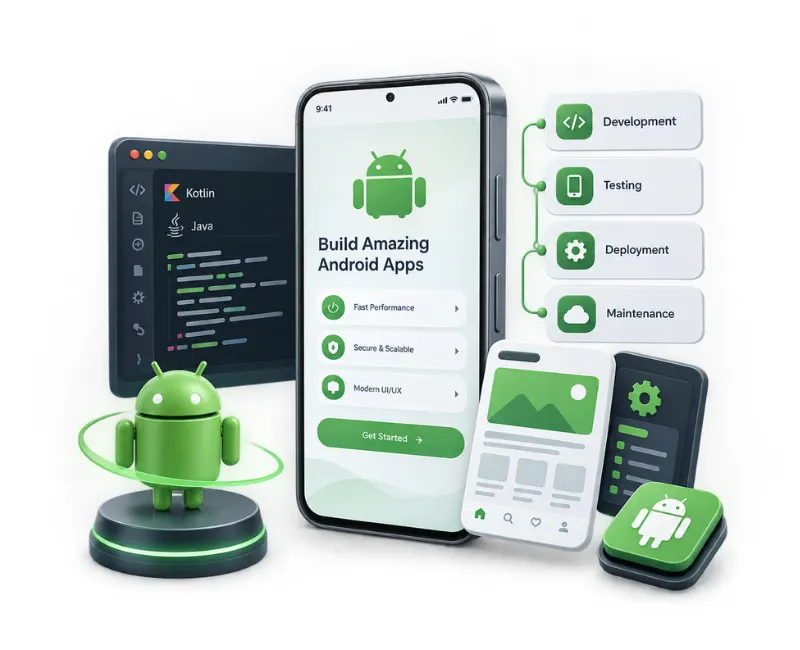
An Android application should solve a defined business or customer problem. The technology comes after the product requirements are understood.
At Falconics, we approach Android app development as a complete product engineering process rather than simply building screens and connecting APIs. We consider how users will interact with the application, what the backend needs to support, how data will move through the system, and how the product can evolve after launch.
Our Android development services can support a new application from the ground up or help improve an existing product that has become difficult to maintain, slow to update, or disconnected from current business requirements.
The result is a mobile product with a clearer technical foundation and a user experience designed for its intended audience.
Every business has different workflows, users, and product requirements. Our custom Android app development approach starts with those requirements rather than forcing your project into a predefined template.
We can develop applications for customer-facing experiences, internal operations, digital products, marketplaces, service businesses, and other mobile-first use cases.
The development scope can include application architecture and feature planning, user authentication and account management, business logic and workflow implementation, API and backend integration, notifications and communication features, payment or transaction functionality where required, data storage and synchronization, analytics and event tracking, and third-party service integrations.
The technology stack is selected according to the application's requirements, expected scale, integration needs, and future roadmap.
A technically capable application can still fail if users struggle to understand or navigate it.
Our Android app UI/UX design focuses on creating interfaces that are intuitive, consistent, and appropriate for the way your customers or employees actually use the application.
The design process may include user flows, information architecture, wireframes, interactive prototypes, visual interface design, navigation structures, responsive layouts for different screen sizes, design systems and reusable components, and usability improvements.
We connect design decisions to the product's purpose, helping ensure that the interface supports important actions instead of simply looking attractive.
For products where Android-specific performance, device capabilities, or platform integration are important, native development can provide greater control over the application environment.
Native Android development can be appropriate for applications requiring high-performance interactions, advanced device functionality, background processing, location-based capabilities, camera or media functionality, Bluetooth or connected-device integration, platform-specific experiences, and detailed control over application behavior.
The right approach depends on the product. We evaluate the requirements before recommending native Android or another development strategy.
An older Android application may still serve an important business function while becoming increasingly difficult to maintain.
Legacy systems can develop technical debt, outdated dependencies, inconsistent interfaces, security concerns, compatibility problems, and performance limitations over time.
Legacy Android app modernization can involve reviewing the existing application architecture, identifying technical debt and maintenance risks, updating outdated components, refactoring problematic code, improving application performance, refreshing the user interface, strengthening security practices, updating integrations, migrating functionality where required, and preparing the application for future development.
The goal is not modernization for its own sake. It is to create a more maintainable foundation while protecting the functionality and business value already present in the application.
Sometimes development is not the first problem to solve.
If you're validating an app idea, choosing between technical approaches, planning an MVP, reviewing an existing application, or deciding how to structure a product roadmap, Android app consulting services can help establish the right direction before development begins.
Consulting may cover product and feature assessment, technical feasibility, MVP planning, architecture considerations, technology selection, integration requirements, development roadmap, modernization planning, performance and scalability considerations, and technical project review.
A well-defined plan can reduce avoidable development work and make later technical decisions easier.
Most business applications need to communicate with systems beyond the mobile device.
We can connect Android applications with APIs, databases, cloud services, payment platforms, authentication systems, analytics tools, CRMs, and other business infrastructure according to project requirements.
Integration planning considers both the Android experience and the systems supporting it, including data flow, authentication, error handling, synchronization, and reliability.
Development does not end when the final feature is coded.
Before release, the application should be tested against its intended functionality, user flows, integrations, performance expectations, and supported devices.
Depending on the project, our delivery process can include functional testing, UI and usability testing, API and integration testing, device and screen-size testing, performance checks, regression testing, release preparation, production deployment support, and post-launch maintenance.
Ongoing application maintenance can then address updates, improvements, bug fixes, compatibility requirements, and new product needs.
A strong Android application should have a measurable business purpose. Depending on your model, that may mean simplifying customer interactions, digitizing internal processes, enabling transactions, or creating an entirely new product channel.
Give customers a convenient mobile channel for purchasing, booking, communicating, managing accounts, accessing services, or interacting with your brand.
Internal Android applications can reduce manual workflows by putting operational tasks, information, approvals, and reporting into a single mobile environment.
An Android application can be the foundation for marketplaces, SaaS products, consumer platforms, on-demand services, and other mobile-first businesses.
Mobile applications can act as an accessible front end for your existing APIs, databases, CRM, ERP, payment infrastructure, or other business systems.
Purpose-built navigation, interaction patterns, and interface design can make important actions easier for users to understand and complete.
A sensible architecture and maintainable codebase make it easier to add features, integrations, and product improvements as requirements change.
We use a structured development process while keeping the scope flexible enough to accommodate the realities of each project.
We begin by understanding the application idea, target users, business objectives, required features, existing systems, and technical constraints.
The outcome is a clearer definition of what needs to be built and what should be prioritized.
Next, we establish the product scope and technical direction.
This can include application architecture, integrations, feature prioritization, technology decisions, data requirements, and an initial development roadmap.
Before development moves too far forward, the core user experience is mapped out.
We define user flows, wireframes, interface elements, navigation, and interaction patterns so the product has a clear experience before engineering work accelerates.
The application is then developed according to the approved scope and technical plan.
Android functionality, backend services, APIs, databases, authentication, third-party integrations, and other required components are connected as part of the broader product.
The application is tested to identify functional issues, interface problems, integration failures, compatibility concerns, and other defects that could affect the user experience.
Issues discovered during testing are addressed before production release.
After launch preparation and deployment, the application can continue to evolve.
Depending on the engagement, ongoing support may include maintenance, technical updates, performance improvements, new functionality, and product enhancements.
Falconics approaches Android development as part of a broader technology ecosystem. This allows an application to be planned with consideration for the systems, platforms, integrations, and digital services surrounding it.
We start with the business problem, users, and desired product outcome before defining the technical implementation.
Your application is shaped around your requirements, workflows, integrations, and audience rather than a generic development package.
UI/UX decisions and technical implementation need to work together. Keeping both considerations aligned helps create an application that is usable as well as technically maintainable.
There is no single technology stack that is appropriate for every Android application. Architecture and development choices should reflect the application's functionality, scale, integrations, and roadmap.
From planning and design through development, testing, launch, and maintenance, the engagement can cover the major stages of the application's lifecycle.
If you're validating a mobile product, Android development can help turn a defined product concept into an MVP that can be tested with real users.
Businesses can use custom Android applications to improve customer service, automate workflows, enable bookings or transactions, and create mobile access to existing services.
Organizations with existing systems may need Android applications that connect employees, customers, field teams, partners, or business operations to their core infrastructure.
Mobile applications can provide dedicated shopping, ordering, account management, notifications, and customer engagement experiences.
Booking, scheduling, field-service, delivery, appointment, and customer-management applications can centralize processes that would otherwise rely on disconnected tools.
If an existing Android product has become difficult to maintain or update, modernization can provide a path toward a more sustainable technical foundation.
Android development can support a wide range of products and business workflows, including e-commerce and mobile shopping, food ordering and delivery, healthcare and appointment platforms, education and learning applications, finance and business applications, travel and booking platforms, logistics and field-service applications, real estate and property applications, customer portals, employee and internal business applications, on-demand service platforms, IoT-connected mobile applications, and subscription or membership products.
The appropriate feature set depends on the users, business model, operational workflow, and systems the application needs to connect with.
Depending on the project scope, deliverables may include requirements and feature documentation, product and technical planning, Android UI/UX designs, application architecture, Android application development, API and backend integration, database and data-flow integration, authentication and user management, third-party integrations, testing and quality assurance, production release support, and technical documentation.
Where relevant, an engagement can also include existing application modernization, performance optimization, additional device integrations, analytics implementation, cloud integration, AI-powered functionality, IoT connectivity, ongoing application maintenance, and feature expansion after launch.
The final deliverables are defined according to the approved project scope rather than a fixed one-size-fits-all package.
Approach: Define the users, business objective, core functionality, technical requirements, and MVP scope before development.
Business direction: Start with the smallest useful product rather than investing immediately in unnecessary functionality.
Approach: Review the architecture, dependencies, codebase, integrations, and known technical problems.
Business direction: Prioritize modernization work that reduces technical risk without disrupting important business functionality.
Approach: Review navigation, user flows, interface hierarchy, interaction patterns, and usability.
Business direction: Improve the experience around the actions that matter most to users and the business.
Approach: Map the required data flows, APIs, authentication, integrations, and system dependencies.
Business direction: Make the mobile application part of your existing technology ecosystem rather than another disconnected system.
Approach: Plan architecture and development around maintainability, clear separation of responsibilities, and future requirements.
Business direction: Build a foundation that can support incremental product development instead of repeatedly rebuilding the application.
There is no reliable single timeline for every Android application.
A basic application with limited screens and straightforward functionality will require considerably less work than a platform involving complex user roles, payments, real-time functionality, third-party integrations, advanced backend systems, or legacy modernization.
The timeline is influenced by the number and complexity of features, UI/UX requirements, backend development, API and third-party integrations, existing codebase condition, number of user roles, security and compliance requirements, device functionality, testing requirements, content and data migration, and changes to scope during development.
A clearer estimate can be provided after the requirements and technical scope have been reviewed.
For clients, the most useful preparation is to have a clear understanding of the target users, business objectives, must-have features, existing systems, and preferred launch priorities.
Android application development pricing depends on the actual scope of work rather than the platform alone.
The major cost factors typically include application complexity, number of features and screens, UI/UX design requirements, backend and API development, third-party integrations, authentication and security requirements, existing application modernization, data migration, testing requirements, ongoing maintenance, project timeline, and development priorities.
Instead of quoting an arbitrary standard price, Falconics can assess the requirements and define the appropriate development scope before proposing an engagement.
The cost depends on the application's features, design requirements, backend, integrations, complexity, testing requirements, and ongoing support. A project-specific estimate is more meaningful than a generic per-app price.
It depends on the product scope. A relatively simple application may require substantially less development time than a complex platform with multiple roles, integrations, payments, real-time features, or an extensive backend.
Yes. Custom Android application development can be structured around your business processes, target users, required functionality, integrations, and long-term product roadmap.
Yes. Legacy Android app modernization can include architecture review, code improvements, dependency updates, interface redesign, performance improvements, integration changes, and other modernization requirements.
Yes. UI/UX can be included as part of the application development process, covering user flows, wireframes, interface design, navigation, and interactive experiences.
It depends on the product. Native Android can be suitable when Android-specific capabilities, performance, or platform control are priorities. Cross-platform development may be appropriate when a product needs to share development across multiple mobile platforms.
The decision should be based on project requirements rather than technology preference alone.
Yes. Android applications can integrate with existing APIs, databases, cloud platforms, CRMs, ERPs, payment systems, authentication services, and other business infrastructure when the required interfaces are available.
Ongoing application maintenance and technical support can be included depending on the engagement. This can cover updates, fixes, compatibility improvements, performance work, and future feature development.
Yes. Android app consulting can help define the product concept, feature priorities, technical requirements, MVP scope, and development direction before full development begins.
The most useful starting information includes your application idea, target users, business objective, required features, existing systems, examples of apps you like, and any technical or launch requirements you already know.
Yes. A well-planned application can be developed incrementally as user needs and business requirements evolve. New features, integrations, performance improvements, and other capabilities can be introduced over time.
Your Android application should have a clear purpose, a usable experience, and a technical foundation that can support the product beyond its first release.
Whether you're starting from an idea, improving an existing application, or planning a larger mobile product, Falconics IT Solutions can help you define the requirements, plan the technology, design the experience, build the application, and support its continued development.
Have an Android app project in mind? Let's discuss what you need to build.
Contact our expert team today for a tailored strategy and free consultation.
Get a Free Consultation