
Ready to transform your business with Enterprise SEO?
Contact our expert team today for a tailored strategy and free consultation.
Get a Free ConsultationNo services available in this category yet.
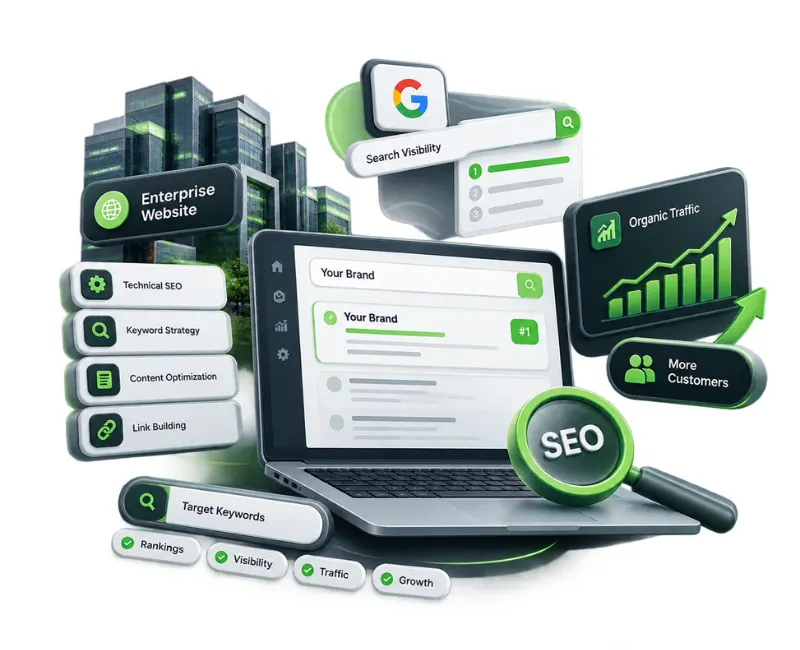
Large websites create SEO challenges that standard optimization approaches often cannot handle efficiently. Thousands of URLs, multiple website sections, complex navigation, overlapping content, technical dependencies, and different stakeholder teams can make organic search difficult to manage.
Falconics IT Solutions provides enterprise SEO designed to bring structure to that complexity. We combine technical SEO, search research, content planning, website architecture, performance analysis, and continuous optimization around the way your business actually operates.
The goal is not simply to optimize more pages. It is to build an SEO framework that can scale with your website, products, markets, and business priorities.
Why enterprise businesses choose this approach:
Enterprise SEO is the process of managing and improving organic search performance across a large or complex digital presence.
Unlike smaller websites, enterprise environments often involve thousands of URLs, multiple content teams, CMS limitations, product or service databases, development teams, regional pages, and competing internal priorities. A change that improves one part of the website can sometimes create problems elsewhere.
That makes enterprise SEO as much about systems and prioritization as individual page optimization.
Falconics approaches the work by examining how your website is structured, how people search for your products or services, where technical barriers exist, and which opportunities deserve attention first.
Technical foundations become increasingly important as website size and complexity grow.
We assess the elements that influence how search engines discover, crawl, understand, and index your website. Depending on the platform and business model, this can include crawl efficiency, indexation, site architecture, canonicalization, redirects, XML sitemaps, internal linking, structured data, duplicate content, URL structures, JavaScript rendering, page performance, and other technical dependencies.
The emphasis is on finding issues that can affect organic search at scale rather than treating every technical issue as equally important.
Where development involvement is required, recommendations can be organized into practical priorities so technical teams can understand what needs to change, why it matters, and how it should be implemented.
Large organizations usually target far more than a small set of high-volume keywords.
Enterprise keyword research needs to connect search behaviour with the actual structure of the business. That means identifying valuable search themes across products, services, categories, locations, use cases, customer needs, and different stages of the buying journey.
We use this research to identify opportunities for existing pages, determine where new content may be justified, and reduce unnecessary overlap between pages targeting similar search intent.
The result is a search strategy that gives your website a clearer role for each important topic rather than simply producing a larger keyword list.
At enterprise scale, publishing more content is not necessarily the answer. The more important question is whether the right content exists, serves a distinct search intent, and supports the broader website structure.
Our enterprise content strategy can address:
Where existing content has potential, improving it may be more valuable than creating another page.
A large website needs a logical relationship between its pages.
We review how important pages are organized, how users and search engines move through the site, and whether internal authority is being distributed effectively. This can reveal orphan pages, excessive page depth, weak category structures, competing URLs, or important commercial pages that receive too little internal support.
Better architecture also helps teams manage future growth. When new products, services, categories, or content are added, the SEO framework should make expansion easier rather than progressively more difficult.
Enterprise SEO often involves more people than an SEO team. Developers, content writers, product managers, designers, marketing teams, and senior stakeholders may all influence the website.
A sustainable strategy therefore needs clear priorities and communication.
Falconics can structure SEO recommendations around defined actions, priorities, performance indicators, and areas of responsibility. This helps turn SEO from a collection of isolated tasks into an ongoing business process.
The exact scope depends on your website, platform, business model, and objectives. A typical engagement can include:
| Area | Typical Scope |
|---|---|
| Technical SEO | Crawling, indexation, architecture, redirects, canonicalization, performance and technical issue analysis |
| Search Research | Keyword research, search intent mapping, opportunity analysis and competitor research |
| On-Page SEO | Metadata, headings, content structure, internal links and page-level optimization |
| Content Strategy | Content gaps, optimization opportunities, topic planning and prioritization |
| Site Architecture | URL structure, category relationships, navigation and internal linking |
| Performance Monitoring | Organic visibility, traffic trends, landing-page performance and priority opportunities |
| Ongoing Optimization | Iterative improvements based on findings, implementation and performance data |
The final deliverables are defined around your website rather than forcing every enterprise client into the same checklist.
We begin with the business model, target audiences, products or services, website technology, existing SEO performance, competitors, and commercial priorities.
This creates the context needed to distinguish strategic problems from low-impact technical details.
The website is assessed across technical SEO, content, architecture, search demand, internal linking, and competitive opportunities.
Findings are then prioritized according to potential impact, implementation complexity, dependencies, and business relevance.
Instead of producing a long list of disconnected recommendations, we organize the findings into an actionable roadmap.
The roadmap can cover immediate technical improvements, content opportunities, structural changes, development requirements, and longer-term optimization.
SEO recommendations are implemented through the appropriate workflows. Where changes require development, content, design, or other teams, the work can be coordinated around clearly defined requirements.
This is particularly important for enterprise websites where SEO changes may affect multiple systems or sections.
SEO does not end when the initial recommendations are implemented.
Performance is reviewed continuously to identify emerging opportunities, technical issues, content priorities, and areas where the strategy needs to change. The roadmap can then evolve as the website and business evolve.
A well-structured enterprise SEO program can support several areas of digital performance.
Greater organic coverage comes from identifying valuable search demand across the breadth of your products, services, categories, and customer needs.
A stronger technical foundation can make it easier for search engines to crawl and understand a large website while reducing avoidable SEO obstacles.
Better use of existing content helps prevent valuable pages from being overlooked while reducing unnecessary duplication and content overlap.
More efficient SEO execution comes from prioritizing actions rather than allowing teams to spend equal effort on issues with very different levels of importance.
Stronger alignment between SEO and business priorities ensures organic search work supports commercially meaningful areas instead of focusing only on rankings and traffic.
Enterprise SEO is particularly useful for organizations with large websites, substantial content portfolios, multiple product or service categories, or complex technical environments.
It can be a strong fit for:
A website does not need to have a particular number of pages to benefit from enterprise thinking. Complexity, organizational structure, technical dependencies, and growth plans can matter just as much as page count.
Enterprise websites often accumulate SEO issues gradually rather than through one obvious failure.
Typical challenges include:
The solution is rarely one isolated optimization. It is usually a combination of diagnosis, prioritization, implementation, and ongoing control.
Falconics brings SEO together with broader digital and technology capabilities, including web development, analytics, AI and automation, ecommerce, software, and digital marketing. That broader technical environment can be useful when enterprise SEO work depends on more than content or metadata changes.
Our approach starts with understanding the business and its digital environment before recommending execution. We focus on practical priorities, measurable performance, and continuous optimization rather than treating SEO as a fixed checklist.
For organizations managing complex websites, having marketing and technology capabilities available within the same partner ecosystem can also simplify coordination when SEO recommendations involve development, analytics, automation, or website improvements.
Enterprise SEO pricing is determined by the actual scope of work rather than a fixed package.
Factors can include website size, technical complexity, number of templates or business units, geographic or product coverage, content requirements, existing SEO condition, implementation responsibilities, competition, and the level of ongoing support required.
After understanding the website and objectives, the engagement can be structured around the priorities that matter most instead of paying for a standardized list of activities that may not apply to your business.
Enterprise SEO is a continuous process, and the pace of progress depends on factors such as website condition, implementation speed, competition, authority, content quality, technical changes, and the resources available to execute recommendations.
Meaningful improvements may require multiple cycles of auditing, implementation, measurement, and refinement. No responsible SEO provider should guarantee a specific ranking, traffic level, lead volume, or revenue outcome.
The strongest enterprise programs are built around a clear roadmap and the ability to keep improving as evidence accumulates.
Enterprise SEO is an SEO approach designed for large, complex, or highly structured websites. It combines technical SEO, search research, content strategy, information architecture, internal linking, measurement, and scalable execution.
The fundamentals are similar, but enterprise SEO has greater emphasis on scale, technical dependencies, website architecture, governance, prioritization, and coordination across teams. A change may affect hundreds or thousands of pages, so execution needs to be more controlled.
Large ecommerce sites, SaaS platforms, B2B organizations, established brands, multi-location businesses, and websites with extensive product, service, or content sections can benefit from an enterprise approach.
Yes. Technical SEO is usually a significant part of enterprise SEO because large websites can have complex crawling, indexing, architecture, rendering, performance, and URL-management requirements.
Yes. Enterprise SEO often requires coordination with internal developers, content teams, marketing managers, and other stakeholders. The engagement can be structured around the resources and responsibilities already available within your organization.
Content strategy can form part of the engagement. This may include identifying content gaps, improving existing pages, mapping search intent, prioritizing topics, and strengthening relationships between related pages.
There is no universal timeline. The duration and pace depend on website complexity, technical requirements, implementation resources, competition, content needs, and the starting condition of the site. Enterprise SEO is generally an ongoing optimization program rather than a one-time task.
Yes. Enterprise ecommerce SEO can address large product catalogs, category structures, faceted navigation, internal linking, indexation, duplicate URLs, product content, and other challenges associated with large online stores.
Pricing depends on the scope and complexity of the engagement. Website size, technical requirements, content needs, number of sections or markets, competition, and ongoing support requirements can all influence the final scope.
An initial discussion typically helps establish your business goals, website, target audiences, current challenges, technical environment, and available resources. From there, the appropriate SEO scope and priorities can be defined.
Enterprise SEO works best when strategy, technology, content, and implementation move in the same direction.
If your website has become too complex for a conventional SEO checklist, Falconics IT Solutions can help assess the current structure, identify the highest-priority opportunities, and build an enterprise SEO roadmap around your business objectives.
Contact our expert team today for a tailored strategy and free consultation.
Get a Free Consultation