
Ready to transform your business with DevOps?
Contact our expert team today for a tailored strategy and free consultation.
Get a Free ConsultationNo services available in this category yet.
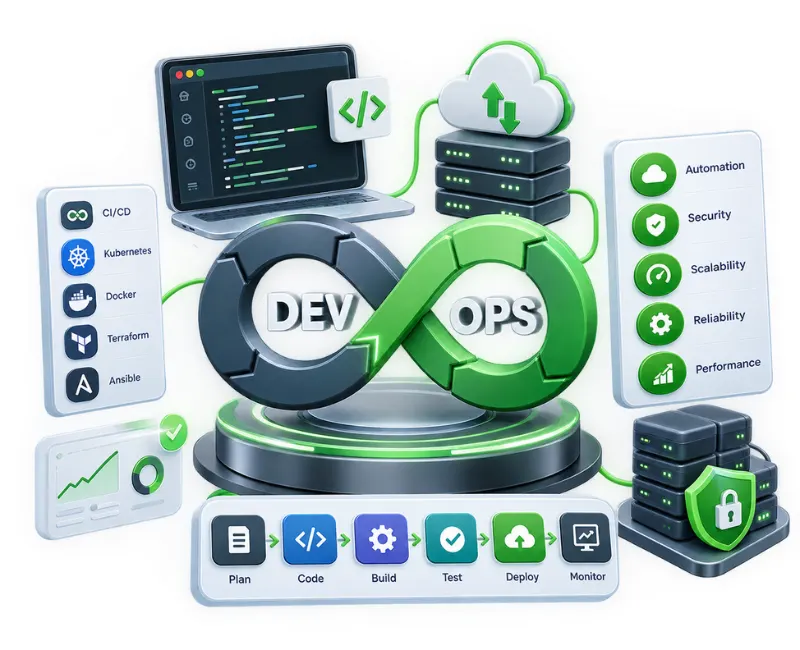
Software development becomes harder to manage when deployments are manual, infrastructure is inconsistent, and development teams spend too much time dealing with operational tasks.
FalconicsIT helps businesses build a more efficient DevOps environment through CI/CD automation, infrastructure management, deployment automation, monitoring and scalability-focused solutions. Our approach is designed around your existing technology, application requirements and operational priorities.
DevOps is not simply about adding automation tools to an existing environment. The right approach connects development, infrastructure, deployment and operations so software can move from development to production in a more controlled and repeatable way.
FalconicsIT works across the areas that have the greatest operational impact, from improving deployment workflows to managing infrastructure and monitoring production environments.
The exact scope can be adapted to your existing architecture, technology stack and business requirements rather than forcing a fixed DevOps package.
A well-designed CI/CD pipeline reduces the dependency on manual build, testing and deployment processes.
We can help structure automated workflows that move code through development, testing and deployment with appropriate checks at each stage. This creates a more consistent release process and gives development teams greater visibility into what happens between code changes and production.
Depending on the environment, the implementation can include pipeline configuration, automated testing workflows, build automation, deployment workflows and release controls.
Application performance depends heavily on how the underlying infrastructure is designed, configured and maintained.
Our DevOps approach can support cloud and infrastructure environments by improving provisioning, configuration consistency, resource management and deployment processes. Infrastructure automation can also make it easier to reproduce environments and reduce dependency on manual configuration.
The objective is practical: infrastructure should support the application without becoming an operational bottleneck.
Manual deployments can introduce avoidable errors and make releases difficult to repeat consistently.
FalconicsIT helps businesses automate deployment workflows so application releases can follow defined processes instead of relying on individual team members to perform repetitive tasks manually.
Where appropriate, deployment automation can also support controlled releases, environment-specific configurations and rollback procedures.
Automation alone does not solve production problems if your team cannot see what is happening after deployment.
Monitoring and observability provide visibility into application behaviour, infrastructure health and operational events. This helps teams identify issues earlier, investigate incidents more effectively and understand where performance or reliability problems are occurring.
The monitoring approach should be aligned with the application rather than creating dashboards that generate information without useful operational context.
Growing applications often place greater demands on infrastructure, deployment processes and operational teams.
DevOps practices can help create environments that are easier to scale and maintain as workloads change. This may involve infrastructure automation, deployment improvements, monitoring, resource management and architecture-level adjustments.
The right solution depends on your application's workload, existing infrastructure and expected growth rather than simply adopting more technology.
Security should be considered throughout the software delivery process rather than treated as a separate task at the end of development.
Where required, DevOps workflows can incorporate security checks, access controls, configuration reviews and other safeguards into development and deployment processes.
This helps teams identify potential issues earlier while keeping security considerations closer to the systems and workflows where changes are being made.
The value of DevOps is ultimately measured by how much easier it becomes to build, release and operate software.
For the right business and technical environment, a structured DevOps implementation can help with:
Every DevOps environment has different constraints. A startup launching its first production application may need a very different setup from an established business managing multiple applications and environments.
Our approach therefore starts with understanding the existing technology and identifying the areas where automation or infrastructure improvements can provide the most practical value.
1. Assess
We review the current development, deployment and infrastructure environment to understand existing workflows, bottlenecks and operational requirements.
2. Plan
The findings are translated into a practical DevOps roadmap covering the improvements that should be implemented first.
3. Implement
Required automation, infrastructure, deployment and monitoring components are configured around the agreed technical requirements.
4. Validate
Workflows and environments are tested to ensure that automation behaves as intended and integrates appropriately with existing systems.
5. Optimize
Once the environment is operating, further improvements can be identified around reliability, scalability, efficiency and maintainability.
DevOps is a methodology rather than a single software product. The technology stack should therefore be selected according to the application's requirements and the team's existing environment.
Depending on the project, DevOps environments may involve technologies for:
The goal is not to introduce the largest possible toolset. It is to create a technology environment that your team can actually operate and maintain.
Startups and growing technology businesses can establish reliable deployment and infrastructure practices before operational complexity becomes difficult to manage.
Software and SaaS companies can use automation to support frequent releases while maintaining greater consistency across environments.
E-commerce businesses can prepare applications and infrastructure for changing workloads, frequent updates and periods of increased demand.
B2B and enterprise applications can benefit from standardized deployment, infrastructure management and stronger operational visibility across complex environments.
Businesses modernizing legacy environments can use DevOps practices as part of a broader effort to improve deployment processes, infrastructure management and application scalability.
DevOps becomes particularly valuable when technology teams begin encountering operational friction.
Common situations include:
Rather than applying the same solution to every situation, the appropriate DevOps approach depends on which of these problems is affecting your business and why.
The final deliverables depend on the scope of the engagement, but a project may include elements such as:
| Area | Potential Deliverables |
|---|---|
| DevOps assessment | Current-state review, technical findings and improvement priorities |
| CI/CD | Pipeline configuration, build automation and deployment workflows |
| Infrastructure | Infrastructure configuration, automation and environment management |
| Deployment | Automated release workflows and deployment processes |
| Monitoring | Monitoring setup, alerts and operational visibility |
| Scalability | Infrastructure and deployment improvements aligned with workload requirements |
| Documentation | Relevant technical documentation and operational guidance |
Not every project requires every component. The scope should reflect the application's architecture, existing tools and business priorities.
DevOps requirements can range from a focused implementation to ongoing infrastructure and automation support.
For a defined requirement, FalconicsIT can work around a project-based scope with clear technical objectives and deliverables.
For businesses that need continuing assistance, DevOps support can be structured around ongoing infrastructure, deployment, monitoring and optimization requirements.
Where the technical direction is still unclear, a consultation or assessment can be a sensible starting point before committing to a larger implementation.
DevOps pricing depends on the scope and technical complexity of the environment rather than a standard one-size-fits-all rate.
Factors that can influence the engagement include the number of applications and environments, existing infrastructure, cloud architecture, CI/CD requirements, automation complexity, monitoring needs, security requirements and the level of ongoing support required.
A focused pipeline automation project will naturally have different requirements from a broader cloud infrastructure or application modernization initiative.
There is no universal timeline for DevOps implementation.
A focused CI/CD or deployment automation project may be considerably simpler than a broader initiative involving cloud infrastructure, application architecture, monitoring, security and multiple environments.
The timeline can also depend on the condition of the existing infrastructure, application complexity, access to technical information and how much work needs to be integrated with existing development processes.
DevOps should be treated as an engineering improvement process, not a promise of instant results. Meaningful progress depends on implementing the right changes and giving teams enough time to validate and adopt new workflows.
FalconicsIT approaches DevOps as part of the wider technology environment rather than as an isolated automation exercise.
Our technology services span areas including software development, AI and automation, IT infrastructure and cloud-related solutions. This broader technical context can be useful when DevOps requirements overlap with application development, infrastructure or modernization work.
We focus on practical implementation, clear technical priorities and solutions that fit the business rather than recommending technology simply because it is available.
The engagement can also be shaped around your current environment, whether you need a specific automation improvement or broader DevOps support.
DevOps services help businesses improve how software is developed, tested, deployed and operated. They can include CI/CD automation, infrastructure management, deployment automation, monitoring, scalability improvements and related operational practices.
A DevOps service provider evaluates the existing development and infrastructure environment, identifies operational bottlenecks and implements appropriate automation, deployment, infrastructure and monitoring improvements.
No. DevOps can be useful for startups, SMEs, software companies and larger organizations. The scope should match the size, architecture, release frequency and operational requirements of the business.
Yes. DevOps improvements do not necessarily require replacing an existing technology stack. The first step is to understand the current environment and determine which components can be improved, automated or integrated.
Yes. CI/CD and deployment automation can replace repetitive manual steps with standardized workflows. The level of automation depends on the application, infrastructure and release process.
It can. Cloud infrastructure management may include environment configuration, infrastructure automation, resource management, deployment processes and scalability improvements, depending on the project's requirements.
DevOps can support scalability by improving infrastructure automation, deployment processes, monitoring and resource management. However, scalability also depends on the application's architecture and workload characteristics.
The timeline depends on the scopeThere is no single price because DevOps projects vary. A focused automation project may be relatively straightforward, while cloud modernization, multi-environment infrastructure or broader DevOps transformation requires more planning and implementation.
Ongoing support can be structured around the requirements of the business, including infrastructure management, deployment workflows, monitoring, troubleshooting and continued optimization.
There is no single price because DevOps projects vary significantly in scope and complexity. The cost is influenced by infrastructure, applications, environments, automation requirements, security needs and ongoing support.
Start with a discussion about your current development workflow, infrastructure and the problems your team is experiencing. From there, the appropriate scope and implementation priorities can be identified.
Whether you need to automate deployments, improve infrastructure management, strengthen monitoring or create a more scalable software delivery process, the right starting point is understanding your current environment.
Talk to FalconicsIT about your DevOps requirements and identify the technical improvements worth implementing first.
Contact our expert team today for a tailored strategy and free consultation.
Get a Free Consultation