
Ready to transform your business with iOS App Development?
Contact our expert team today for a tailored strategy and free consultation.
Get a Free ConsultationNo services available in this category yet.
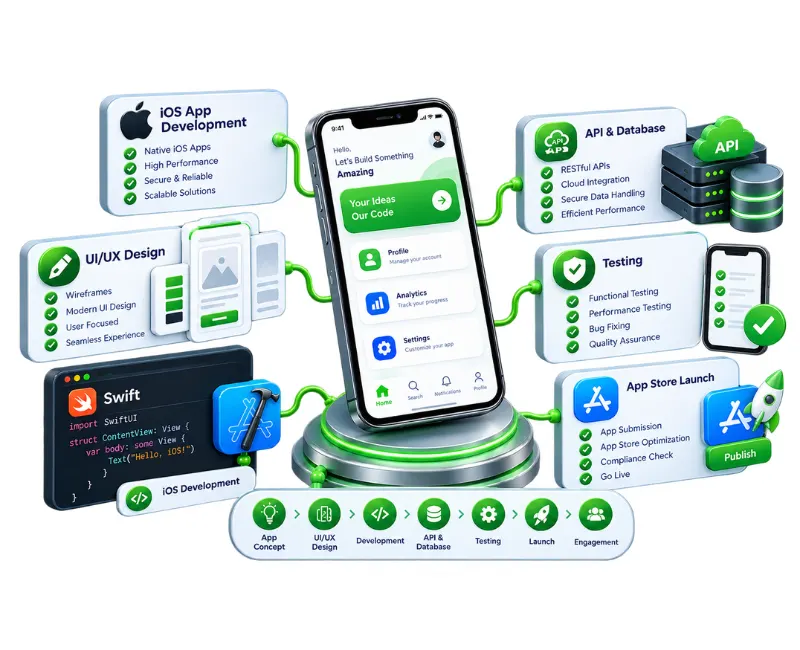
Turn your product idea, business workflow or existing application into a well-engineered iOS experience designed for real users and practical business requirements.
Falconics IT develops custom iOS applications for startups, growing businesses and established organizations that need more than a basic mobile interface. We focus on clear product requirements, intuitive experiences, reliable engineering and an architecture that can support future changes.
A successful iOS application is not simply a set of screens converted into mobile form. It needs a clear product structure, intuitive navigation, dependable backend communication, appropriate security controls and careful testing across supported devices and operating-system versions.
Our iOS application development approach brings these considerations together from the beginning. Whether you are launching a new product, extending an existing web platform to mobile or modernizing an older application, the scope is planned around what the app needs to accomplish.
The result is an application built around your users and business workflows rather than a collection of disconnected features.
Falconics IT can support the complete development lifecycle or specific stages of an iOS project, depending on your requirements.
Product Planning & Technical Consulting
Before development starts, we clarify the application's purpose, target users, essential features, integrations and technical requirements. This helps establish a practical scope and provides a clearer direction for design and development.
iOS UI/UX Design
The interface is planned around mobile usability, navigation, accessibility and the way users complete tasks on an Apple device. Wireframes, user flows and visual interfaces can be developed before implementation so important experience decisions are made early.
Native iOS Application Development
We build custom iOS applications around the approved product requirements, architecture and user experience. Development can include application logic, user accounts, notifications, location-based functionality, media, device capabilities and other features relevant to the product.
API & Third-Party Integrations
An iOS application often needs to communicate with existing business systems. We can integrate APIs, databases, payment services, authentication systems, cloud services, CRM platforms and other required technologies so the app fits into the wider technology environment.
iOS App Testing & Quality Assurance
Testing covers functionality, usability, performance, compatibility and common failure scenarios. The objective is to identify issues before release and provide a stable experience across the supported Apple device and OS combinations.
App Store Deployment
A finished application still needs to be prepared for distribution. The release process can include production configuration, app metadata, certificates, provisioning, privacy requirements, submission preparation and release support.
iOS App Maintenance & Enhancement
Post-launch requirements rarely remain static. Existing applications can be maintained, updated for newer platform requirements, improved for performance and extended with new functionality as the product develops.
The value of an iOS application depends on how effectively it solves a genuine customer or operational problem.
A thoughtfully developed app can help businesses:
The right outcome is not necessarily a larger feature list. In many projects, a focused application that makes a few important tasks significantly easier is more valuable than an overloaded product.
The application architecture and feature set should reflect how the business operates.
For startups and new products, the priority may be validating an idea with a focused first release that can evolve as user feedback becomes available.
For ecommerce and D2C businesses, an iOS app can bring product discovery, accounts, carts, payments, order tracking, notifications and customer engagement into a dedicated mobile channel.
For service businesses, applications can support bookings, customer requests, payments, location-based services, notifications and communication.
For B2B and enterprise organizations, mobile applications can provide employees, partners or customers with access to dashboards, approvals, field workflows, documents, CRM data and operational systems.
For existing digital businesses, an iOS application can extend an established website or web application into a more convenient mobile experience without rebuilding the entire technology ecosystem from scratch.
01 — Discovery & Requirements
We begin by understanding the business objective, target users, core workflows, existing systems and technical constraints. The result is a clearer definition of what the application needs to accomplish.
02 — Product & UX Planning
User journeys, information architecture, functionality and interface requirements are mapped before development. This reduces ambiguity and helps prioritize the features that matter most.
03 — UI Design & Development
Approved designs are translated into the iOS application, with the frontend, application logic and required backend connections developed according to the agreed scope.
04 — Integration & Testing
The application is connected with relevant APIs and services, followed by functional, usability, performance and compatibility testing.
05 — Deployment & Launch
The production build is prepared for App Store distribution, release requirements are addressed and the application is moved toward launch.
06 — Improvement & Support
After release, performance and user feedback can inform future fixes, enhancements and new versions.
Falconics IT approaches mobile development as part of a broader digital and technology environment rather than treating the app as an isolated product.
Our wider capabilities across web development, software, AI, analytics and digital growth can be useful when an iOS application needs to connect with existing digital systems or support a larger business objective.
The development process is built around understanding the requirement first, selecting an appropriate technical approach and then moving through execution, testing and refinement. This keeps technical decisions connected to the purpose of the product.
Where a project requires additional technology capabilities, the broader Falconics IT service ecosystem can also support the surrounding digital infrastructure.
The exact scope depends on the application, but a typical engagement may include:
The final deliverables are defined according to the project's requirements rather than a fixed feature package.
Many businesses approach development with a clear idea but an uncertain technical path. Common challenges include an unclear MVP scope, disconnected systems, outdated applications, difficult user journeys or the need to bring an existing digital product to iOS.
The development process helps translate these requirements into a structured product plan, identify dependencies early and establish a technical foundation that can accommodate future changes.
For an existing app, the focus may instead be modernization, performance improvement, compatibility updates or adding new capabilities without unnecessarily rebuilding stable parts of the product.
There is no reliable single timeline for every iOS application.
A relatively focused application with defined requirements can move through planning and development more quickly than a product involving multiple user roles, complex backend systems, payments, real-time functionality, extensive integrations or enterprise workflows.
The timeline is influenced by factors such as:
A clear scope at the beginning generally makes planning, estimation and development more predictable.
iOS app development pricing is determined by the requirements of the individual project rather than a standard package price.
Important factors include application complexity, number of screens and workflows, design requirements, backend development, integrations, security requirements, device capabilities, testing scope and ongoing maintenance.
A basic business application and a complex marketplace, enterprise platform or transaction-heavy application can therefore have very different development requirements.
For an accurate estimate, the most useful starting point is a discussion of the product idea, required features, existing technology and expected user journey.
iOS development can be a strong fit when your customers, employees or business operations would benefit from a dedicated Apple-device experience.
It is particularly relevant for startups validating a mobile product, businesses extending an existing web platform, ecommerce brands building a direct customer channel, service businesses requiring mobile workflows and organizations digitizing internal or field operations.
If you already have an Android application or web platform, an iOS version can also provide a dedicated experience for users who access your product through Apple devices.
iOS app development is the process of designing, building, testing and deploying applications for Apple's mobile platform. Depending on the project, it can include UI/UX design, application development, backend integration, testing, App Store deployment and ongoing maintenance.
There is no fixed cost because the scope varies significantly between applications. Features, design complexity, integrations, backend requirements, testing and ongoing support all influence the final project cost.
The timeline depends on the product's complexity, feature set, integrations, design requirements and approval cycles. A focused application generally requires less development effort than a feature-rich or enterprise application.
Yes. Custom iOS applications can be developed around specific business processes, customer journeys, product requirements and technology environments rather than relying on a generic app structure.
Yes. An iOS application can connect with existing APIs, databases, authentication systems, payment services, CRM platforms and other business software when the required integration interfaces are available.
Yes. Existing applications can be assessed for UI improvements, performance issues, compatibility requirements, architectural changes and new functionality. The appropriate approach depends on the condition and structure of the current application.
App Store release preparation can be included in the development scope. This may involve production configuration, release assets, certificates, provisioning, privacy-related requirements and submission preparation.
Payment integration can be developed when it is appropriate for the application's business model and requirements. The specific implementation depends on the payment provider, transaction flow and applicable platform requirements.
Yes. Maintenance can cover fixes, compatibility updates, performance improvements, security-related updates and additional features, depending on the agreed support arrangement.
A useful starting point is your business objective, target users, core features and any existing website, application, API or software that the iOS app needs to work with. If the requirements are still being defined, the initial discussion can focus on shaping the scope.
Whether you are starting with an idea, extending an existing product or improving an established iOS application, the first step is understanding what the product needs to achieve.
Share your requirements with Falconics IT and discuss the right development approach, feature scope and technical direction for your iOS application.
Contact our expert team today for a tailored strategy and free consultation.
Get a Free Consultation