
Ready to transform your business with Technical SEO?
Contact our expert team today for a tailored strategy and free consultation.
Get a Free ConsultationNo services available in this category yet.
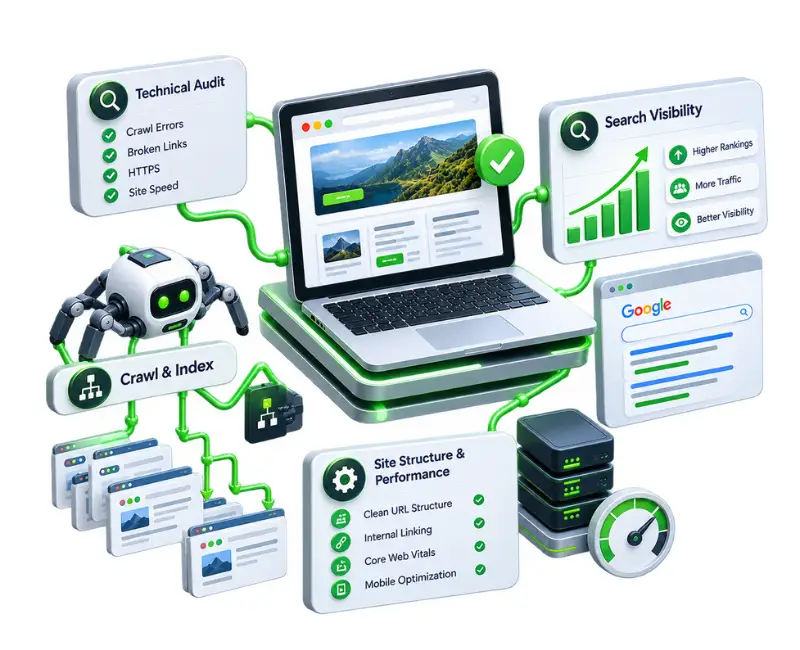
A website can have strong content and a well-planned SEO strategy, yet still struggle when technical issues prevent search engines from properly accessing or understanding its pages.
Falconics IT provides Technical SEO services focused on the underlying structure and performance of your website. We examine how your site is crawled, indexed, rendered and experienced across devices, then prioritize improvements based on their potential business and search impact.
From technical SEO audits and crawlability to page speed, structured data and website architecture, the goal is simple: remove avoidable technical barriers and give your broader SEO strategy a reliable foundation.
Technical SEO deals with the parts of a website that influence how search engines discover, process and interpret its content. Much of this work happens behind the visible interface, but its effects can influence both search visibility and user experience.
Depending on the website, Technical SEO may involve crawling and indexing controls, URL structures, canonicalization, redirects, XML sitemaps, robots.txt, JavaScript rendering, site speed, mobile usability, structured data, HTTPS and internal website architecture.
The right priorities depend on the website rather than a fixed checklist. A small business website, ecommerce store and large content platform can have very different technical requirements.
A technical SEO audit provides a structured view of what may be preventing a website from being efficiently crawled, indexed or experienced.
We assess the website architecture and identify issues such as broken links, redirect problems, duplicate or conflicting signals, indexation issues, crawl inefficiencies, missing technical elements and other structural concerns.
The outcome is more than a list of errors. Findings can be organized by importance so your development and marketing teams can understand what needs attention first.
Search engines need to discover the right pages and determine which versions should be included in their index.
Falconics IT reviews elements such as XML sitemaps, robots.txt directives, internal links, status codes, canonical signals and indexation patterns. For larger websites, we also consider how website architecture and unnecessary URLs can make crawling less efficient.
The objective is to help search engines reach important content while reducing technical signals that create confusion or waste crawling resources.
A clear website structure helps both visitors and search engines understand how different pages relate to one another.
We review URL patterns, navigation, internal linking and page hierarchy to identify structural weaknesses. Where necessary, recommendations can be made to create a more logical relationship between important pages, categories and supporting content.
This becomes particularly valuable for ecommerce websites, large corporate websites and businesses that continuously add new pages.
Website performance is both a usability concern and an important part of technical website quality.
Technical SEO work can examine issues involving oversized resources, inefficient scripts, excessive requests, redirects, caching, image delivery, server response and other factors that affect loading and interaction.
Rather than optimizing a speed score in isolation, the focus should be on practical improvements that make important pages faster and more usable without compromising functionality.
A technically sound website needs to work effectively across the devices used by its audience.
We evaluate mobile presentation, responsive behaviour, usability and important technical differences between mobile and desktop experiences. This can help identify situations where content, navigation, resources or functionality perform differently across devices.
For businesses receiving significant mobile traffic, these checks are an important part of maintaining a consistent search and user experience.
Structured data provides search engines with additional context about eligible content on a page.
Where appropriate, we can review and implement relevant schema markup for elements such as organizations, products, services, breadcrumbs and other supported content types.
The purpose is not to add schema simply for the sake of adding code. Markup should accurately represent the content on the page and follow relevant search-engine requirements.
Technical SEO also overlaps with important page-level signals that help search engines interpret individual URLs.
Depending on the project, our review may cover title and meta information, canonical tags, heading structure, indexation directives, image attributes, internal links, pagination and other HTML or technical elements.
These details are considered within the wider site structure rather than treated as isolated SEO tasks.
Secure connections and correctly configured redirects are fundamental parts of a healthy website.
We look for issues such as insecure resources, incorrect HTTP-to-HTTPS handling, redirect chains, redirect loops and inconsistent URL versions. Resolving these problems can help maintain cleaner technical signals and prevent unnecessary user or crawler friction.
A Technical SEO engagement is designed to give your website a clearer technical foundation and a practical path for improvement.
Depending on the agreed scope, the engagement can include:
The exact deliverables depend on the size, platform, condition and objectives of the website.
Technical problems are often not obvious from the front end of a website. A site may look perfectly functional to a visitor while search engines encounter very different issues.
Common examples include:
The priority is to distinguish genuine SEO problems from issues that have little practical impact, so effort is spent where it matters.
1. Understand the website
We begin by reviewing the website, business objectives, platform, audience, existing SEO setup and any known technical concerns.
2. Audit and diagnose
The website is examined from a technical SEO perspective to identify crawl, indexing, performance, architecture and implementation issues.
3. Prioritize the findings
Not every technical issue deserves the same level of attention. Findings are evaluated according to factors such as search impact, affected pages, implementation complexity and business importance.
4. Implement or guide improvements
Depending on the engagement, recommendations can be implemented directly or provided to your developers with clear technical direction.
5. Monitor and refine
After key changes are made, technical signals and website performance can be reviewed again to identify remaining issues and new opportunities.
This approach keeps Technical SEO connected to the wider business objective instead of turning it into an endless checklist of minor technical fixes.
Falconics IT brings SEO together with web development, technology, analytics and digital marketing capabilities. That matters when a technical SEO recommendation requires more than an SEO platform or report and needs to be understood from a development perspective.
Our approach is built around understanding the business and website first, then identifying the technical changes that are genuinely relevant to the project.
Because Falconics works across SEO, web development, analytics and technology, technical issues can be considered within the broader digital ecosystem rather than in isolation.
The focus is on clear recommendations, practical execution and continuous improvement rather than promising rankings that no SEO provider can responsibly guarantee.
Technical SEO can be useful for businesses at different stages, particularly when a website has grown in size or complexity.
Growing businesses and SMEs can use technical SEO to establish a clean foundation before website issues become harder to resolve.
Ecommerce businesses often need deeper attention to product URLs, categories, filters, pagination, duplicate pages, structured data and large-scale indexation.
B2B and professional service companies can benefit when important service and solution pages are difficult for search engines to discover or when technical issues are limiting organic performance.
Larger websites and established businesses may require ongoing technical monitoring as new sections, technologies and pages are introduced.
Businesses undergoing a website migration or redesign should consider technical SEO before and during the transition to reduce the risk of losing existing search signals.
A website redesign or platform migration can introduce technical SEO risks even when the new website looks better.
URL changes, redirects, altered page structures, canonical tags, internal links, sitemap changes and indexation settings all need to be considered before launch.
Technical SEO can therefore be integrated into the migration process rather than treated as a post-launch repair exercise.
Technical SEO pricing depends on the actual scope of the website rather than a universal package price.
Factors can include website size, number of URLs, platform and CMS, ecommerce functionality, technical complexity, number of domains or subdomains, existing issues, migration requirements and whether implementation is included.
A focused audit for a smaller website will naturally require a different level of work from an ongoing technical SEO engagement for a large ecommerce or enterprise platform.
Falconics IT can determine the appropriate scope after understanding the website and its objectives.
Technical SEO is not a one-time switch that guarantees a specific ranking position.
The time required depends on website size, issue severity, development resources, implementation complexity and the number of changes involved. Some improvements can be addressed quickly, while architectural or development-related issues may require more planning.
Technical improvements also work alongside content quality, authority, relevance, competition and other SEO factors. Resolving technical problems creates a stronger foundation, but it does not guarantee a particular traffic or ranking outcome.
If your website has indexing issues, slow pages, inconsistent URLs, crawl problems or technical SEO concerns that are difficult to diagnose, the next step is to understand what is actually holding the site back.
Falconics IT can assess your website, identify the highest-priority technical opportunities and help establish a practical path forward.
Technical SEO is the process of improving the technical structure and performance of a website so search engines can efficiently crawl, understand and index its content. It can include areas such as website architecture, indexation, page speed, mobile performance, redirects, canonicalization, structured data and technical security.
A technically weak website can make it harder for search engines to discover, process or correctly interpret important pages. Technical SEO helps remove structural and performance-related barriers that can interfere with broader SEO efforts.
An audit can examine crawling, indexation, URLs, redirects, canonical tags, sitemaps, robots.txt, internal linking, website architecture, page performance, mobile usability, structured data and other technical signals. The exact audit scope depends on the website.
There is no universal timeline. A smaller website with a limited number of issues may require relatively focused work, while large or technically complex websites can require multiple stages of analysis, implementation and monitoring.
Technical SEO can address issues that interfere with crawling, indexing, rendering, usability and website quality. However, rankings also depend on content, relevance, authority, competition and other SEO factors, so responsible Technical SEO providers should not guarantee specific ranking positions.
No. Smaller websites can also have technical issues that affect search visibility. The difference is usually the scale and complexity of the work required.
Implementation depends on the agreed project scope and the nature of the required changes. Where development work is involved, recommendations can also be coordinated with the website's technical team.
Yes. Ecommerce websites often have additional technical considerations involving product variations, categories, filters, pagination, duplicate URLs, structured data, internal linking and indexation. Technical SEO can help establish clearer signals across large numbers of pages.
Ideally, technical SEO should be considered before and during a redesign or migration. Planning redirects, URL structures, indexation, internal links and other SEO signals early can reduce avoidable problems after launch.
Pricing depends on factors such as website size, platform, technical complexity, number of URLs, current issues, migration requirements and whether implementation or ongoing support is required. A suitable scope can be determined after reviewing the website.
Start with a website assessment or consultation. The initial review can help determine the site's current technical condition, identify priority concerns and establish the most appropriate scope of work.
Contact our expert team today for a tailored strategy and free consultation.
Get a Free Consultation