
Ready to transform your business with SaaS Development?
Contact our expert team today for a tailored strategy and free consultation.
Get a Free ConsultationNo services available in this category yet.
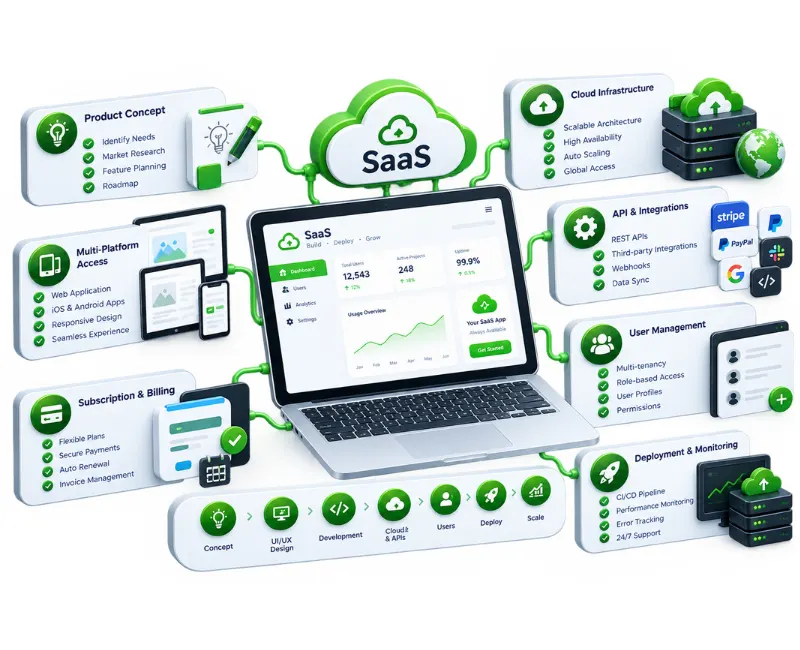
Build a SaaS product that is practical to launch, reliable for users, and structured to evolve as your business grows. Felconics IT helps startups, SMEs, product companies, and established businesses turn SaaS ideas into functional digital products or improve existing platforms.
From product planning and interface development to backend engineering, APIs, cloud infrastructure, testing, and post-launch support, the engagement can be shaped around the stage and technical requirements of your product.
SaaS development is more than building a web application. A successful SaaS product needs an architecture that can support multiple users or organisations, reliable data handling, appropriate access controls, integrations, billing or subscription workflows where required, and an interface that remains usable as the product becomes more capable.
Felconics IT approaches development around the actual product requirements rather than starting with a fixed technology stack. The objective is to create a foundation that supports the first release without making future changes unnecessarily difficult.
Whether you have a validated product concept, an MVP requirement, an existing application that needs modernization, or a SaaS platform that requires additional functionality, the development scope can be tailored accordingly.
For businesses starting a new SaaS product, development begins by translating the product requirements into a workable technical structure. This includes defining application workflows, user roles, core functionality, interfaces, data requirements, and integration needs.
Development can cover both the customer-facing application and the backend systems that power it, including authentication, business logic, APIs, databases, administrative functionality, and third-party integrations.
The result is not simply a collection of features, but a connected application designed around how customers will actually use the product.
An MVP should answer important product questions without unnecessarily building everything at once.
Felconics IT can help define and develop a focused first version containing the functionality needed to test the product concept and gather meaningful user feedback. The architecture can be planned so that validated features can be expanded rather than discarded when the product evolves.
This approach is particularly useful for startups and businesses entering a new software category where product requirements are expected to change after real-world usage.
Architecture decisions have a direct impact on how easily a SaaS application can handle increasing users, data, integrations, and operational requirements.
The development approach can account for areas such as:
The appropriate architecture depends on the product rather than following a one-size-fits-all model. A smaller SaaS product may require a simpler foundation, while a more complex platform may need stronger separation between services, workloads, or tenants.
A technically capable SaaS product can still struggle if users cannot understand how to navigate it.
The frontend development process focuses on creating clear workflows for the people who will use the platform regularly. This can include dashboards, account areas, forms, reporting interfaces, administrative screens, onboarding flows, and responsive web experiences.
Where design assets or prototypes are available, development can translate them into functional interfaces. Where product requirements are still being shaped, interface decisions can be aligned with the underlying workflows and technical capabilities.
SaaS products often need to communicate with payment systems, CRMs, communication platforms, analytics tools, business applications, or other external services.
API development and integration work can include designing application interfaces, connecting third-party services, handling data exchange, implementing authentication, and testing integration behaviour.
Well-structured APIs also make it easier to extend a product later, connect additional applications, or support different frontend and mobile experiences.
Testing needs to account for more than whether individual features work.
The QA process can examine functional behaviour, user workflows, responsiveness, integrations, application performance, and security-related requirements. Regression testing is particularly important for SaaS products because frequent feature releases can unintentionally affect existing functionality.
Testing scope is adapted to the product, release stage, technical architecture, and risk profile rather than treating every application identically.
An existing SaaS product may not need to be rebuilt from scratch.
If the application has accumulated technical limitations, performance issues, outdated components, or new business requirements, development can focus on targeted modernization and feature improvements.
This may involve restructuring parts of the application, improving APIs, updating interfaces, introducing new functionality, addressing technical debt, or preparing the platform for a higher operational load.
Launching a SaaS product is the beginning of its operational lifecycle.
Ongoing support can address application issues, technical updates, performance improvements, security-related maintenance, and new feature requirements. Continuous development also allows the product to respond to customer feedback and changing business priorities.
The exact level of post-launch involvement can be defined according to the product's needs.
A practical development process keeps business requirements and technical decisions connected throughout the project.
1. Discovery & Requirements
We clarify the product objective, target users, workflows, core features, integrations, technical constraints, and expected first-release scope.
2. Product & Technical Planning
Requirements are translated into application flows, technical architecture, development priorities, and an implementation roadmap.
3. Design & Development
The product interface and underlying application are developed in coordinated stages, with functionality progressively integrated rather than treated as isolated components.
4. Testing & Refinement
The application is tested against functional, technical, and usability requirements. Issues are addressed before release, with additional refinement based on the project's needs.
5. Deployment & Ongoing Development
The product is prepared for its production environment and can continue through maintenance, monitoring, enhancements, and additional feature development.
SaaS architecture can support a wide range of business applications. Depending on the product requirements, development may be used for:
The important consideration is not the category itself, but whether the product's workflows, users, data, and commercial model can be translated into a sustainable software platform.
Startups and founders can use SaaS development to turn a validated idea or early product concept into a functional MVP and establish a foundation for subsequent releases.
SMEs and established businesses can develop software around internal workflows, customer services, or a new digital product without forcing their requirements into an off-the-shelf platform.
Product companies can extend existing SaaS applications, introduce new modules, improve technical architecture, or develop additional integrations.
Businesses replacing legacy software can modernize older applications and move toward a more maintainable, cloud-oriented product architecture where appropriate.
The exact deliverables depend on the project scope, but a typical SaaS development engagement may include:
Specific deliverables are agreed before development begins so that both the technical scope and expected outcome are clear.
SaaS projects often become difficult when the product grows faster than its original technical foundation.
Felconics IT can help address situations such as an MVP that needs to evolve into a more complete product, an existing application that has become difficult to maintain, disconnected third-party systems, inefficient workflows, new feature requirements, or the need for a more structured approach to ongoing development.
The right solution depends on the underlying problem. In some cases, targeted improvements are more appropriate than rebuilding an entire platform.
Technology should follow the requirements of the SaaS product rather than determine them.
Depending on the project, the development environment may involve modern frontend frameworks, backend technologies, databases, APIs, cloud infrastructure, and supporting development tools. The final stack can be selected around factors such as application complexity, team requirements, performance, integrations, maintainability, and future development plans.
This keeps technology decisions connected to the product's actual needs rather than adopting tools simply because they are popular.
SaaS development requires decisions that remain useful beyond the first release. Felconics IT focuses on understanding the product requirements before translating them into technical implementation.
The engagement is structured around clear scope, practical development priorities, maintainable architecture, and communication throughout the project. Rather than assuming every SaaS product needs the same architecture or development process, the scope can be adjusted to the maturity and complexity of the application.
For businesses that already have a product, this also means the starting point can be the existing application and its actual limitations—not an automatic recommendation to rebuild everything.
SaaS development timelines vary considerably because a focused MVP and a complex multi-user business platform are very different projects.
The number and complexity of features, UI requirements, integrations, architecture, data migration, testing requirements, and feedback cycles can all affect the schedule.
Before development begins, the project scope should establish what belongs in the initial release and what can be addressed later. This helps keep development focused while leaving room for future product iterations.
Meaningful progress should be evaluated against agreed milestones and product requirements rather than an arbitrary promise of a specific launch date.
There is no single price for SaaS development because the cost depends on what is being built and how complex the underlying product needs to be.
Important factors include the number of features, user roles, application complexity, UI/UX requirements, integrations, cloud architecture, security requirements, data migration, testing scope, and ongoing development needs.
For an accurate proposal, the most useful starting point is a discussion of your product idea or existing creating software that customers or organisations access as an online service. It typically involves application development, backend systems, databases, APIs, user management, cloud infrastructure, application, required functionality, intended users, and first-release priorities.
CTA: Get a SaaS Development Consultation
SaaS development is the process of creating software that customers or organisations access as an online service. It typically involves application development, backend systems, databases, APIs, user management, cloud infrastructure, security, testing, and ongoing improvements.
Yes. An MVP can be scoped around the core functionality required to validate a product concept and begin collecting real user feedback. The initial architecture can also be planned with subsequent product development in mind.
Yes. The development process can begin with a product concept, requirements document, wireframes, prototype, or existing application. The first step is to understand the product's intended users, workflows, functionality, and technical requirements.
Yes. Existing applications can be assessed for feature development, modernization, performance improvements, integrations, technical changes, or other requirements without assuming that a complete rebuild is necessary.
Cloud deployment can be included when required by the project. The appropriate infrastructure and deployment approach depend on the application's architecture, security requirements, expected workload, and operational needs.
The timeline depends on the product's scope and complexity. An MVP with a focused feature set will generally have different requirements from a mature SaaS platform with multiple roles, integrations, advanced workflows, and extensive testing.
Yes. SaaS applications can be connected with relevant external services through APIs and other integration methods. Requirements vary depending on the systems involved and the type of data or functionality being exchanged.
Yes. SaaS products can be designed with different roles, permissions, workflows, tenant structures, or configurable features when those requirements are appropriate for the business model.
Useful starting information includes the product idea, target users, core features, business objectives, existing designs or software, required integrations, and any technical or compliance requirements you already know.
Pricing depends on factors such as product complexity, development scope, integrations, architecture, design requirements, testing, migration, and ongoing support. A project assessment is needed before a meaningful estimate can be prepared.
Post-launch support can be structured around the application's needs and may include bug fixes, technical updates, performance or adding new capabilities to a live platform, Felconics IT can help define the development scope improvements, feature enhancements, and ongoing development.
Start by sharing your product idea or existing application, the problem it needs to solve, your intended users, and the functionality you consider essential for the first release. From there, the scope and technical direction can be discussed.
A strong SaaS product starts with clear product requirements and a technical foundation that can support the next stage of development.
Whether you are validating a new SaaS idea, building an MVP, improving an existing application, or adding new capabilities to a live platform, Felconics IT can help define the development scope and next technical steps.F
Contact our expert team today for a tailored strategy and free consultation.
Get a Free Consultation