
Ready to transform your business with WooCommerce Development?
Contact our expert team today for a tailored strategy and free consultation.
Get a Free ConsultationNo services available in this category yet.
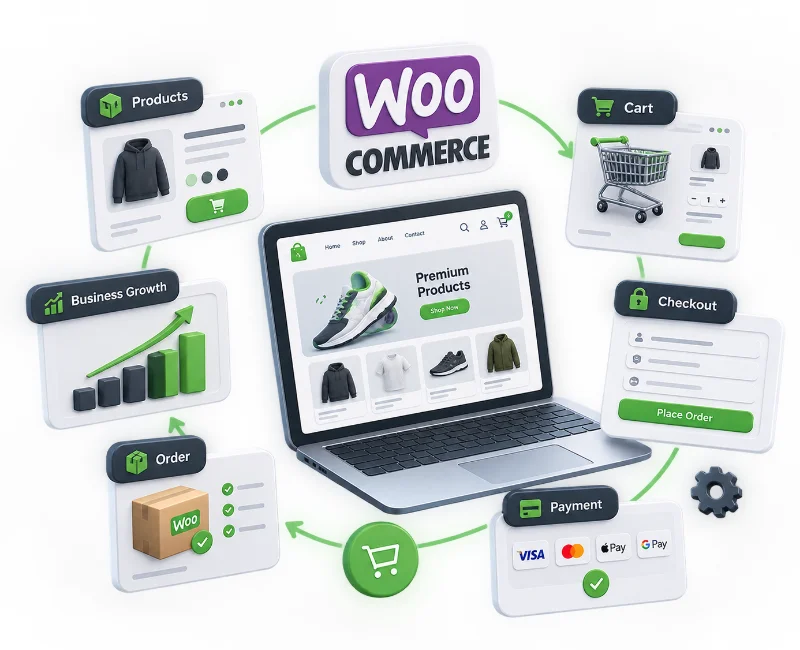
Your ecommerce store needs more than attractive product pages. It needs a reliable shopping experience for customers and a practical system for managing products, orders, payments, inventory and day-to-day operations.
Falconics IT provides WooCommerce Development services for businesses launching a new online store, improving an existing WooCommerce website, or requiring functionality beyond standard configurations. We combine WordPress and WooCommerce development with purposeful design, integrations and technical planning around your business requirements.
Custom WooCommerce functionality built around your requirements
Responsive storefronts designed for desktop and mobile shopping
Payment, shipping and third-party system integrations
Migration, upgrades, maintenance and ongoing improvements
WooCommerce provides a flexible foundation for ecommerce, but the way that foundation is configured matters. Product structure, navigation, checkout, payment methods, shipping rules, customer accounts and administrative workflows should reflect how your business actually operates.
Our WooCommerce development approach starts with those requirements rather than forcing your business into a predefined store structure. The result is an ecommerce website designed to be useful for both the customer placing an order and the team managing the store.
Launching a new WooCommerce store involves more than installing WordPress and adding products. The store needs a logical catalogue, intuitive navigation, product pages that communicate essential information, a straightforward cart and checkout journey, and an administration experience your team can manage.
Depending on the project scope, development can cover store architecture, product and category setup, customer accounts, cart and checkout functionality, payment configuration, shipping options, order management and other business-specific requirements.
Standard WooCommerce functionality is suitable for many businesses, but some operations require a more tailored approach.
Custom development can support requirements such as specialized product configurations, advanced filtering, custom pricing rules, unique checkout workflows, subscriptions, customer-specific experiences, custom dashboards or integrations with existing business systems.
The objective is not to add complexity for its own sake. Each custom feature should have a clear purpose and solve an identifiable business or customer problem.
Your storefront needs to represent the brand while making shopping easy. Navigation, product presentation, search, filters, calls to action, cart interactions and checkout should work together as one experience.
Falconics IT can develop and customize WooCommerce storefronts with responsive layouts so customers can browse products and complete purchases across different screen sizes.
An online store often needs to communicate with systems outside WordPress. Connecting those systems properly can reduce manual work and create a more consistent flow of information.
Depending on your requirements, integrations may include:
Payment gateways and transaction services
Shipping and logistics platforms
Inventory, ERP or accounting systems
CRM and marketing platforms
Analytics and reporting tools
Other third-party applications through suitable APIs
The exact integration approach depends on the systems your business already uses and the information that needs to move between them.
An existing ecommerce website may become difficult to maintain, slow to manage or unable to accommodate new business requirements. In other cases, the store may simply need a structured redesign or technical upgrade rather than a complete rebuild.
WooCommerce migration and upgrade projects can involve moving products and other relevant data, restructuring the store, improving functionality, updating the design or connecting new systems.
When an existing store contains valuable URLs, product information, customer records or order data, migration planning should also consider data integrity and SEO-related requirements.
Customers should be able to browse products, view details, add items to their cart and complete checkout without unnecessary friction.
Performance and responsive implementation therefore form an important part of development. The store structure, media, scripts, plugins, layouts and customer journey all need to work together without compromising essential functionality.
Mobile usability is considered as part of the complete shopping experience rather than as a separate finishing step.
The right features depend on your products and operating model. Common WooCommerce functionality can include product variations, categories, search and filtering, customer accounts, coupons, reviews, stock management, order tracking and flexible checkout options.
For more specialized businesses, WooCommerce can be extended to support subscriptions, bulk ordering, custom product options, customer-specific pricing, specialized workflows and other requirements where suitable.
A good ecommerce build is not defined by the number of features it contains. It is defined by whether those features make the store easier to use, manage and grow.
A properly structured WooCommerce website can support several areas of the business beyond online transactions.
A clearer buying journey
Logical navigation, useful product information and a streamlined checkout help customers move from product discovery to purchase with fewer unnecessary steps.
Better store management
Structured products, orders, customers and inventory can give internal teams a more consistent way to manage ecommerce operations.
Greater flexibility
WooCommerce can be extended when standard functionality does not fully accommodate a particular business process or customer requirement.
Stronger mobile usability
Responsive design allows customers to interact with the store across phones, tablets and desktop devices.
Room for future development
A well-planned technical foundation makes it easier to introduce additional products, integrations and functionality as requirements change.
Every project starts with the business requirement rather than a fixed implementation.
01 — Discovery & Requirements
We review your business model, products, target customers, existing website, operational requirements, integrations and project objectives.
02 — Planning & Architecture
The store structure, WooCommerce configuration, technical requirements, integrations and custom functionality are mapped before development moves forward.
03 — Design & Development
The storefront and required ecommerce functionality are developed around the agreed scope, including product structures, customer journeys, checkout and relevant integrations.
04 — Testing & Refinement
Key user journeys and functionality are reviewed across relevant devices. Issues involving responsiveness, forms, checkout, integrations and other project-specific requirements are identified and addressed.
05 — Launch & Ongoing Improvements
After launch, the store can continue to evolve through maintenance, feature enhancements, technical updates and further integrations based on business needs.
D2C and ecommerce brands can use WooCommerce to create product-focused shopping experiences with structured catalogues, promotions, product variations and streamlined checkout journeys.
B2B businesses may require features such as bulk ordering, customer-specific pricing, account management, quotation workflows or connections with internal business systems.
Startups and growing businesses can benefit from a practical store architecture that addresses current requirements without introducing unnecessary technical complexity.
Established retailers and businesses may need WooCommerce to work alongside existing inventory, accounting, logistics, CRM or operational systems.
The exact deliverables depend on the agreed project scope. A WooCommerce Development Service may include:
WooCommerce store development and configuration
Responsive storefront implementation
Product and category structure
Cart and checkout functionality
Payment and shipping integration
Customer and order management functionality
Custom WooCommerce features
Third-party API integrations
Migration or upgrade support
Testing and launch assistance
Ongoing maintenance where required
Additional functionality can be planned when it has a clear role in the business requirements.
WooCommerce development does not always begin with a completely new store. Sometimes the business already has a website but needs to address a specific limitation.
Common requirements include an outdated storefront, difficult product management, poor mobile usability, an inefficient checkout journey, limited WooCommerce functionality, disconnected business systems or the need for a new integration.
The appropriate solution depends on the underlying problem. In some cases, a targeted improvement or integration is more practical than rebuilding the entire ecommerce website.
There is no single WooCommerce development price that applies to every business. The project scope and technical requirements have a direct effect on the overall cost.
Factors can include:
Number and complexity of products or categories
Custom design and functionality
Payment and shipping requirements
Third-party integrations
Migration and data-transfer requirements
Custom business workflows
Performance and technical requirements
Ongoing maintenance and support
Once these requirements are understood, the project can be scoped around the functionality your business actually needs rather than an arbitrary package.
The development timeline depends on the size and complexity of the store. A focused WooCommerce website using standard functionality will require a different schedule from a highly customized store involving multiple integrations, migration or specialized workflows.
Progress can also depend on the timely availability of product information, images, content, brand assets, access credentials and business requirements.
A WooCommerce store should also be treated as an evolving business asset. New products, customer expectations, integrations and operational needs can create opportunities for future improvements after launch.
Falconics IT approaches ecommerce projects as business systems as well as customer-facing websites. Our wider capabilities across web development, ecommerce, digital marketing, software, analytics and technology allow relevant technical and digital requirements to be considered together.
The focus is on understanding the requirement first, selecting practical solutions, developing maintainable functionality and creating a store that your team can continue to work with after launch.
For businesses that need more than a basic WooCommerce installation, this approach provides room to address custom functionality, integrations and future development within the same technical direction.
WooCommerce Development is suitable for businesses that want the flexibility of WordPress combined with ecommerce functionality and room for customization.
It can be a practical option for:
D2C and consumer brands
Product-based startups
Small and medium-sized businesses
B2B businesses with specialized ordering requirements
Retailers expanding into online sales
Existing WordPress websites that need ecommerce functionality
The suitability of WooCommerce ultimately depends on the catalogue, business processes, technical requirements, integrations and future plans of the business.
WooCommerce development is the process of creating, customizing or improving an ecommerce website using WooCommerce and WordPress. It can include storefront development, product management, cart and checkout functionality, integrations, custom features, testing and ongoing improvements.
The scope depends on the project. It may include WooCommerce setup, storefront development, product and category structures, payment and shipping integration, custom functionality, responsive implementation, testing, migration and launch support.
Yes. Custom WooCommerce development can be used when standard functionality does not adequately support your business requirements. This may involve custom product functionality, pricing, checkout workflows, integrations or other specialized features.
Yes. An existing store can be redesigned or selectively rebuilt to address issues involving appearance, usability, mobile responsiveness, functionality, performance or changing business requirements.
Yes, where suitable integration methods are available. Depending on the project, WooCommerce can connect with payment services, shipping platforms, inventory systems, ERP and CRM software, accounting tools, analytics platforms and other applications.
There is no universal timeline. Project duration depends on the store's scope, number of products, design requirements, custom functionality, integrations, migration needs, testing and client feedback. A more reliable schedule can be established after the requirements are reviewed.
The cost varies according to the scope and complexity of the project. Custom functionality, design, catalogue size, integrations, migration requirements, payment and shipping needs and ongoing support can all affect the final estimate.
Yes. Migration can involve transferring relevant product, customer, order and other business data while rebuilding or restructuring the store. URLs, redirects, functionality and existing SEO considerations should also be reviewed as part of migration planning.
Ongoing support can be arranged according to the project's requirements. This may include maintenance, troubleshooting, updates, feature enhancements, integration changes and further development.
Useful starting information includes your business model, existing website if applicable, products, required features, preferred integrations, payment and shipping requirements, brand assets and project objectives. This helps establish a realistic scope and development approach.
Your online store should work for both sides of the transaction: customers need a straightforward shopping experience, while your team needs a dependable system for managing ecommerce operations.
Whether you are launching a new WooCommerce store, improving an existing website or need custom functionality and integrations, Falconics IT can help plan and develop a solution around your requirements.F
Contact our expert team today for a tailored strategy and free consultation.
Get a Free Consultation