
Ready to transform your business with Web Applications?
Contact our expert team today for a tailored strategy and free consultation.
Get a Free ConsultationNo services available in this category yet.
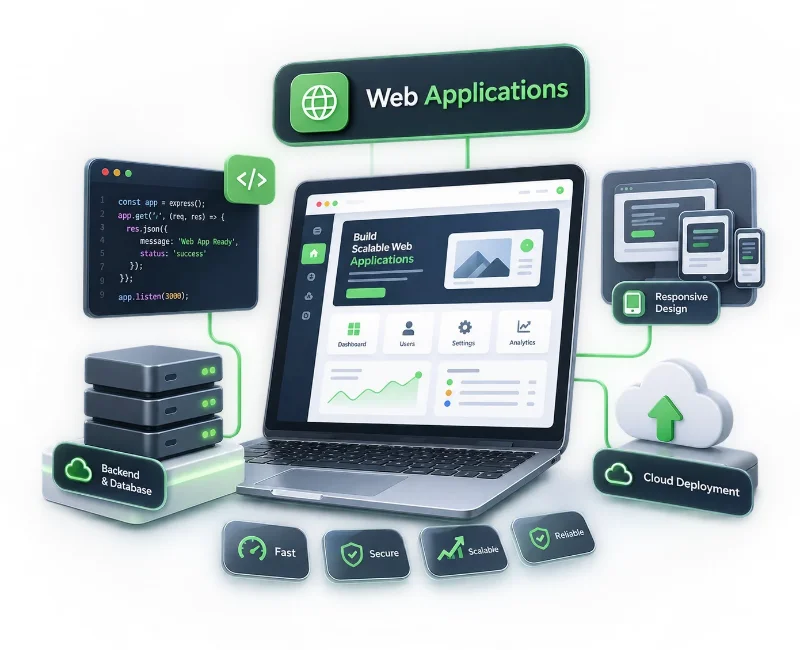
A business web application should do more than put information on a screen. It should make a process easier, connect the systems your team already uses, and give users a reliable way to complete important tasks.
Falconics IT builds custom web applications around those requirements. We combine UI/UX, frontend and backend development, database architecture, APIs, integrations, security, and deployment to create applications that fit the way your business actually operates.
Whether you need a new application, want to replace a manual workflow, or need to modernize an existing system, the development approach starts with understanding the problem before choosing the technology.
Discuss Your Web Application →
Web applications are interactive software systems accessed through a web browser rather than installed like conventional desktop software. Unlike a basic website that primarily presents information, a web application allows users to perform actions, manage information, interact with business processes, and access personalized functionality.
Examples include customer portals, dashboards, booking systems, CRM interfaces, employee platforms, inventory systems, reporting tools, workflow applications, SaaS products, and online management systems.
The right architecture depends on what the application needs to accomplish. A relatively focused internal tool may require a very different technical foundation from a multi-user SaaS platform or a system connected to several external services.
Off-the-shelf software can be useful when your processes closely match the software's predefined features. Problems arise when your team has to change established workflows simply to accommodate a generic platform.
Custom web applications allow the functionality, permissions, workflows, interfaces, and integrations to be designed around your requirements.
Falconics IT can structure applications around areas such as:
The exact functionality is defined during planning rather than forcing every project into the same development package.
The interface is where users interact with the application, so clarity matters as much as technical functionality. Falconics IT focuses on responsive interfaces that make navigation, forms, dashboards, search, data management, and other frequent actions straightforward.
The frontend can be structured for different user roles and device sizes while maintaining consistent interaction patterns. Where the application contains complex workflows, the interface is organized to reduce unnecessary steps rather than simply reproducing the underlying technical structure.
The backend controls the rules and processes behind the interface. It handles application logic, data processing, authentication, permissions, integrations, and communication between different parts of the system.
A well-planned backend also gives the application room to evolve. New modules, users, integrations, and workflows can be introduced without requiring the entire application to be rebuilt around every change.
Many web applications need to exchange information with other systems. APIs provide the connection layer between your application and services such as payment platforms, CRM systems, accounting software, communication tools, databases, or other business applications.
Integration requirements are considered as part of the architecture rather than treated as an afterthought. This helps keep information flowing between systems and reduces unnecessary manual data entry.
Applications that handle business information need clear control over who can access what. User authentication and role-based permissions can be structured according to different responsibilities within the application.
Depending on the project requirements, functionality may include secure login, role-based access, password management, session controls, administrative permissions, and other appropriate security measures.
Security requirements are considered throughout development rather than added only after the application has been built.
An application should allow authorized staff to manage the system without depending on developers for routine operations.
Custom admin panels and dashboards can provide centralized control over users, records, content, settings, reports, transactions, or workflows. The dashboard structure is based on what administrators actually need to monitor and manage.
For management teams, dashboards can also bring relevant operational information into one interface instead of requiring data to be collected manually from multiple systems.
Business users may access applications from desktops, laptops, tablets, and mobile devices. Responsive development helps the interface adapt to different screen sizes while preserving important functionality.
The appropriate responsive approach depends on how the application is used. A field-sales application, for example, may require a different mobile experience from an internal finance dashboard primarily used on desktop computers.
Scalability should be considered according to the application's expected users, data volume, integrations, and future requirements.
Falconics IT can structure the application architecture with future expansion in mind, allowing additional functionality and users to be introduced as requirements develop. Cloud infrastructure, database design, API architecture, caching, and other technical decisions can be selected according to the actual workload rather than using unnecessary complexity from the beginning.
A successful application starts with a clearly defined problem. Falconics IT follows a structured development process that keeps business requirements connected to technical decisions.
1. Requirement Discovery
We understand your business process, users, application goals, existing systems, required features, and technical constraints.
2. Planning & Architecture
The requirements are translated into application structure, workflows, user roles, database requirements, integrations, and an appropriate technology approach.
3. UI/UX Design
Key screens and user journeys are planned so the application is easy to navigate and practical for its intended users.
4. Development
Frontend, backend, database functionality, APIs, and integrations are developed according to the agreed scope.
5. Testing & Quality Checks
The application is evaluated for functionality, responsiveness, integration behaviour, usability, and relevant technical issues before launch.
6. Deployment & Support
After deployment, the application can be monitored, maintained, improved, and extended according to ongoing business requirements.
Technology should support the application rather than dictate the business process. Falconics IT works with modern development technologies including React, Node.js, Vue.js, JavaScript, Next.js, HTML5, CSS3, PHP, Python, Java, MongoDB, PostgreSQL, AWS, Docker, and related development infrastructure where appropriate.
The final technology stack is selected according to factors such as application complexity, existing systems, performance requirements, integrations, development needs, and long-term maintainability.
A properly designed web application can become an operational layer between your people, customers, data, and existing software.
The value may include:
The actual business outcome depends on the application's purpose, adoption, data quality, implementation, and the processes surrounding it.
Businesses often reach a point where spreadsheets, disconnected software, email-based approvals, or manual processes become difficult to manage.
A custom application can be considered when you need to:
The goal is not to automate every process simply because technology makes it possible. The better approach is to identify where an application will create practical operational value.
Custom web applications can be useful for a range of organizations, particularly when their processes require more functionality than a conventional website or standard software package provides.
Startups and SaaS Businesses can use web applications to build and validate digital products, customer platforms, subscription services, and MVPs.
SMEs can digitize internal processes such as lead management, inventory, operations, reporting, customer communication, and administration.
B2B Businesses can provide customers, distributors, partners, or employees with secure portals and specialized workflows.
E-commerce Businesses can connect customer-facing experiences with inventory, order management, CRM, payment, analytics, and other systems.
Growing Organizations can replace disconnected tools with a centralized platform that supports more users and increasingly complex processes.
A traditional website is generally designed around pages, content, navigation, and public information. A web application is built around interaction, data, users, and processes.
| Area | Traditional Website | Web Application |
|---|---|---|
| Primary purpose | Information and content | Interactive tasks and processes |
| User interaction | Generally limited | Often extensive |
| User accounts | Optional | Frequently required |
| Data management | Limited | Core functionality |
| Business workflows | Limited | Can be built into the system |
| Integrations | Usually fewer | APIs and system integrations can be central |
| Personalization | Basic to moderate | Can be role- and user-specific |
| Complexity | Usually lower | Varies according to functionality |
The distinction is useful when deciding whether your business needs a website, an application, or both.
Falconics IT approaches web application development as a business and technology project rather than simply a coding assignment.
Our broader capabilities span web development, software solutions, AI and automation, cloud infrastructure, mobile applications, and digital services. This allows application requirements to be considered alongside the wider technology ecosystem when the project requires it.
The development process is structured around understanding the requirement, building the appropriate solution, checking its functionality, and supporting future improvements.
Depending on the project scope, a web application engagement can include:
Not every project requires every component. Deliverables are defined according to the application's actual requirements.
Web application timelines vary considerably because the scope can range from a focused internal tool to a complex multi-user platform.
The main factors include the number of modules, user roles, integrations, database requirements, UI/UX complexity, third-party dependencies, testing requirements, and the amount of existing functionality that needs to be migrated or replaced.
Clear requirements and timely access to business information can help keep development moving efficiently. Projects may also evolve during development as users review prototypes or new requirements emerge, which can affect the final schedule.
There is no single price for web application development because the cost depends on the solution being built.
Factors that influence the project cost include:
Falconics IT can assess your requirements and provide a project-specific proposal rather than applying an arbitrary fixed price to fundamentally different applications.
A useful web application is not defined by the number of features it contains. It is defined by how effectively those features support the people and processes that use it.
If you already have a detailed specification, Falconics IT can work from it. If the requirement is still at the idea stage, the first step can be defining the users, workflows, core functionality, integrations, and technical priorities before development begins.
A web application is interactive software that users access through a web browser. It can support functions such as dashboards, portals, bookings, CRM workflows, reporting, data management, transactions, and other business processes.
A website primarily provides information and content, while a web application is designed for interaction and functionality. A web application may include user accounts, databases, dashboards, workflows, permissions, and integrations.
Yes. Custom functionality can be planned around your business workflows, user roles, technical requirements, integrations, and application objectives rather than being limited to a predefined template.
Yes. Where APIs or other appropriate integration methods are available, a web application can connect with third-party platforms, databases, payment systems, CRM tools, communication services, and other business software.
Yes. Responsive application interfaces can be designed for different screen sizes. The appropriate mobile experience depends on how users interact with the application and what functions they need while using smaller devices.
Yes. Existing applications can be assessed for modernization, performance improvements, interface updates, architecture changes, integrations, or migration requirements. The approach depends on the application's current technology and business dependencies.
There is no reliable single timeline for every application. Scope, functionality, integrations, design requirements, technical complexity, testing, and changes during development can all affect the schedule.
Ongoing maintenance can be important for applications that require security updates, bug fixes, infrastructure management, performance improvements, compatibility updates, or new functionality. The level of support depends on the application and operating requirements.
Cost is primarily influenced by application scope, functionality, design complexity, integrations, user roles, technical architecture, security requirements, and support needs. A project-specific estimate can be prepared after the requirements are understood.
The most useful starting information includes the application's purpose, target users, required workflows, important features, existing systems, integrations, preferred technology if applicable, and any technical or business constraints. If these details are not yet defined, they can be clarified during the initial discussion.
Share your application idea, existing requirements, or current business process with Falconics IT. The next step is to understand the scope, identify the appropriate technical approach, and determine the development requirements.
Your application should support the way your business operates—not force your team into a process that does not fit.
Whether you are planning a new digital product, replacing manual workflows, connecting existing systems, or modernizing an older platform, Falconics IT can help translate the requirement into a practical web application.
Contact our expert team today for a tailored strategy and free consultation.
Get a Free Consultation