
Ready to transform your business with Shopify SEO?
Contact our expert team today for a tailored strategy and free consultation.
Get a Free ConsultationNo services available in this category yet.
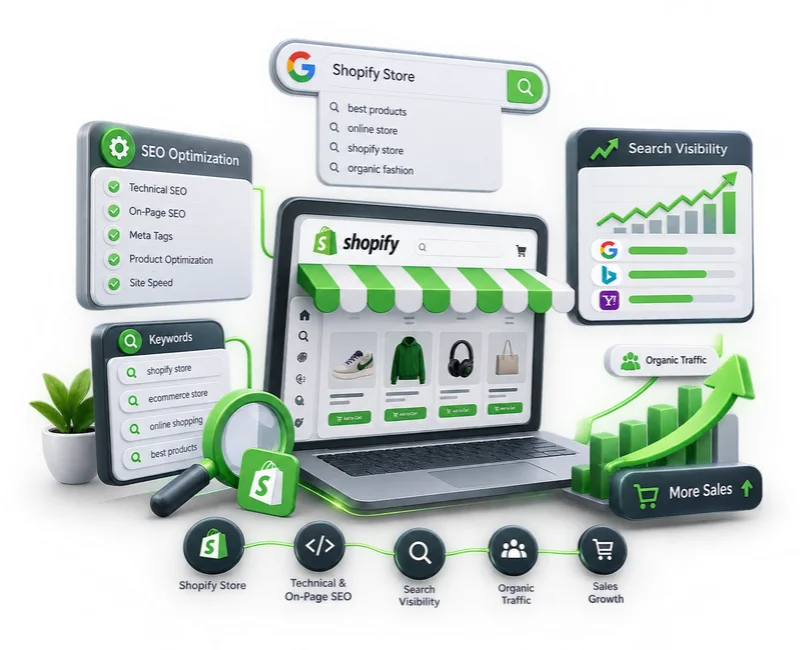
Your Shopify store can have strong products and a polished design yet still struggle to attract organic customers. Shopify SEO connects your store structure, product and collection pages, content, technical performance, and search intent so search engines can understand your business and shoppers can find the products they are looking for.
Falconics IT provides Shopify SEO services for ecommerce businesses that want a structured, practical approach to organic search. We focus on identifying the issues that matter most to your store, prioritising the right pages and keywords, and turning those opportunities into measurable SEO work.
What you can expect:
Every Shopify store has a different SEO situation. A new store may need a solid search-friendly architecture, while an established store may need to resolve indexing issues, weak product pages, duplicate content, poor internal linking, or pages competing for the same searches.
Our approach begins by understanding your catalogue, customers, commercial priorities and current organic performance. From there, we identify the opportunities and technical limitations specific to your Shopify setup rather than applying the same checklist to every business.
The goal is to make your store easier for search engines to crawl and understand while creating a better path from search query to relevant product or collection.
A Shopify SEO campaign should begin with knowing what needs attention.
We review the areas that can influence organic performance, including site architecture, indexability, metadata, internal linking, page templates, product and collection pages, content quality, redirects, canonicalisation, mobile experience and other relevant technical signals.
The outcome is a prioritised action plan rather than a long list of disconnected SEO observations. This helps separate high-impact work from minor fixes and gives your team a clearer view of where SEO effort should go first.
Ranking for a keyword is useful only when the search reflects a genuine opportunity for your business.
We research terms around your products, categories, customer problems, comparisons and buying journeys. Keywords are then mapped to the most appropriate Shopify pages so product, collection and informational content each have a clear search purpose.
For an ecommerce business, this can mean targeting different stages of the customer journey—from category-level searches to specific product requirements and research-oriented queries.
Product and collection pages are often the most commercially valuable pages on an ecommerce store, so they need more than basic metadata optimisation.
We improve relevant on-page elements such as titles, descriptions, headings, product copy, internal links and supporting content while maintaining a natural experience for shoppers. Collection architecture is also reviewed to ensure important categories are discoverable and logically connected.
Where appropriate, we identify opportunities to strengthen product descriptions, category copy, FAQs, buying information and other content that can help both search engines and customers understand what you sell.
Technical problems can limit organic performance even when the content itself is strong.
Our Shopify technical SEO work can address issues involving crawlability, indexation, canonical signals, redirects, broken links, site architecture, duplicate URL patterns, structured data and performance-related concerns.
We also consider the impact of themes, apps and other elements that can affect the store experience. The focus is not on changing technical elements simply for, FAQs, comparison content, category resources an SEO score; it is on resolving issues that can interfere with search visibility, usability or the ability of important pages to perform.
SEO content should support the products you sell rather than exist simply to publish more articles.
We identify useful content opportunities based on customer questions, product comparisons, use cases, category searches and informational intent. Depending on the store, this may include buying guides, FAQs, comparison content, category resources or supporting blog content.
This creates additional entry points into the store while giving potential customers useful information before they make a purchase decision.
A growing Shopify catalogue can quickly become difficult to organise from a search perspective.
We review how products, collections, content and other important pages connect with one another. Relevant internal links can help distribute authority, clarify relationships between pages and make important sections easier for users and search engines to discover.
The objective is a logical ecommerce structure that can continue to work as your catalogue expands.
Search behaviour, product categories and competition vary significantly across markets. For businesses targeting customers in India, SEO needs to reflect the language, product demand, commercial intent and competitive environment relevant to the market.
We can align keyword targeting and content priorities with the locations and customer segments your Shopify store actually serves, whether you operate nationally, target specific regions, or serve a defined customer niche.
The strategy remains focused on your business rather than adding location keywords where they do not naturally belong.
Effective Shopify SEO is not limited to keyword rankings. The work should improve the quality and discoverability of the store as a whole.
Depending on the starting point, the engagement may help address:
The specific priorities depend on your store, market, catalogue and competitive landscape.
01 — Understand
We start with your store, products, audience, competitors, current search performance and commercial objectives. This establishes what SEO needs to accomplish for the business.
02 — Audit & Prioritise
We assess technical SEO, site structure, keywords, product and collection pages, content and other relevant areas. Issues are prioritised according to their likely business impact.
03 — Optimise
The agreed improvements are implemented across the appropriate Shopify pages and technical areas. Content and on-page recommendations are aligned with search intent rather than keyword frequency.
04 — Measure & Refine
SEO performance is monitored through relevant search and business signals. Findings from the data help determine what should be improved, expanded or prioritised next.
The exact deliverables depend on the condition and size of your Shopify store, but a Shopify SEO engagement may include:
The scope can be adjusted according to whether you need a one-time SEO project, an initial optimisation programme, or ongoing SEO support.
Shopify SEO can be valuable for different stages of ecommerce growth.
New Shopify stores can establish a search-friendly structure before the catalogue and content become difficult to manage.
Growing ecommerce brands can improve important product and collection pages while expanding their organic reach into new search opportunities.
Established Shopify stores can use SEO to identify technical limitations, content gaps, declining pages and opportunities that may not be visible through basic Shopify reports or SEO apps.
D2C and niche product brands can build visibility around specific product categories, customer problems and high-intent searches where relevance matters more than simply attracting large volumes of traffic.
Falconics IT combines digital marketing with web, ecommerce, technology and analytics capabilities. That broader technical perspective is useful when SEO issues extend beyond content and require attention to the underlying website experience.
Our approach is built around tailored strategies rather than a fixed package. We begin with the actual condition of your store, prioritise the work that matters, and use measurement to guide subsequent improvements.
Just as importantly, we keep expectations realistic. SEO is influenced by competition, site history, content quality, technical conditions, search behaviour and the consistency of implementation. We focus on creating a stronger foundation and making informed improvements rather than promising instant rankings.
Shopify SEO is an ongoing process rather than a one-time switch. The time required depends on the size of the store, its existing authority, technical condition, content quality, competition and the amount of work being implemented.
Some technical and on-page improvements can be addressed relatively quickly, while changes in organic visibility generally require search engines to recrawl pages and evaluate the updated site over time.
Meaningful SEO evaluation should therefore look at trends rather than isolated ranking changes. Depending on the project, relevant indicators may include impressions, indexed pages, keyword visibility, organic sessions, engagement and ecommerce conversions.
There is no useful one-size-fits-all Shopify SEO price because the required work varies considerably between stores.
Pricing is typically influenced by factors such as:
After understanding your store and objectives, the scope can be defined around the work that actually needs to be done rather than charging for unnecessary activities.
Yes. Shopify provides a solid foundation for ecommerce SEO, but the platform alone does not guarantee organic visibility. Performance depends on how the store's architecture, content, product and collection pages, technical elements and search intent are handled.
Depending on the project, Shopify SEO can include technical SEO, keyword research, product and collection optimisation, metadata, internal linking, content strategy, site architecture and ongoing performance analysis.
Yes.There is no fixed timeline for SEO results. The timeframe depends on factors such as competition, website history, technical issues, content quality, authority and the consistency of implementation. SEO should be evaluated through Existing stores can be audited to identify technical, structural, content and on-page opportunities. The work can then be prioritised according to the store's current condition and business objectives.
There is no fixed timeline for SEO results. The timeframe depends on factors such as competition, website history, technical issues, content quality, authority and the consistency of implementation. SEO should be evaluated through sustained performance trends rather than a guaranteed ranking date.
Yes. Product-page SEO can improve how individual products are understood and matched with relevant searches. This involves more than adding keywords; the page needs useful, relevant content and an appropriate relationship with the rest of the store.
SEO apps can be useful for specific tasks and basic optimisation, but they do not replace strategic decisions about keyword targeting, site architecture, content, technical priorities or competitive positioning.
Yes, technical SEO can form part of the engagement where the store requires it. The scope depends on the issues identified during the audit and may include crawlability, indexation, redirects, canonicalisation, internal linking, structured data and performance-related considerations.
Yes. SEO can be structured around the geographic markets and customer segments relevant to the business. For a national ecommerce store, this may involve broader search demand, while businesses with regional products or services may require more focused targeting.
Performance can be evaluated using relevant organic search and business indicators such as impressions, rankings, organic traffic, indexed pages, engagement and conversions. The most useful measurements depend on the store's objectives.
No. Search rankings are affected by competition, algorithms, website quality, authority, search behaviour and many external factors. A responsible SEO programme should focus on improving the factors within the business's control rather than guaranteeing specific positions.
The first step is to understand your Shopify store, current SEO position, target customers and business goals. From there, an SEO assessment can identify the highest-priority opportunities and determine an appropriate scope of work.
If your Shopify store is not reaching enough relevant customers through organic search, the first step is understanding what is limiting its performance.
Falconics IT can assess your Shopify store, identify practical SEO opportunities, and build a strategy around your products, audience and commercial priorities.
Contact our expert team today for a tailored strategy and free consultation.
Get a Free Consultation