
Ready to transform your business with Shopify Development?
Contact our expert team today for a tailored strategy and free consultation.
Get a Free ConsultationNo services available in this category yet.
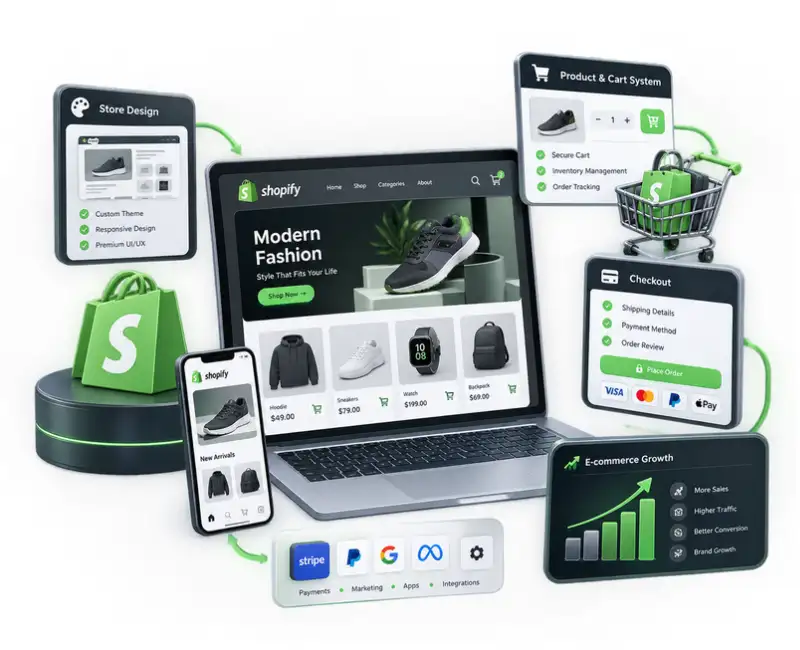
A Shopify store should do more than display products. It should make it easy for customers to discover what they need, understand the value of your products, complete purchases, and return for future orders.
Falconics builds and customizes Shopify stores for businesses that need a reliable ecommerce foundation without compromising on design, functionality, performance, or future growth.
Whether you are launching a new store, improving an existing Shopify website, moving from another ecommerce platform, or connecting your store with other business systems, we shape the development around your actual requirements.
Key advantages:
Shopify provides the ecommerce foundation, but the way that foundation is configured and customized determines how effectively the store works for your business.
Falconics approaches Shopify development from both a technical and commercial perspective. We consider your products, catalogue structure, customer journey, operational requirements, integrations, and future plans before deciding what should be customized and what can be handled through Shopify's existing capabilities.
The objective is not to add complexity for its own sake. It is to create a store that is practical to manage, straightforward for customers to use, and capable of supporting your next stage of growth.
For businesses starting from scratch, we can develop a Shopify storefront around the products you sell and the experience you want customers to have.
This can include Shopify configuration, navigation, collection structures, product presentation, responsive layouts, storefront functionality, and launch preparation.
The result is a structured ecommerce website that gives your team a practical platform for managing products and orders while giving customers a clear path from discovery to checkout.
Standard Shopify features can cover many ecommerce requirements, but some businesses need functionality specific to their products, customers, or internal processes.
Custom Shopify development can be used when your store requires specialized features, custom workflows, additional functionality, or connections that cannot be handled effectively through standard configuration alone.
We first determine whether an existing Shopify capability, app, configuration, or custom development approach is the most sensible option. This helps avoid unnecessary development and keeps the store easier to maintain.
Your storefront is often the first meaningful interaction a customer has with your brand.
Falconics can customize an existing Shopify theme or develop storefront experiences around your brand identity, content structure, products, and customer journey. The focus is on clean presentation, intuitive navigation, responsive behaviour, and a consistent shopping experience across devices.
Theme work can include homepage layouts, collection pages, product pages, navigation, promotional sections, content areas, and other storefront components.
An ecommerce store rarely operates in isolation. Orders, customer information, inventory, payments, shipping, marketing, and business reporting may all depend on connected systems.
We can help integrate Shopify with relevant third-party platforms and business tools based on your operational requirements.
Potential integration areas include:
The exact integration approach depends on the systems involved, available APIs, data requirements, and the workflows your business needs to automate or connect.
Moving to Shopify involves more than transferring products from one platform to another.
A well-planned migration considers product and customer data, URLs, content, collections, functionality, integrations, redirects, and the operational processes that need to continue working after launch.
Falconics can assess your existing ecommerce setup and help plan the transition so that the new Shopify store is structured around your current requirements rather than simply reproducing limitations from the old platform.
An attractive storefront can still underperform if customers struggle to navigate it, pages respond slowly, product information is unclear, or important purchase steps create friction.
Our development approach considers the technical and user-experience factors that affect how customers interact with your store.
Depending on the project, optimization may involve theme improvements, responsive design adjustments, code refinement, image handling, app and script review, navigation improvements, product-page enhancements, or technical fixes.
The exact scope is determined by your store and business requirements rather than a fixed package.
Core deliverables may include:
Additional functionality can be included when it has a clear purpose and fits the technical requirements of the project.
Shopify can support different ecommerce business models, but the development priorities vary according to how the business operates.
D2C and consumer brands may need a strong product discovery experience, mobile-first shopping, flexible merchandising, and a storefront that reflects their brand.
Startups and growing businesses may need a practical store that can launch efficiently while leaving room for additional products, integrations, and functionality later.
Established ecommerce businesses may be looking to redesign an existing store, improve its usability, connect operational systems, or migrate from another platform.
B2B and wholesale businesses may require more specialized catalogue structures, customer workflows, pricing logic, or integrations. These requirements should be assessed during discovery before development begins.
Shopify development is often required when an existing ecommerce setup is creating practical limitations.
Common examples include:
The solution depends on the underlying issue. Sometimes a focused improvement is enough; in other cases, rebuilding or migrating the store is the more appropriate route.
A Shopify project works best when development decisions are made before code is written.
01 — Understand
We review your business model, products, audience, existing store or platform, technical requirements, integrations, and project objectives.
02 — Plan
The required functionality, storefront structure, integrations, content requirements, and development priorities are defined before implementation begins.
03 — Build
The Shopify environment, theme, custom functionality, integrations, and storefront components are developed according to the agreed scope.
04 — Test
The store is reviewed across key customer journeys, devices, functionality, forms, navigation, integrations, and ecommerce processes before launch.
05 — Launch & Improve
After launch, we address required refinements and can continue supporting technical improvements as the store evolves.
Falconics brings web development, ecommerce, digital marketing, analytics, and technology capabilities together rather than treating the Shopify store as an isolated website project.
That broader perspective can be useful when your ecommerce requirements extend beyond storefront development. A Shopify project may also involve SEO, analytics, conversion optimization, advertising, automation, custom software, or other digital systems.
Our approach is centered on understanding the business requirement first, selecting an appropriate technical solution, and keeping development aligned with measurable commercial objectives.
We also avoid treating every Shopify project as a custom-build exercise. Where Shopify's native functionality or an appropriate existing solution can meet the requirement, that may be preferable to adding unnecessary technical complexity.
Shopify development pricing depends on the scope and complexity of the project, so there is no responsible one-size-fits-all price without understanding the requirements.
Factors that can influence the investment include:
A focused Shopify customization project will naturally have different requirements from a complete store build or platform migration. Falconics can define the appropriate scope after understanding your store and objectives.
The timeline depends on the size and complexity of the Shopify project.
A relatively straightforward store customization may require considerably less development work than a fully customized ecommerce experience involving multiple integrations, extensive product data, migration, or specialized functionality.
The quality and availability of product information, brand assets, content, access credentials, third-party integration documentation, and stakeholder feedback can also affect delivery.
Rather than promising an arbitrary launch date, the project timeline should be established around the confirmed scope and dependencies.
Shopify development can include store setup, theme customization, custom functionality, responsive storefront development, integrations, migration, testing, optimization, and ongoing technical support. The exact deliverables depend on the requirements of your store.
Yes. A new Shopify store can be structured around your products, brand identity, customer journey, catalogue, and operational requirements, followed by development, testing, and launch preparation.
Yes. Existing Shopify stores can be improved without necessarily rebuilding everything. Depending on the issue, the work may involve theme customization, new functionality, UX improvements, technical fixes, integrations, or performance-related changes.
Shopify migration can involve transferring products, collections, customer information, content, functionality, and other relevant data. Migration planning should also consider URLs, redirects, integrations, and the processes that need to remain operational after launch.
Yes. Shopify can be connected with relevant third-party systems depending on their available integration methods and your business requirements. Common areas include payments, shipping, CRM, inventory, analytics, and marketing platforms.
Not necessarily. A ready-made theme can be a sensible choice when it meets the store's requirements. Custom development becomes more useful when the business needs a distinct customer experience, specialized functionality, or workflows that standard options cannot handle effectively.
Yes. If the current store has a sound foundation, targeted improvements may be more efficient than starting again. The right approach depends on the theme, code quality, functionality, integrations, and business objectives.
Ongoing technical support can be arranged for store updates, improvements, issue resolution, functionality changes, performance-related work, and other development requirements.
There is no fixed price that applies to every Shopify project. Cost depends on factors such as design requirements, store size, custom functionality, integrations, migration complexity, and ongoing support. A project-specific scope is needed to provide an appropriate proposal.
Start by sharing your existing store or project requirements, the products or services you sell, your current ecommerce platform if applicable, and the functionality or improvements you need. The next step is to assess the requirements and define the appropriate development scope.
Whether you are launching a new ecommerce business or improving an existing Shopify store, the right development approach starts with understanding what the business actually needs.
Falconics can help you define the scope, choose the right implementation approach, and build a Shopify experience that is practical for your team and easier for customers to use.
Contact our expert team today for a tailored strategy and free consultation.
Get a Free Consultation