
Ready to transform your business with ROAS Optimization?
Contact our expert team today for a tailored strategy and free consultation.
Get a Free ConsultationNo services available in this category yet.
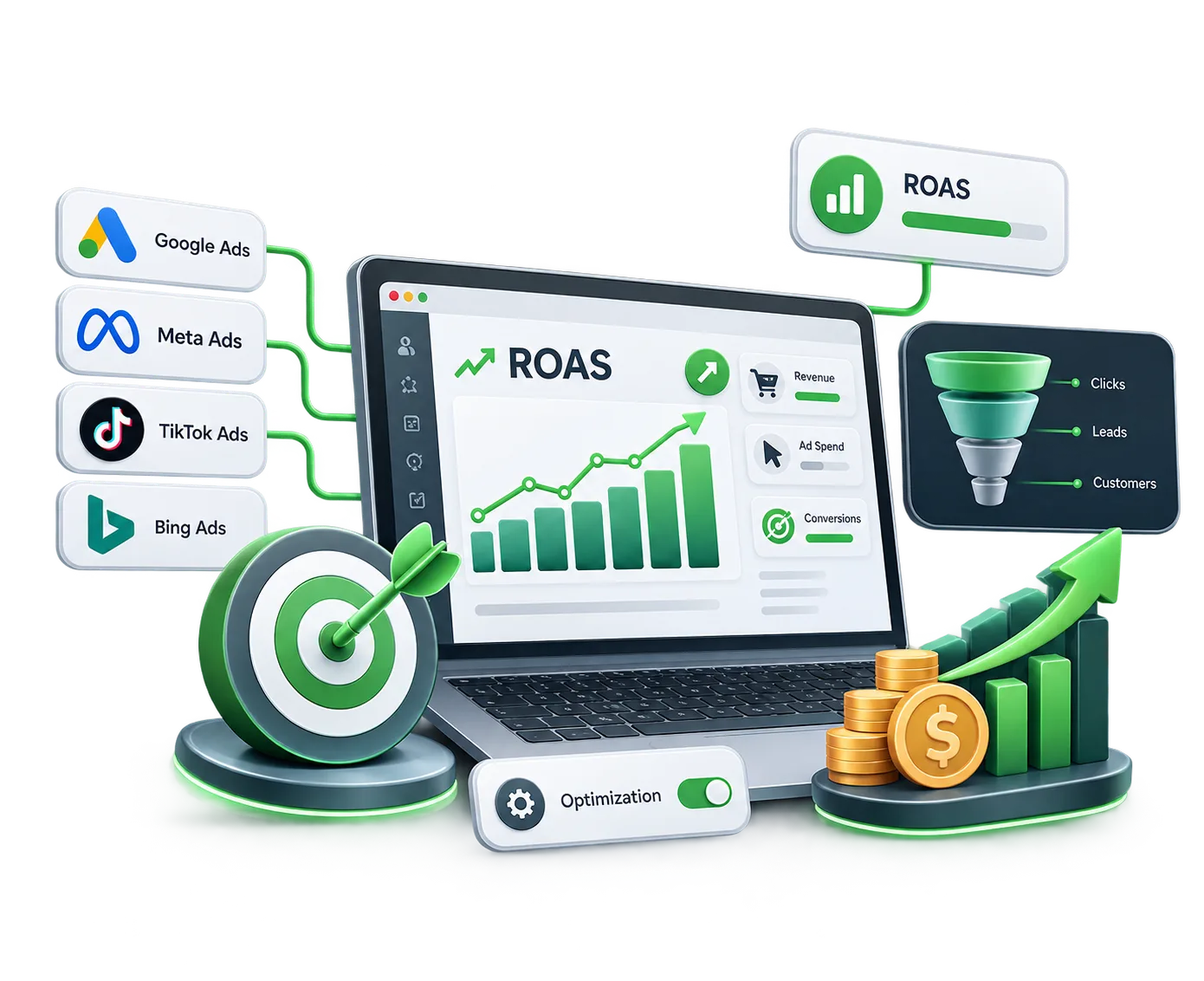
ROAS Optimization is the process of improving how effectively your advertising budget turns into measurable revenue. It goes beyond changing bids or increasing budgets—it requires reliable tracking, campaign analysis, audience and creative evaluation, landing-page performance, and disciplined budget allocation.
Falconics IT helps businesses bring these elements together into a structured optimization process. We examine campaign performance, identify inefficient spend, prioritize meaningful opportunities, and use ongoing testing and analysis to improve advertising efficiency.
What you can expect from a structured ROAS optimization program:
Clearer visibility into advertising performance
Better allocation of campaign budgets
Identification of inefficient campaigns, audiences, and placements
Continuous testing of creatives, offers, and targeting
Performance reporting tied to meaningful business metrics
A campaign can generate conversions while still using its budget inefficiently. Similarly, a strong ROAS figure at campaign level can hide underperforming products, audiences, creatives, or traffic sources.
ROAS Optimization looks at the complete path between advertising spend and revenue. That means examining the quality of conversion data, campaign structure, audience segments, bidding decisions, creative performance, landing pages, and the economics behind the offer.
The objective is not simply to chase a higher number in an advertising dashboard. The objective is to make better decisions about where money should be spent, where it should be reduced, and what should be tested next.
Optimization starts with understanding the current account rather than immediately changing campaigns.
We review campaign structures, spending patterns, conversion data, bidding approaches, targeting, placements, search terms where applicable, creative performance, and other available performance signals.
This helps identify areas such as budget being concentrated in weak campaigns, promising campaigns being underfunded, inconsistent conversion tracking, or performance differences between audiences and products.
The resulting analysis provides a practical foundation for deciding what should be retained, adjusted, tested, or discontinued.
Advertising budgets should follow performance—not simply historical spending patterns.
Falconics IT evaluates how budget is distributed across campaigns, products, audiences, locations, platforms, and other relevant segments. Where the data supports it, stronger-performing areas can receive greater attention while inefficient spending is reduced or investigated.
Budget decisions are made within the context of your objectives, margins, sales cycle, conversion volume, and available data. A campaign with high ROAS is not automatically the right place to put every additional rupee.
ROAS optimization depends on trustworthy data.
If purchases, leads, revenue values, or other important conversions are being recorded incorrectly, optimization decisions can be based on misleading information. We therefore assess the measurement setup and identify gaps that may affect campaign evaluation.
Depending on the engagement, this can include reviewing conversion events, revenue attribution, analytics implementation, platform reporting, and the connection between advertising activity and downstream business outcomes.
Advertising performance is influenced by both who sees an ad and what they see.
We analyze available data to understand which creative concepts, formats, messages, audiences, and placements are contributing to meaningful actions. Underperforming combinations can then be refined or replaced, while promising approaches can be developed into further tests.
For ecommerce and consumer-focused campaigns, this may include evaluating product presentation, offers, hooks, landing-page alignment, and the relationship between creative engagement and purchase behaviour.
Advertising optimization should not stop when someone clicks an ad.
A campaign can attract relevant traffic but still produce weak commercial results if the landing page is slow, unclear, poorly aligned with the advertisement, or difficult to navigate.
Where landing-page performance is affecting advertising efficiency, we identify conversion barriers and recommend improvements to messaging, page structure, calls to action, forms, product information, or user experience.
ROAS improvement is rarely the result of one permanent campaign change.
Markets, audiences, creative fatigue, offers, competitors, and platform behaviour can all change over time. Our approach therefore uses ongoing analysis and controlled testing rather than relying on a single optimization exercise.
Depending on the account, tests may involve:
Campaign and budget structures
Bidding and targeting approaches
Ad creatives and messaging
Audience segments
Landing-page experiences
Product or offer positioning
The focus remains on learning from measurable performance and making the next decision with better information.
ROAS is useful, but it should be interpreted alongside the economics of the business.
A higher advertising return can be valuable when it is accompanied by commercially viable customers, sustainable margins, appropriate order values, and sufficient conversion volume. For lead-generation businesses, the quality and downstream value of leads may matter more than the platform-reported conversion count alone.
A well-managed optimization program can help businesses make more informed decisions about:
Where advertising budget is working efficiently
Which campaigns require restructuring or refinement
Which audiences and creative approaches deserve further testing
Where conversion friction is affecting paid traffic
How advertising performance should be evaluated against business objectives
01 — Audit & Understand
We begin by understanding your business model, advertising objectives, customer journey, campaign structure, tracking setup, and existing performance.
02 — Diagnose
Performance data is examined to identify waste, inconsistencies, underperforming segments, conversion barriers, and opportunities that warrant further investigation.
03 — Prioritize
Not every campaign requires the same intervention. We prioritize changes according to potential business impact, available data, implementation requirements, and testing needs.
04 — Optimize & Test
Campaign settings, budgets, audiences, creatives, landing experiences, and other relevant elements are refined or tested according to the strategy.
05 — Measure & Refine
Performance is reviewed against agreed objectives. Findings from each optimization cycle inform subsequent decisions rather than relying on assumptions or isolated metrics.
ROAS Optimization can be particularly useful for businesses already investing in paid advertising and looking for greater control over advertising efficiency.
It can suit:
Ecommerce and D2C businesses
Useful when purchase data is available and advertising spend needs to be evaluated against product revenue, order value, margins, and customer behaviour.
B2B companies
Useful when paid campaigns generate enquiries or leads and the business needs to understand which advertising activity contributes to commercially valuable opportunities.
Lead-generation businesses
Relevant for companies where campaign efficiency depends not just on lead volume, but on lead quality and the eventual sales outcome.
Growing businesses with active ad accounts
Particularly relevant when campaign structures have become complex, budgets have increased, or performance is becoming harder to evaluate manually.
Many ROAS problems are not caused by one poorly performing advertisement. They can develop through several smaller issues across the advertising and conversion journey.
Common areas we investigate include:
Spending concentrated in campaigns that do not justify their budget
Incomplete or unreliable conversion data
Campaign structures that make performance difficult to interpret
Creative fatigue or weak message-to-audience alignment
Poor allocation between campaigns, products, or audiences
Landing pages that fail to convert relevant paid traffic
Scaling decisions made without sufficient performance data
Platform metrics that do not fully reflect business profitability
The appropriate response depends on what the account data reveals. Optimization should diagnose the cause before prescribing the solution.
The exact scope depends on your advertising setup and engagement requirements, but a ROAS Optimization engagement can include:
Advertising account and campaign performance review
Conversion and revenue tracking assessment
Budget and spend-efficiency analysis
Campaign and audience performance analysis
Creative performance review
Landing-page and conversion-path assessment
Optimization recommendations and implementation
Ongoing performance monitoring
Reporting and strategic recommendations
Where additional technical, creative, analytics, or development work is required, the scope can be defined separately rather than being assumed as part of every engagement.
Falconics IT approaches advertising performance as part of a broader digital growth system rather than treating ad-platform metrics in isolation.
Our capabilities span digital marketing, web development, ecommerce, data and analytics, conversion optimization, and technology. That connected perspective can be useful when an advertising problem extends beyond campaign settings—for example, when tracking, website experience, or conversion flow is influencing paid performance.
We also follow a structured cycle of understanding, execution, measurement, and optimization. The emphasis is on practical decisions supported by available business and campaign data rather than generic recommendations applied to every account.
There is no universal ROAS target that makes sense for every business.
Performance depends on factors such as product or service economics, average order value, gross margin, customer acquisition costs, sales cycle, conversion rate, competition, creative quality, audience size, website experience, and the accuracy of tracking.
For this reason, optimization should be evaluated against the commercial objectives of the business—not against an arbitrary benchmark alone.
The time required to optimize an account depends on its size, historical data, conversion volume, tracking quality, campaign complexity, and the number of changes that need to be tested.
Initial analysis can identify obvious issues relatively quickly, but meaningful optimization is generally an ongoing process. Some changes can be evaluated sooner than others, while larger structural or conversion improvements may require more time and sufficient data.
Clients should also expect that optimization involves testing. Not every hypothesis will improve performance, and useful learning from an unsuccessful test can be as important as a successful change.
ROAS Optimization pricing depends on the scope and complexity of the advertising account rather than a fixed one-size-fits-all fee.
Factors that can influence the engagement include the number of advertising platforms, campaign volume, monthly spend, tracking requirements, creative testing needs, landing-page work, reporting requirements, and the level of ongoing management required.
After understanding your advertising setup and objectives, the appropriate scope can be defined before work begins.
ROAS Optimization is the ongoing process of improving how efficiently advertising spend generates measurable revenue or commercially valuable conversions. It combines campaign analysis, tracking, budget allocation, targeting, creative testing, conversion improvement, and performance monitoring.
No. Ecommerce businesses can calculate ROAS directly from purchase revenue, but the broader optimization approach can also apply to lead-generation and B2B campaigns. In those cases, lead quality, sales value, and downstream conversion data may need to be considered alongside platform metrics.
Yes, ROAS optimization can be applied across multiple advertising platforms. The specific work depends on the campaigns, tracking setup, objectives, and data available within each platform.
No. Advertising performance depends on many variables outside an optimization process, including market conditions, offer economics, competition, creative response, website performance, and available conversion data. The focus is on systematic improvement and informed decision-making rather than guaranteed numbers.
An existing campaign provides historical data that can be analyzed, but ROAS-focused strategy can also be incorporated when building or restructuring paid campaigns. The appropriate starting point depends on your current advertising setup.
Typically, useful information includes access to relevant advertising and analytics platforms, business objectives, product or service information, conversion definitions, revenue or lead-value information where available, and any existing performance reports.
Potentially, but limited data can restrict how confidently individual changes can be evaluated. In such situations, the strategy may need to prioritize measurement quality, account structure, conversion fundamentals, and carefully selected tests before making larger optimization decisions.
Optimization should be continuous, but that does not mean changing campaigns every day without a clear reason. The appropriate frequency depends on spend, conversion volume, campaign maturity, testing requirements, and the type of change being evaluated.
Yes. When the available scope includes conversion optimization or website analysis, paid traffic can be reviewed alongside landing-page experience, messaging, forms, calls to action, and other conversion factors that may influence advertising efficiency.
Start by sharing your current advertising goals, platforms, approximate spend, and the main performance challenge you are trying to solve. Falconics IT can then assess the requirements and determine an appropriate ROAS Optimization scope.
ROAS Optimization is not about chasing a single dashboard metric. It is about understanding where advertising investment creates value, finding the points where performance is being lost, and creating a repeatable process for making better campaign decisions.
If your paid advertising is generating data but you are unsure where to increase spend, what to reduce, or what to test next, Falconics IT can help you build a clearer optimization process around your business objectives.
Contact our expert team today for a tailored strategy and free consultation.
Get a Free Consultation