
Ready to transform your business with Retargeting Campaigns?
Contact our expert team today for a tailored strategy and free consultation.
Get a Free ConsultationNo services available in this category yet.
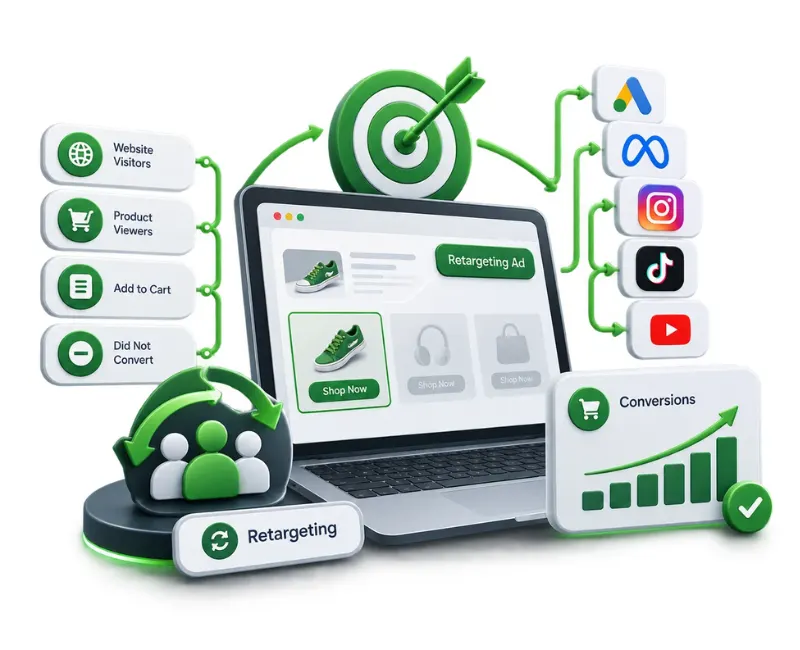
Not every visitor is ready to enquire or purchase on the first visit. Retargeting campaigns give your business a structured way to reconnect with people who have already shown interest, rather than relying entirely on reaching new audiences.
Falconics IT plans and manages retargeting campaigns around audience behaviour, campaign objectives, advertising platforms, creative relevance, and conversion paths. The focus is on showing the right message to the right audience segment without repeatedly exposing users to irrelevant ads.
What you can expect:
Audience segments based on meaningful interactions and intent
Retargeting campaigns across relevant paid advertising channels
Creative and messaging aligned with the user's previous interaction
Conversion tracking and performance monitoring
Ongoing testing and campaign refinement
Retargeting is a paid advertising approach that reconnects with people who have previously interacted with your business. Depending on the campaign setup, that audience may include website visitors, product viewers, people who engaged with content, previous leads, or customers.
The purpose is not simply to show the same advertisement again. Effective retargeting uses the context of the previous interaction to determine what the person should see next.
For example, someone who viewed a product but did not purchase may need a reminder or additional product information. Someone who visited a service page may be better suited to an enquiry-focused message.
Falconics IT approaches retargeting as part of the wider customer journey rather than as an isolated advertising tactic.
Audience planning and segmentation
We identify meaningful audience groups based on actions such as page visits, product interactions, engagement, lead activity, or other available signals. Different levels of intent can then receive different campaign messages.
Campaign and platform setup
Campaigns can be structured across suitable advertising platforms based on where your audience is active and what you are trying to achieve. The setup may include Google Ads, Meta advertising, or other relevant paid channels.
Tracking and audience configuration
Accurate tracking is essential because retargeting depends on understanding previous user interactions. We help configure the required tags, events, audiences, and conversion actions so campaign activity can be measured properly.
Ad creative and messaging
Retargeting ads should reflect the user's stage in the buying journey. Creative can be developed around product reminders, service benefits, educational content, offers, trust signals, or a specific next action.
Campaign optimization
Performance is reviewed regularly to identify underperforming audiences, creatives, placements, and conversion paths. Campaign adjustments are based on the available data rather than keeping the initial setup unchanged.
A visitor who browsed your homepage should not necessarily receive the same advertisement as someone who reached a pricing page or abandoned a shopping cart.
Our campaign structure can account for these differences.
For ecommerce businesses, this may mean separating product viewers, cart abandoners, recent purchasers, and broader website visitors.
For B2B and service businesses, audiences can be organized around interactions such as service-page visits, enquiry-page visits, content engagement, or other meaningful website actions.
This segmentation helps make advertising more relevant and gives each audience a clearer reason to return.
Retargeting can make better use of the attention your existing marketing has already generated.
Instead of treating every website visit as the end of the journey, campaigns can create additional touchpoints for users who have not yet completed the desired action.
The business value can include:
Re-engaging visitors who left without converting
Supporting longer consideration cycles
Bringing potential customers back to relevant pages
Creating more focused advertising audiences
Testing different messages against known user behaviour
Improving the connection between paid traffic and conversion opportunities
Results will vary depending on the quality of the original traffic, audience size, offer, website experience, creative, competition, and campaign execution.
01 — Understand the customer journey
We begin by identifying your offer, target audience, conversion goals, existing traffic sources, and the actions that indicate meaningful interest.
02 — Build audience segments
Relevant visitors and interactions are organized into practical audience groups. Where appropriate, audiences can be separated according to pages visited, engagement level, product behaviour, lead activity, or customer status.
03 — Configure tracking and campaigns
Tracking requirements, conversion events, campaign structure, exclusions, platforms, budgets, and audience rules are established before campaigns are launched.
04 — Develop and test creative
Ad formats, messaging, calls to action, and creative variations are matched to the audience segment and campaign objective. Testing helps identify which combinations deserve further investment.
05 — Measure and optimize
Campaign performance is monitored against relevant metrics and business objectives. We use the findings to refine audiences, creative, placements, bidding, exclusions, and other campaign variables where appropriate.
Retargeting campaigns can help address several common paid advertising challenges.
A business may be receiving website traffic but losing interested visitors before they enquire. Another may have strong product interest but a large number of abandoned carts. A B2B company may also need multiple touchpoints because prospects rarely make a decision during their first visit.
The campaign response depends on the underlying problem. A visitor who needs more information may require educational content, while a high-intent shopper may need a product reminder or a simpler route back to checkout.
The right advertising platform depends on the audience and the campaign objective.
Google's advertising ecosystem can be useful for reconnecting with audiences across eligible placements and search-related journeys. Meta platforms can support audience-based campaigns across Facebook and Instagram. Other channels may be appropriate for specific B2B, video, or content-led campaigns.
Rather than automatically using every available channel, the campaign should prioritize platforms that make sense for your audience, available data, creative assets, and budget.
Repeated exposure can become counterproductive when the audience sees the same message too frequently.
Retargeting creative should therefore have a defined purpose and a sensible lifecycle. Depending on the campaign, variations might highlight a different product benefit, answer a common objection, reinforce credibility, introduce useful content, or encourage the next stage of the journey.
Audience exclusions and frequency controls can also help prevent campaigns from continuing to target people who have already converted or are no longer relevant.
Retargeting performance should be evaluated against the action the campaign is designed to generate.
Depending on the objective, relevant metrics may include:
Click-through rate and engagement
Conversion rate
Cost per click or cost per conversion
Return on ad spend for suitable ecommerce campaigns
Assisted or post-click conversion activity
Audience and creative performance
The numbers are most useful when interpreted in relation to the complete customer journey. A high click-through rate, for example, does not automatically mean that a campaign is commercially effective if the landing page or conversion process fails to turn that interest into action.
Retargeting can be particularly useful for businesses that already have a meaningful level of digital traffic or audience engagement.
Ecommerce businesses can reconnect with product viewers and shoppers who leave before completing a purchase.
B2B companies can stay relevant during longer consideration cycles where prospects may research several providers before making contact.
Service businesses can reconnect with visitors who viewed important service or enquiry pages but did not submit a form or make contact.
D2C and consumer brands can build segmented campaigns around product discovery, engagement, and previous customer interactions.
The approach should be adjusted to the buying cycle rather than applying one retargeting structure to every business.
Depending on the agreed scope, a retargeting engagement can include:
Audience and customer-journey planning
Retargeting campaign structure
Tracking and conversion configuration
Audience segmentation and exclusions
Ad copy and creative direction
Campaign setup and management
Performance monitoring
Testing and optimization
Reporting and performance insights
The exact deliverables can be adapted to your existing advertising setup, platforms, campaign objectives, and business requirements.
Falconics IT combines digital marketing, advertising, analytics, technology, and conversion-focused services within one broader digital growth team. This makes it possible to consider the advertising campaign alongside the website, tracking setup, landing experience, analytics, and wider acquisition strategy rather than treating each element in isolation.
Our working approach follows a clear cycle: understand the business and audience, build the campaign, measure the response, optimize what the data supports, and scale where the underlying performance justifies it.
We also avoid treating surface-level advertising metrics as the complete picture. Campaign evaluation should connect advertising activity with the actions that matter to the business.
The timeline for a retargeting campaign depends on factors such as the existing tracking setup, audience size, number of platforms, creative requirements, website changes, approval cycles, and campaign complexity.
Initial work typically involves understanding the customer journey and configuring the campaign foundation before advertising is launched. Once campaigns are active, sufficient data needs to accumulate before meaningful optimization decisions can be made.
Performance should therefore be evaluated as an ongoing process rather than against a guaranteed number of days or predetermined outcome.
Retargeting campaign pricing depends on the scope of work rather than a fixed universal rate.
Factors can include the number of advertising platforms, audience complexity, tracking requirements, creative production, campaign volume, ongoing management, reporting needs, and the level of optimization required.
Falconics IT can determine the appropriate engagement after understanding your current advertising setup, objectives, audience, and campaign requirements.
The terms are often used interchangeably. Both generally refer to campaigns designed to reconnect with people who have previously interacted with a business. The exact implementation depends on the advertising platform, audience data, and campaign setup.
Retargeting can be useful for ecommerce, B2B, D2C, and service businesses that receive relevant website or digital engagement but need additional touchpoints before visitors take action.
Yes. Where the required tracking and audience signals are available, campaigns can be structured around specific website interactions, such as product pages, service pages, pricing pages, or other meaningful actions.
Yes. Ecommerce campaigns can be structured around behaviours such as product views, cart activity, previous purchases, and other relevant customer actions. Audience exclusions are important so that messaging remains appropriate after a conversion.
The appropriate platform depends on the audience and objective. Campaigns may use platforms such as Google Ads and Meta, with other channels considered when they provide a relevant opportunity to reach the intended audience.
Reliable tracking is an important part of effective retargeting. The exact requirements depend on the platforms and conversion actions involved, and the existing website and analytics setup should be reviewed before launch.
There is no universal timeframe. Audience volume, traffic quality, campaign budget, conversion cycle, creative, offer, competition, and tracking quality can all affect how quickly enough data becomes available for meaningful evaluation.
Yes. Audience rules, messaging, creative, exclusions, platforms, conversion goals, and campaign structure can be adapted to the business and customer journey.
No advertising campaign can responsibly guarantee a specific number of sales, leads, revenue, or conversions. Retargeting performance depends on multiple factors, including audience quality, offer, website experience, creative, budget, and market conditions.
Start by sharing your business model, current advertising setup, target audience, conversion goal, and any existing campaign or tracking information. Falconics IT can then assess the requirements and recommend an appropriate retargeting approach.
Your existing visitors have already taken a step toward your business. A well-structured retargeting campaign can give relevant prospects another reason to return, continue evaluating your offer, or complete the action they previously left unfinished.
Contact our expert team today for a tailored strategy and free consultation.
Get a Free Consultation