
Ready to transform your business with PPC Campaign Management?
Contact our expert team today for a tailored strategy and free consultation.
Get a Free ConsultationNo services available in this category yet.
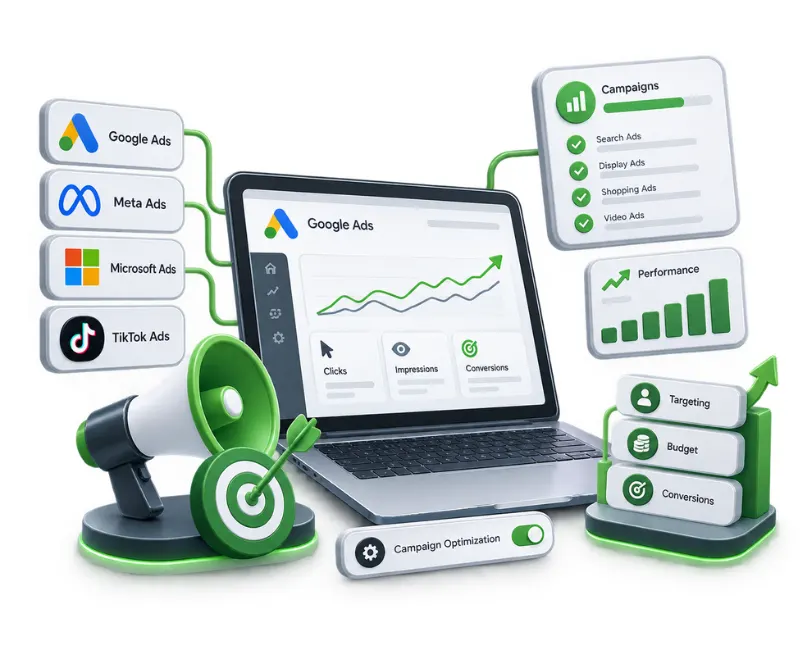
Paid advertising can generate immediate opportunities, but simply launching campaigns is not enough. Effective PPC requires the right targeting, campaign structure, messaging, budget allocation, tracking, and ongoing optimization.
Falconics IT manages PPC campaigns with a business-focused approach, connecting advertising activity with measurable actions such as enquiries, qualified leads, purchases, or other conversion goals.
Whether you are launching paid campaigns for the first time or an existing account is consuming budget without producing enough meaningful outcomes, our approach starts by understanding what you are trying to achieve and where the current campaign is falling short.
PPC Campaign Management covers the planning, execution, monitoring, and improvement of paid advertising campaigns. The work extends beyond creating advertisements; it involves making sure the right audience sees the right message and reaches a relevant destination.
Depending on your objectives, campaign management can include paid search, Google Ads, Meta Ads, remarketing, audience targeting, campaign testing, conversion tracking, and performance analysis.
The exact scope is shaped around your business model, target audience, advertising platforms, budget, and conversion goals.
A strong campaign starts with a clear structure. We assess your business objectives, target customers, products or services, geographical focus, competition, and existing advertising data before defining the campaign direction.
This helps determine campaign types, targeting approach, keyword themes, audience segments, bidding considerations, budget allocation, and conversion goals.
For businesses operating across different regions or customer segments, campaigns can also be structured to separate audiences and locations where meaningful performance differences exist.
Search advertising allows businesses to appear when potential customers are actively looking for relevant products or services.
PPC management can cover keyword research, campaign structure, ad groups, search terms, negative keywords, ad copy, bidding, audience settings, location targeting, and ongoing account refinement.
The objective is not simply to generate clicks. Campaign decisions should reflect the commercial value of the searches being targeted and the actions users take after visiting the website.
For businesses where demand can be developed through audience targeting, paid social campaigns can complement search advertising.
Meta Ads can be structured around relevant customer characteristics, interests, behaviours, remarketing audiences, or campaign objectives. Creative and messaging can then be tested against different audience groups to identify useful patterns.
This can be particularly relevant for ecommerce brands, consumer businesses, service providers, and businesses with visually engaging offers.
Advertising decisions are only as useful as the information behind them. Campaign management therefore needs reliable tracking for the actions that matter to the business.
Where applicable, Falconics IT can work with analytics and tracking systems such as Google Analytics 4 and Google Tag Manager to help establish a clearer view of campaign performance.
Instead of treating clicks and impressions as the final objective, reporting can focus on meaningful conversion actions and the relationship between advertising spend and business outcomes.
PPC accounts require ongoing attention because search behaviour, competition, audience response, creative performance, and conversion patterns can change.
Optimization may involve reviewing search terms, adjusting targeting, refining advertisements, reallocating budget, testing variations, improving bidding strategies, and identifying campaigns or audience segments that need further attention.
The purpose of continuous optimization is to make informed improvements based on observed campaign behaviour rather than relying on assumptions.
A successful advertisement cannot compensate for a confusing or poorly aligned landing experience.
When campaign performance indicates a conversion issue, we look beyond the advertisement itself and consider factors such as message alignment, page relevance, calls to action, user experience, mobile usability, and the clarity of the offer.
Where appropriate, PPC activity can be aligned with Falconics IT's web development, conversion optimization, and analytics capabilities so that advertising and the destination experience work together.
The appropriate outcome depends on the business model and campaign objective. PPC Campaign Management can support:
Generating relevant enquiries for service businesses and B2B companies
Capturing demand from users actively searching for specific solutions
Supporting ecommerce sales and product discovery
Reaching defined audiences through paid social campaigns
Re-engaging previous website visitors through remarketing
Testing offers, messaging, and audience segments with measurable feedback
Building a clearer relationship between advertising spend and conversion activity
PPC should not be treated as a guaranteed source of a particular number of leads, sales, or revenue. Performance depends on factors such as market demand, competition, offer quality, website experience, budget, targeting, and sales follow-up.
01 — Understand & Audit
We begin by reviewing your business objectives, target audience, existing campaigns, website or landing pages, conversion goals, and available performance data. If you already have an active account, the initial review can identify structural or performance issues that need attention.
02 — Plan & Structure
The campaign strategy is developed around the intended customer journey. This includes deciding which platforms and campaign types are appropriate, how audiences or keywords should be organized, and which conversion actions should be measured.
03 — Build & Launch
Campaigns, targeting, advertisements, tracking elements, budgets, and relevant settings are configured before launch. The focus is on creating a measurable foundation rather than treating launch as the end of the process.
04 — Measure & Optimize
Performance data is reviewed to identify what is working, what requires adjustment, and where budget or targeting decisions may need to change. Optimization is carried out progressively rather than through arbitrary changes.
05 — Report & Refine
Performance insights are communicated in a practical format, with attention to the metrics that matter to your campaign objectives. The findings then inform the next cycle of testing and optimization.
The exact deliverables depend on the agreed scope, but a PPC engagement may include:
Campaign and account assessment
Keyword and search-term research
Audience and location targeting
Campaign and ad-group structuring
Ad copy development and testing
Google Ads campaign management
Meta Ads campaign management where relevant
Conversion tracking coordination
Search term and negative keyword management
Budget and bidding optimization
Remarketing campaign management
Performance monitoring and reporting
Ongoing recommendations for campaign improvement
Advertising platform charges are separate from the management scope unless specifically agreed otherwise.
Businesses often approach PPC management when they are facing issues such as high advertising spend without enough qualified enquiries, inconsistent campaign performance, poorly structured accounts, irrelevant search traffic, weak conversion tracking, or uncertainty about where their budget is being used.
The solution is rarely one isolated setting. A campaign can underperform because of the interaction between targeting, keywords, advertisements, landing pages, tracking, budget allocation, and the actual offer.
Our role is to examine those connections and prioritize changes that are relevant to the campaign's commercial objective.
PPC can be useful for businesses that need measurable paid acquisition and have a clear product, service, offer, or conversion objective.
It can be particularly relevant for B2B companies that want to capture high-intent enquiries, ecommerce businesses seeking product sales, startups and growing businesses testing new acquisition channels, and local service businesses targeting customers in specific cities or service areas.
It can also support established businesses that already advertise but want a more structured approach to campaign management, tracking, and optimization.
Falconics IT approaches paid advertising as part of a wider digital growth system rather than treating PPC as an isolated channel.
Our capabilities span PPC, SEO, social media, web development, analytics, CRO, ecommerce, and technology. This allows campaign decisions to be considered alongside the website, tracking setup, content, and conversion journey when those areas affect advertising performance.
The working approach is structured around four practical stages: understanding the business, executing the strategy, measuring performance, and continuously optimizing based on the information available.
You also have the option to work with one digital partner across related marketing and technology requirements instead of coordinating disconnected providers for every part of the customer journey.
Paid advertising in the Indian market can involve diverse audiences, locations, price points, languages, customer behaviours, and levels of purchase intent.
Campaign structure should therefore reflect the actual business rather than relying on a generic setup. Location targeting, search intent, audience segmentation, offer positioning, and conversion paths can all influence how a campaign should be managed.
For businesses targeting multiple Indian cities or regions, campaigns can be structured to distinguish markets where customer demand and performance justify separate treatment.
PPC management pricing is determined by the scope and complexity of the engagement rather than a single fixed figure.
Factors can include the number of advertising platforms, campaign volume, geographical targeting, account complexity, ecommerce requirements, tracking needs, landing page requirements, creative requirements, reporting depth, and the level of ongoing optimization involved.
Your advertising budget and the management fee should be considered separately. A suitable engagement should make the scope of work clear before campaigns are actively managed.
The initial setup period depends on the condition of the existing account, tracking requirements, campaign complexity, website readiness, and the amount of information available.
New campaigns generally require a period of data collection and testing before stronger optimization decisions can be made. Existing campaigns may provide more immediate data for an initial audit, although improvements still depend on the quality and volume of available information.
PPC does not provide guaranteed rankings, leads, sales, revenue, or return on ad spend. Results can be affected by factors outside the advertising account, including market demand, competitors, pricing, website performance, seasonality, and sales processes.
PPC Campaign Management is the ongoing planning, execution, monitoring, and optimization of paid advertising campaigns. It can include campaign strategy, keyword research, audience targeting, ad creation, bidding, budget management, tracking, reporting, and performance improvements.
Yes. Google Ads and paid search management are part of the PPC capabilities relevant to Falconics IT's digital marketing services. The specific campaign scope is determined according to your business objectives and advertising requirements.
Yes, where paid social advertising is appropriate for the campaign. Meta Ads can be incorporated when audience-based targeting, remarketing, or social advertising supports the customer's acquisition strategy.
No. PPC management can be planned for a new advertising setup as well as an existing account. Existing accounts can also be reviewed before ongoing management begins.
Campaigns can begin generating activity soon after launch, but meaningful optimization requires sufficient performance data. The timeframe varies according to budget, competition, conversion volume, targeting, offer quality, and other campaign conditions.
Yes. PPC can be suitable for small businesses when campaigns are structured around a clear commercial objective and an appropriate budget. Targeting can be narrowed by location, audience, search intent, or product/service depending on the campaign.
Reporting can be included within the agreed management scope. Reports should provide useful information about campaign activity and performance rather than simply presenting large volumes of platform metrics.
Yes. Campaigns can be structured around specific locations when geographical targeting is important to the business. The appropriate structure depends on the service area, audience, budget, and performance data.
Landing page requirements can be assessed as part of campaign planning and optimization. If landing page development or major website changes are required, those can be discussed separately according to the project scope.
Ongoing management is useful when campaigns need regular monitoring, testing, budget adjustments, search-term reviews, audience refinement, and performance analysis. The appropriate level of management depends on campaign complexity and business objectives.
Start by sharing your business objectives, target audience, current advertising setup if available, website, target locations, and approximate advertising requirements. Falconics IT can then review the requirements and discuss an appropriate campaign management scope.
Paid advertising works best when campaign decisions are connected to a clear business objective, reliable measurement, and continuous improvement.
Tell Falconics IT what you are promoting, who you want to reach, and what action you want customers to take. We can discuss the campaign structure, tracking requirements, and management scope around your specific business.
Contact our expert team today for a tailored strategy and free consultation.
Get a Free Consultation