
Ready to transform your business with Payment Gateway Integration?
Contact our expert team today for a tailored strategy and free consultation.
Get a Free ConsultationNo services available in this category yet.
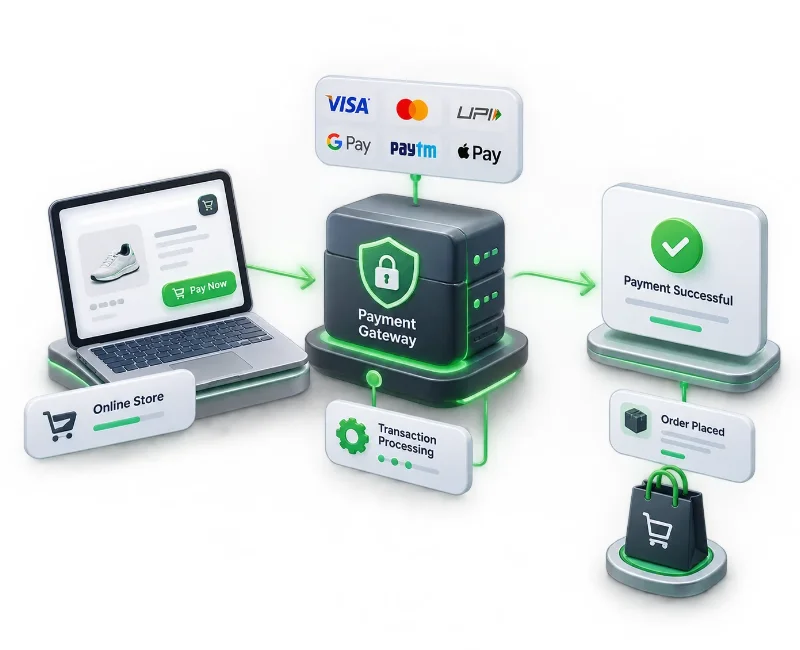
Accepting online payments should be simple for customers and manageable for your business.
Falconics IT provides Payment Gateway Integration services for businesses that need reliable online payment functionality across websites, ecommerce platforms, mobile applications and custom software.
We connect your selected payment gateway with the relevant frontend, backend and business workflows so transactions can be processed, tracked and handled correctly.
Whether you are launching a new ecommerce store, adding payments to an existing application or upgrading an outdated integration, we can structure the implementation around your technical and business requirements.
Payment gateway API integration
Website and ecommerce checkout integration
Mobile app payment integration
Transaction status and webhook handling
Payment success, failure and retry flows
Payment integration involves more than adding a payment button to a website.
The gateway needs to communicate correctly with your website or application, return transaction information, handle unsuccessful payments and keep order, booking or account status synchronized.
Falconics IT can work with existing websites, ecommerce platforms, mobile applications and custom software. The integration is planned around your current technology environment rather than forcing your business into an unnecessary rebuild.
The result is a payment flow designed to fit naturally into the wider customer journey and business process.
The exact scope depends on your platform, gateway and transaction requirements. A typical integration may include:
| Service Area | What It Includes |
|---|---|
| Payment API Integration | Connecting payment gateway APIs with your website, application or software |
| Checkout Integration | Implementing a practical payment experience for customers |
| Payment Status Handling | Managing successful, failed, pending and cancelled transactions |
| Webhooks & Callbacks | Receiving payment updates and synchronizing transaction information |
| Payment Methods | Integrating the payment options supported by the selected gateway |
| Testing & Validation | Testing important payment scenarios before deployment |
| Technical Support | Assistance with integration issues, updates and improvements |
The final deliverables are defined according to your business model and technical requirements.
For ecommerce businesses, payment functionality is a critical part of the purchasing journey.
A technically working payment gateway can still create problems when customers encounter confusing redirects, unclear payment statuses or inconsistent order updates.
Falconics IT can integrate payment functionality into ecommerce websites while considering the complete checkout flow. This can include stores built with platforms such as WooCommerce, Shopify, Magento or custom ecommerce technology.
The objective is to connect payment processing with the shopping experience and the systems responsible for managing orders.
Custom software often requires a more flexible approach than a standard payment plugin.
A payment gateway may need to communicate with user accounts, orders, subscriptions, bookings, invoices, memberships or other application workflows.
Falconics IT can integrate payment APIs into custom applications according to the existing architecture and business logic.
This approach is particularly useful when payment processing is one part of a larger software platform rather than an isolated website feature.
Mobile applications may require payment functionality for purchases, bookings, subscriptions, services or other transactions.
The integration can connect payment initiation, transaction responses and payment status with the application's backend and relevant user workflow.
Falconics IT can support payment integration for Android, iOS and cross-platform applications, depending on the technology and payment provider involved.
The right payment gateway depends on your business model, technology platform, target customers and required payment methods.
For businesses operating in India, payment requirements may include UPI, debit and credit cards, net banking and wallets, depending on the gateway and merchant configuration.
Common payment gateway options may include Razorpay, PayU, Cashfree, Stripe and other providers.
If you already have a preferred gateway, the integration can be planned around it. If you are still evaluating options, the technical requirements can be considered before implementation.
A payment integration needs to account for what happens after a customer initiates a transaction.
Payments may be successful, failed, pending or cancelled. Your website or application needs to respond appropriately to each situation.
Webhook and callback handling can help synchronize payment updates with orders, bookings, user accounts or other business records.
Proper transaction handling also helps reduce situations where the payment provider and your application show different transaction states.
Payment systems should be tested beyond a single successful transaction.
Depending on the project, testing may cover successful payments, failed transactions, cancellations, pending payments, redirects, duplicate responses and other relevant scenarios.
Testing helps identify integration problems before the payment system is used by real customers.
The testing process and scope are determined by the gateway, platform and complexity of the payment workflow.
A well-planned payment integration can improve how customers interact with your digital platform while making transaction management easier for your business.
Smoother checkout experience
Customers can move from product selection, booking or service selection to payment through a more consistent journey.
Clearer transaction management
Payment information can be connected with relevant orders, accounts or business records.
Flexible payment options
Businesses can provide the payment methods supported by their selected gateway and merchant account.
Better platform compatibility
The integration can be developed around your existing website, ecommerce store, application or software.
Scalable payment infrastructure
A properly structured integration can provide a foundation for additional payment-related functionality as your business requirements change.
Every integration is different, but a structured implementation helps reduce avoidable technical issues.
1. Requirement & Platform Assessment
We review your website, ecommerce store, mobile application or software along with the payment requirements and existing transaction workflow.
2. Gateway & Integration Planning
The selected gateway, APIs, payment methods, checkout flow and technical integration points are mapped against your existing platform.
3. Development & Integration
The payment gateway is connected with the required frontend and backend components, including transaction initiation and status handling.
4. Testing & Validation
The integration is tested across relevant transaction scenarios to identify errors before deployment.
5. Deployment & Support
Once the integration is ready, it can be deployed to the production environment. Ongoing maintenance and technical support can be provided according to the project requirements.
Payment integration often connects several parts of a digital system, including the customer interface, application logic, database, order management and external payment provider.
Falconics IT approaches payment integration as part of the broader technology environment rather than treating it as an isolated feature.
Our development capabilities cover websites, ecommerce platforms, mobile applications, custom software and APIs, allowing the payment implementation to be considered alongside the systems it needs to work with.
The focus is on clear requirements, appropriate technical implementation, practical testing and an integration that matches the way your business actually processes transactions.
Payment gateway integration can be useful for businesses that need customers to complete transactions online.
Ecommerce businesses — Accept payments for products and manage transactions alongside online orders.
Startups and growing businesses — Add payment functionality to newly launched websites or applications.
SaaS businesses — Connect payments with software accounts, plans or subscription workflows.
Service businesses — Accept payments for appointments, bookings or professional services.
Marketplaces and platforms — Support more complex transaction and application workflows.
Existing businesses — Upgrade, replace or extend an existing payment integration.
Payment completed but order status remains pending
This can occur when payment responses, callbacks or webhooks are not handled correctly. The integration can be reviewed to ensure relevant transaction updates reach the appropriate business system.
Customers experience confusing payment failures
Payment failures need clear handling so customers understand what happened and what action they can take next.
A payment gateway needs to be connected to a new platform
When a business moves to a new website, ecommerce system or application, the payment integration needs to work with the new technology environment.
A standard plugin no longer meets business requirements
Custom API integration can provide greater control when standard payment functionality does not support the required workflow.
A mobile application needs online payment functionality
The gateway can be connected with the mobile application and its supporting backend according to the selected payment provider and application architecture.
The project timeline depends on the payment provider, technology platform, number of payment flows and level of customization required.
A straightforward integration may require less development than a custom system involving subscriptions, multiple transaction types, complex order logic or several backend integrations.
Before development begins, the scope should clarify the payment gateway, platform, required payment methods, transaction flows, testing requirements and technical dependencies.
There is no standard cost for every payment gateway integration project.
Pricing can vary depending on:
Existing website or application technology
Selected payment gateway
Number of payment methods
Number and complexity of transaction flows
API and backend requirements
Ecommerce or custom application architecture
Testing and deployment requirements
Ongoing maintenance and support
Falconics IT can review your requirements and define the appropriate project scope before providing a quotation.
Payment gateway integration connects a website, ecommerce store, mobile application or software system with a payment provider so customers can make online payments and the application can process the resulting transaction information.
The available options depend on your requirements and the payment provider's integration capabilities. We can work with your preferred gateway or assess the technical requirements for the project.
Yes, UPI can be integrated when it is supported by the selected payment gateway and merchant configuration.
Yes. Payment gateway functionality can be integrated into WooCommerce stores using the appropriate gateway integration method or API.
Payment options can be implemented in Shopify according to the platform's available payment integrations and the selected provider's supported functionality.
Yes. Payment functionality can be incorporated into Android, iOS or cross-platform applications, depending on the gateway and application architecture.
Yes. Existing integrations can be reviewed when businesses experience transaction-status issues, checkout problems, payment failures or new integration requirements.
The timeline varies according to the platform, payment gateway, number of payment flows, customization requirements and testing scope. A simple integration and a complex custom payment system will have different development requirements.
Security depends on the payment provider, integration architecture and implementation practices. The integration should follow the applicable technical and security requirements of the selected payment gateway.
Recurring payments can be implemented when the selected payment provider supports the required functionality. The exact implementation depends on the provider, billing model and application architecture.
You can provide your website or application details, preferred payment gateway, required payment methods and description of the transaction workflow. Existing technical documentation can also help define the integration requirements.
Share your website or application details and explain what you need customers to pay for. Falconics IT can review the requirements and determine the appropriate integration scope.
Your payment gateway should work as a connected part of your website, ecommerce store or application.
Falconics IT can help you plan and implement the payment integration around your platform, transaction workflow and business requirements.
Contact our expert team today for a tailored strategy and free consultation.
Get a Free Consultation