
Ready to transform your business with On-Page SEO?
Contact our expert team today for a tailored strategy and free consultation.
Get a Free ConsultationNo services available in this category yet.
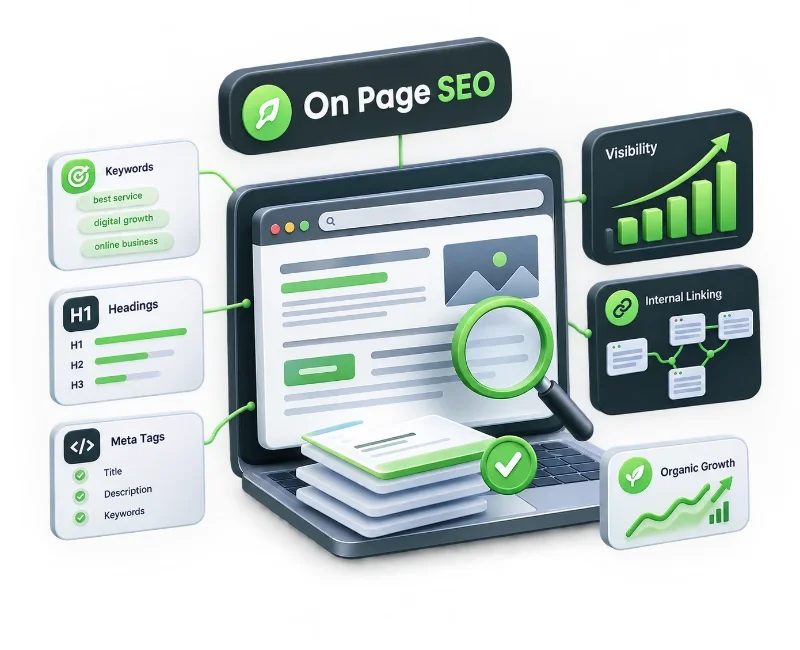
Your website can have valuable products, services, and expertise, but search engines still need clear signals to understand what each page is about and which searches it should serve.
Falconics IT provides On-Page SEO services focused on improving the relevance, structure, and usability of your website. We look beyond simply adding keywords, aligning page content with search intent, optimizing important on-site elements, and creating a stronger connection between your pages and your target audience.
The work can support businesses across India, from growing SMEs and startups to B2B companies, ecommerce brands, and established organizations.
What you can expect:
Search-focused page structure and content
Keyword-to-page mapping based on search intent
Optimized titles, descriptions, headings, and URLs
Stronger internal linking and content relationships
Recommendations that consider both SEO and conversions
On-Page SEO is the optimization of elements within your website that influence how search engines interpret and evaluate individual pages.
That includes more than metadata. Effective optimization considers the relationship between search intent, keywords, page content, headings, internal links, URLs, images, user experience, and the overall structure of the website.
The objective is to make each important page more focused and useful rather than optimizing every page with the same checklist.
A page should target a clear topic and satisfy the reason someone is searching for it.
We assess relevant search terms and map them to the pages where they make the most sense. This helps avoid situations where multiple pages compete for the same topic or where an important service has no clearly optimized landing page.
Keyword placement is handled naturally within titles, headings, copy, and other relevant elements rather than forcing exact-match phrases into the content.
Existing content is reviewed for relevance, clarity, depth, structure, and alignment with the intended search query.
Where appropriate, optimization may involve improving sections, expanding missing information, restructuring copy, clarifying service descriptions, refining calls to action, or identifying content that should be consolidated or rewritten.
The aim is not to make pages longer for the sake of SEO. It is to make them more useful and more closely aligned with what the visitor is actually looking for.
Page titles and meta descriptions help communicate what a page is about in search results, while headings provide structure for both visitors and search engines.
Falconics IT reviews these elements for relevance, clarity, uniqueness, and appropriate keyword usage. Heading structures are also assessed to ensure the page has a logical hierarchy rather than a collection of disconnected keywords.
Clean, descriptive URLs make it easier to understand the subject of a page and maintain a logical website architecture.
We review URL structures alongside navigation and page relationships to identify unnecessary complexity, unclear naming, duplicate page themes, or opportunities to create a more organized site structure.
Internal links help visitors discover related information while helping search engines understand how different pages on your website relate to one another.
Our On-Page SEO work can identify relevant linking opportunities between service pages, product pages, category pages, blogs, and other important resources. The focus is on useful contextual connections rather than adding links simply to increase link counts.
Images can contribute to page experience and accessibility when they are properly implemented.
Depending on the website, on-page optimization may include reviewing image filenames, alternative text, contextual relevance, image placement, and other factors that support a clear and efficient page experience.
On-page optimization often overlaps with technical aspects of how a page is delivered and understood.
Where relevant, we review areas such as crawlability, indexability, canonicalization, structured data opportunities, mobile experience, page performance, and other technical factors that can affect the effectiveness of page-level SEO.
More extensive technical issues can be addressed alongside dedicated Technical SEO when the website requires deeper implementation work.
The exact scope depends on the website, its current condition, and the number and type of pages being optimized.
Typical deliverables may include:
| Area | Typical Work |
|---|---|
| Keyword Mapping | Assign relevant search terms and topics to appropriate pages |
| Content | Improve relevance, structure, clarity, and search intent alignment |
| Metadata | Optimize page titles and meta descriptions |
| Headings | Refine heading structure and topical organization |
| URLs | Review and improve descriptive URL structures where appropriate |
| Internal Links | Identify contextual links between related pages |
| Images | Review image SEO and accessibility-related elements |
| Technical Elements | Identify relevant on-page technical improvements |
| Recommendations | Prioritize issues and opportunities based on business importance |
Not every website requires every item. The scope is shaped around the pages and problems that matter most.
Well-structured pages give search engines clearer information while giving visitors a more coherent experience.
For a business, that can create several practical advantages:
More relevant organic visibility
Pages are aligned more closely with the topics and searches they are intended to address.
Better content clarity
Visitors can understand what a page offers without working through poorly structured or unfocused copy.
Stronger website architecture
Internal links and logical page relationships make important information easier to discover.
Improved conversion pathways
SEO recommendations can be considered alongside calls to action, page structure, and the visitor journey.
A stronger foundation for broader SEO
On-page optimization provides an important base for activities such as technical SEO, content development, local SEO, and authority building.
Falconics IT follows a structured process while keeping the scope specific to the website.
01 — Understand
We review the business, target audience, website structure, important offerings, existing SEO work, and commercial priorities.
02 — Audit & Research
Key pages and on-site elements are assessed alongside relevant search topics, content gaps, page relationships, and optimization opportunities.
03 — Prioritize
Not every SEO issue has the same business value. We identify changes that should be addressed first based on relevance, impact, page importance, and implementation requirements.
04 — Optimize
The agreed improvements are implemented across relevant pages, including content, metadata, headings, internal links, URLs, and other applicable on-page elements.
05 — Measure & Refine
Performance and page-level signals are reviewed to identify further opportunities. SEO is treated as an ongoing process rather than a one-time checklist.
Falconics IT combines digital marketing, web development, analytics, and technology capabilities under one team. That matters when SEO recommendations involve not just content, but also website structure, implementation, tracking, UX, or conversion considerations.
Our broader approach starts with understanding the business and its objectives before moving into execution. SEO work can therefore be considered alongside the website and other digital channels rather than in isolation.
The focus is on practical recommendations, clear execution, and continuous improvement rather than unsupported ranking promises.
Startups and growing businesses can establish a clearer search foundation as their website and content portfolio expand.
B2B companies can optimize service and solution pages around the specific problems, industries, and searches that potential buyers use.
Ecommerce businesses can improve the structure and relevance of product, category, and supporting content pages.
Professional service firms can make service pages more useful to prospects while improving their alignment with relevant search intent.
Established websites can address outdated, overlapping, underperforming, or poorly structured pages without rebuilding the entire website.
Many websites do not have a single major SEO problem. Instead, performance can be limited by a collection of smaller issues.
Common examples include pages targeting unclear topics, duplicated metadata, weak headings, poorly structured content, missing internal links, keyword cannibalization, thin service pages, unclear URLs, outdated information, or pages that attract visitors without giving them a clear next step.
Our role is to identify which issues actually matter for your website and prioritize them accordingly.
On-Page SEO focuses primarily on what exists within your website: content, page structure, metadata, internal linking, URLs, and other page-level signals.
Technical SEO addresses the technical systems that affect crawling, indexing, performance, and website accessibility.
Off-Page SEO focuses on signals and activities outside the website, including link acquisition and broader authority-building efforts.
These areas work together, but they solve different problems. A website may need one, two, or all three depending on its current situation and competitive environment.
There is no useful one-size-fits-all price for On-Page SEO because the scope can vary substantially between websites.
Pricing is generally influenced by factors such as the number of pages, website size, current optimization level, content requirements, technical complexity, ecommerce or CMS structure, research depth, and whether implementation is included.
After reviewing the website and requirements, the engagement can be scoped around the work that actually needs to be done rather than applying unnecessary services.
The time required depends on the size and condition of the website and how quickly recommended changes can be implemented.
Initial audits and optimization recommendations can be completed within the project workflow, while broader SEO improvements may take longer to evaluate because search visibility depends on competition, website authority, content quality, technical factors, and search engine processing.
On-Page SEO can improve the quality and relevance of a website, but no responsible SEO provider can guarantee a specific ranking position, traffic level, or revenue outcome.
On-Page SEO is the process of improving elements within a website so search engines can better understand its content and visitors can find and use the information more easily. It includes content, keywords, metadata, headings, URLs, internal links, and other relevant page-level factors.
The scope can include keyword and search-intent mapping, content optimization, title and meta description optimization, heading improvements, URL reviews, internal linking, image optimization, and relevant technical on-page recommendations.
Yes. On-Page SEO focuses largely on page content and structure, while Technical SEO deals more deeply with crawling, indexing, performance, website architecture, and other technical systems. There is some overlap between the two.
The timeline depends on the number of pages, website complexity, existing SEO condition, content requirements, and implementation process. A smaller website may require considerably less work than a large ecommerce or enterprise website.
Yes. On-Page SEO can be performed on an existing website without requiring a complete redesign. The first step is to identify which existing pages and elements need improvement.
No. Rankings depend on many factors beyond on-page optimization, including competition, authority, technical health, content quality, search intent, and search engine changes. A responsible SEO engagement should focus on improving the factors within the website's control rather than guaranteeing a specific position.
Not necessarily. Existing content can often be improved through restructuring, refinement, expansion, consolidation, or better search-intent alignment. New content is recommended when an important search topic is not adequately covered.
It can contribute to a better conversion path by making pages clearer, more relevant, easier to navigate, and better aligned with visitor intent. Conversion performance also depends on factors such as the offer, pricing, trust signals, UX, and overall sales process.
Yes. Ecommerce websites can benefit from optimization across category pages, product pages, collections, informational content, internal links, metadata, and site structure. The exact priorities depend on the catalogue and platform.
Depending on the project, we may need access to the website or CMS, existing SEO and analytics information, business priorities, target audiences, product or service information, and approval for content or technical changes.
Start with a discussion about your website, business objectives, target audience, and current SEO challenges. Falconics IT can then determine the appropriate On-Page SEO scope and recommend the next steps.
Your website should make it clear what you offer, who it serves, and why each important page deserves to be found.
Falconics IT can assess your current website and identify practical On-Page SEO opportunities across content, structure, metadata, internal linking, and other relevant page-level elements.
Contact our expert team today for a tailored strategy and free consultation.
Get a Free Consultation