
Ready to transform your business with Motion Graphics?
Contact our expert team today for a tailored strategy and free consultation.
Get a Free ConsultationNo services available in this category yet.
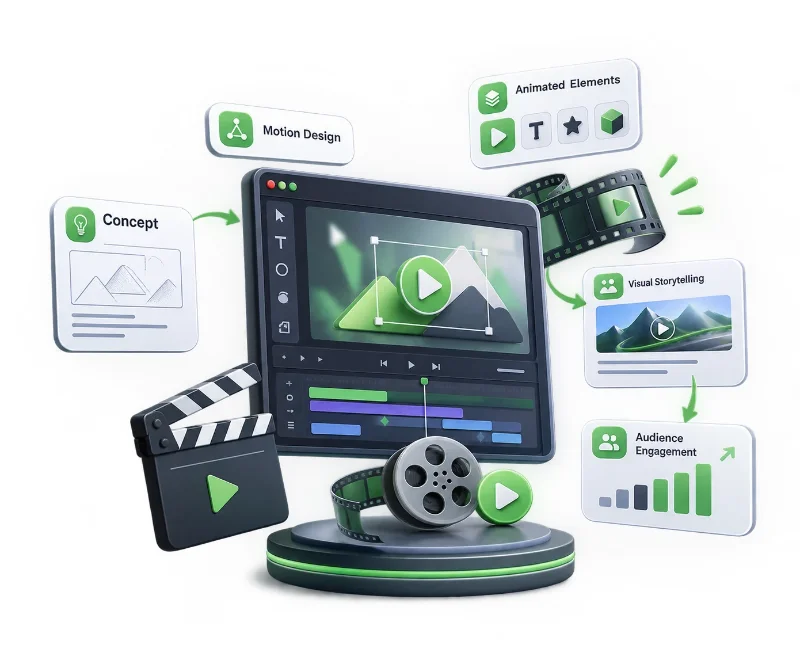
Static visuals can communicate a message, but movement can add context, sequence and attention. Falconics IT creates motion graphics that combine design, animation, typography and visual storytelling to communicate business ideas in a concise and engaging format.
Whether you need an explainer animation, product visual, animated infographic, social media creative or branded motion content, the approach starts with your message, audience and intended platform.
What we focus on:
Motion graphics are animated visual elements used to communicate information, products, services, processes or brand messages. They can combine typography, illustrations, icons, shapes, product visuals, transitions and other designed elements into a moving visual narrative.
Unlike live-action production, motion graphics can communicate many concepts without requiring a physical shoot. This makes them useful when a business needs to demonstrate a process, explain a digital product, present information or create branded content in a controlled visual environment.
Effective motion design is more than adding animation to an existing graphic. The visual sequence needs to support what the viewer is supposed to understand, remember or do next.
A product may need a feature demonstration. A technology company may need to simplify a complex workflow. A marketing campaign may need short-form animated content that communicates one idea quickly. Each requirement calls for a different visual treatment.
Falconics IT approaches the creative direction around the message, audience, brand, content format and distribution platform rather than applying the same animation style to every project.
Explain a product, service, workflow or business concept through a structured combination of visuals, animation and messaging. Explainer content can be particularly useful when the subject is difficult to communicate through static content alone.
Show how a product works, demonstrate important features or visually communicate a product's functionality. Animated product visuals can be used across websites, presentations, campaigns and promotional content.
Create short-form animated content for social platforms, campaigns, announcements, educational posts and promotional communication. The format can be adapted to the platform and the intended viewing experience.
Turn statistics, processes, comparisons, charts and other information into motion-based visual content. Animation can reveal information progressively, helping viewers follow a sequence instead of receiving everything at once.
Give an existing brand identity a motion treatment for videos, presentations, websites, advertisements and other branded communication. The animation can be developed to complement the existing visual identity rather than distract from it.
Create professional animated content for business presentations, internal communication, training material, events, product demonstrations and corporate campaigns.
Motion graphics can support different stages of the customer and communication journey. The same creative concept can also be adapted into different formats when a campaign requires multiple placements.
Common applications include:
Some information becomes easier to understand when it is presented progressively.
Instead of placing a complete process on screen at once, motion can guide the viewer from one point to the next. A software workflow, for example, can move from the problem to the solution, demonstrate how the product works and then highlight the relevant outcome.
The creative structure depends on the subject, but a useful narrative may follow:
Problem → Solution → How It Works → Key Information → Next Step
The objective is not simply to make content move. It is to give the viewer a logical visual path through the message.
Motion graphics can be adapted to different business models and communication requirements.
Technology and SaaS: Explain software workflows, product functionality, integrations or technical concepts.
E-commerce and Product Brands: Highlight product features, demonstrations, benefits and promotional messages.
B2B Companies: Simplify complex services, processes, solutions and business propositions.
Education and Training: Present concepts, processes and learning material through structured animation.
Real Estate: Present project information, property features, layouts or development concepts through visual storytelling.
Professional Services: Make intangible services and processes easier for prospective customers to understand.
Good motion graphics combine visual design with communication strategy. The animation should support the information rather than compete with it.
A well-planned project can help you:
The final impact depends on the quality of the concept, design, messaging, animation and its relevance to the intended audience.
We begin by understanding what the animation needs to communicate and where it will be used. The discussion can cover your business objective, audience, core message, brand identity and desired outcome.
The message is translated into a suitable visual concept and content structure. This is where the overall storytelling direction, visual style, pacing and format are considered.
Graphic elements are developed around the approved direction. Typography, illustrations, icons, product visuals and other elements are designed to work together as one visual system.
The designed elements are brought to life through motion, transitions and timing. The animation is refined to maintain visual clarity, appropriate pacing and consistency with the creative direction.
The completed motion graphic is prepared according to its intended use and required format. Where applicable, the creative can be adapted for different digital placements.
The exact deliverables depend on the scope and creative requirements, but a motion graphics project may include:
The final scope should be established before production so that the creative direction, number of assets, duration, formats and revision requirements are clear.
“Our product is difficult to explain.”
A structured animation can break the product or workflow into smaller visual steps.
“Our social content feels too static.”
Motion-based creative can introduce movement, pacing and visual storytelling while retaining the brand's existing identity.
“Our presentations contain too much information.”
Animated diagrams, charts and visual sequences can help reveal information progressively.
“Our service is intangible.”
Motion graphics can visually represent processes, workflows and concepts that are otherwise difficult to show.
“We need content for different platforms.”
The creative direction can be planned with the intended platforms and formats in mind from the beginning.
Falconics IT combines creative services with a wider digital and technology environment. The company's service portfolio spans branding and creative, digital marketing, web development, software, AI and automation, media and advertising, and data and analytics.
That broader understanding can be useful when motion graphics are part of a larger digital requirement rather than an isolated creative asset. A motion graphic may ultimately appear on a website, support a marketing campaign, explain a software product or become part of a broader brand communication system.
The focus is therefore on creating visual content that has a clear purpose within the business communication journey—not animation simply for the sake of adding movement.
Motion graphics can be relevant to:
The right format depends on the audience, message, platform and purpose of the content.
Motion graphics pricing depends on the actual scope rather than a fixed universal rate. Factors can include:
A clear project brief allows the scope and commercial requirements to be discussed before production begins.
The production timeline depends on the complexity of the concept, amount of content, number of scenes, design requirements, feedback cycles and final output formats.
Projects generally move from briefing and creative planning through visual design, animation, review and final delivery. Providing the required brand assets, product information, scripts and feedback promptly can help keep the production process organized.
Motion graphics should also be evaluated according to their communication objective. There is no universal timeframe in which a particular business outcome can be guaranteed.
Motion graphics are animated graphic elements used to communicate information, products, services, processes or brand messages through movement, design and visual storytelling.
The service can cover explainer motion graphics, product and feature animation, social media motion graphics, animated infographics, logo animation and corporate motion graphics, depending on the project scope.
Yes. Motion graphics can be designed as short-form content for social posts, campaigns, promotional communication and other platform-specific placements.
Yes. Motion graphics can be used for website sections, product demonstrations, process explanations, animated visuals and other digital communication requirements.
Yes. Animation can break technical workflows, software functionality and product processes into smaller visual sequences that are easier to follow.
Not necessarily. The required level of input depends on the project. You can provide existing messaging, product information, a rough concept or other relevant material, after which the creative direction and content structure can be discussed.
Yes. The visual direction can be developed around your existing brand elements, including typography, colors, graphic style and other relevant identity guidelines.
There is no single timeline for every project. Duration depends on factors such as animation complexity, content length, number of scenes, design requirements, revisions and output formats.
Pricing depends on the project's scope, complexity, duration, design requirements, number of assets, revisions and final deliverables. A project-specific scope is required before determining the engagement cost.
Yes. The required output formats and dimensions can be considered during planning so the creative is suitable for its intended platforms.
Share your business objective, the message you want to communicate, intended platform, available brand assets and any existing script or reference material. Falconics IT can then discuss the appropriate creative direction and project scope.
The strongest motion graphics begin with a clear message. Whether you need to explain a product, demonstrate a process, communicate a service or create more engaging branded content, the animation should have a defined role in the overall communication.
Falconics IT can help turn that requirement into structured, purposeful motion content designed around your business, audience and intended platform.
Have a product, service or business message that is difficult to communicate through static content?
Contact our expert team today for a tailored strategy and free consultation.
Get a Free Consultation