
Ready to transform your business with Meta Ads?
Contact our expert team today for a tailored strategy and free consultation.
Get a Free ConsultationNo services available in this category yet.
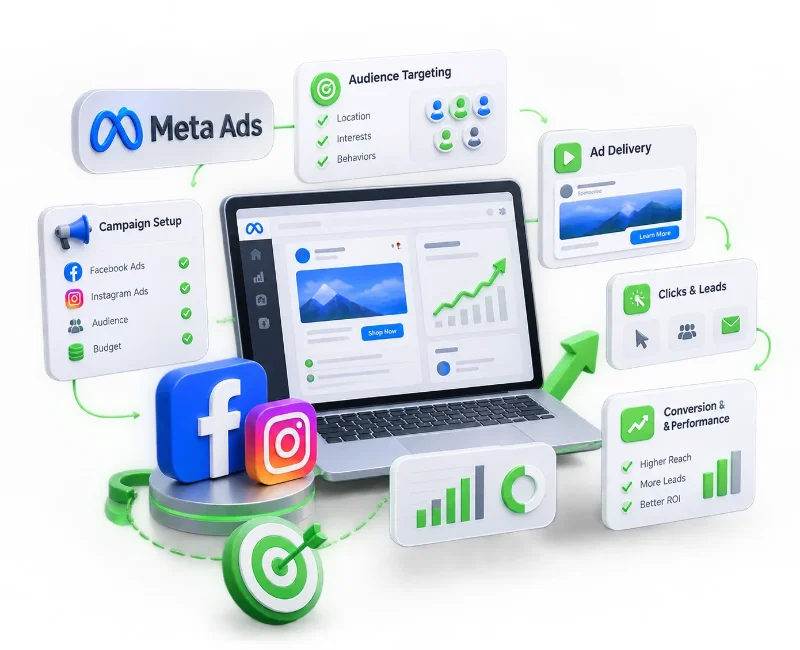
Reach the right audience on Facebook and Instagram with Meta Ads built around your business goals—not just impressions or clicks.
Falconics IT plans, manages and optimizes paid social campaigns for businesses that want a more structured approach to customer acquisition. From campaign setup and audience research to creative testing, retargeting and performance analysis, we manage the moving parts that influence campaign efficiency.
Whether the objective is generating qualified enquiries, increasing ecommerce purchases, promoting a service, or building demand for a new offer, the campaign structure is shaped around the outcome you need.
Why work with Falconics IT?
Campaign strategy aligned with your business objective
Audience and funnel planning based on customer behaviour
Creative and ad-format testing
Ongoing budget and campaign optimization
Tracking and performance-focused reporting
Meta advertising gives businesses access to customers across Facebook and Instagram through a range of campaign formats and objectives.
The opportunity, however, is not simply putting an advertisement in front of more people. Effective paid social campaigns require a clear understanding of who should see the ad, what message they need, where they are in the buying journey, and what action should follow.
For an ecommerce brand, that may mean product-focused campaigns and retargeting visitors who did not purchase. For a B2B or service business, the focus may be qualified enquiries, lead forms or landing-page conversions. For a local business, campaigns can be structured around a defined geographic audience and a specific offer.
Falconics IT connects these decisions into a single campaign strategy rather than treating each advertisement as an isolated activity.
We manage the core advertising process across Meta's advertising ecosystem, from campaign planning and setup through monitoring and optimization.
Campaign structures can be developed around objectives such as lead generation, website conversions, ecommerce sales, remarketing or other relevant business actions. The account structure is planned to make testing and performance analysis more meaningful as campaigns mature.
Audience quality has a direct influence on how relevant an advertisement is to the people who see it.
We assess your offer, customer profile, location, buying behaviour and funnel stage to develop appropriate audience strategies. Depending on the campaign, this can include prospecting audiences, remarketing groups, customer-based audiences and other suitable targeting approaches.
The goal is not to target as narrowly as possible. It is to create an audience structure that gives the campaign enough relevance and room to learn.
A well-structured campaign still needs advertising that earns attention and communicates the offer quickly.
Creative planning can cover static advertisements, carousels, short-form video, Reels and other formats appropriate to the campaign. We consider the hook, message, offer, visual treatment and call to action rather than relying on one creative concept throughout the campaign.
Testing different creative directions helps identify which messages and formats deserve further investment.
For businesses where enquiries are more valuable than direct online purchases, Meta lead campaigns can be structured around the quality and relevance of prospective customers.
Campaigns may use Meta lead forms or send users to a dedicated landing page, depending on the sales process and tracking requirements. The campaign strategy can also account for qualification questions, follow-up processes and the difference between generating a lead and generating a useful sales opportunity.
For online businesses, the advertising strategy needs to connect media spend with the purchasing journey.
We can structure campaigns around products, offers, customer segments and remarketing opportunities while monitoring relevant performance signals such as conversion volume, cost per acquisition, revenue contribution and return on ad spend where reliable tracking is available.
The emphasis is on understanding what is happening after the click—not simply optimizing for inexpensive traffic.
Many potential customers do not convert during their first interaction with a brand.
Retargeting helps businesses reconnect with people who have already interacted with the website, products, content or advertisements, where the necessary tracking and audience data are available.
Different messages can be used for different stages of the journey, helping move users from initial interest toward enquiry or purchase without showing every visitor the same advertisement.
The exact scope depends on your campaign requirements, but a typical engagement may cover:
Account and campaign structure planning
Audience research and campaign targeting
Campaign setup and configuration
Ad copy and creative direction
Creative and audience testing
Lead generation or conversion campaigns
Retargeting campaigns
Budget allocation and optimization
Conversion and event tracking coordination
Performance monitoring and reporting
Ongoing campaign recommendations
Creative production, landing-page development, advanced tracking or other supporting services can be incorporated where required and agreed as part of the project scope.
Our process is designed to establish a clear foundation before increasing campaign complexity or spend.
1. Understand the Business
We begin with your offer, audience, sales process, market, competition, objectives and existing advertising activity. If you already have campaigns running, their structure and performance provide useful starting information.
2. Build the Campaign Strategy
We determine the appropriate campaign objectives, audience structure, funnel stages, messaging direction and measurement approach. The strategy is shaped around what constitutes a meaningful business outcome for your company.
3. Launch & Test
Campaigns are launched with controlled variables so that audiences, messages, formats and creative concepts can be evaluated more effectively.
4. Measure & Optimize
Performance data is reviewed to identify what is working, where costs are increasing and which parts of the campaign require adjustment. Changes may involve creative, audience allocation, campaign structure, budget distribution or conversion paths.
5. Scale What Makes Business Sense
When a campaign demonstrates sustainable performance and sufficient data is available, budgets can be adjusted progressively. Scaling is treated as an optimization decision rather than simply increasing spend.
Meta Ads can support different commercial objectives, so success should be defined according to your business model.
For some businesses, the priority is qualified leads rather than a high volume of form submissions. For ecommerce brands, it may be profitable customer acquisition and repeat purchasing. For a new product or service, the initial objective may be building demand and learning which audiences and messages respond.
This approach keeps campaign reporting connected to business decisions instead of relying exclusively on surface-level advertising metrics.
Meta Ads can be useful for businesses with a clearly defined audience, offer and conversion path.
Ecommerce and D2C brands can use Facebook and Instagram advertising to introduce products, generate purchases and reconnect with previous visitors or customers.
Service businesses can use lead-focused campaigns to generate enquiries for consultations, appointments, quotes or other services.
B2B companies can use paid social selectively to build awareness, reach defined audiences and support lead-generation campaigns where the offer and buying journey are suitable for the channel.
Local businesses can use geographic targeting and offer-led campaigns to reach prospective customers within relevant service areas.
Startups and growing businesses can use structured testing to learn which audiences, positioning and creative approaches generate meaningful responses before committing more budget.
Poor campaign performance is not always caused by the advertising platform itself. The underlying issue may be the offer, audience, creative, tracking, landing page or campaign structure.
Falconics IT can help businesses address situations such as:
Campaigns receiving clicks but producing few meaningful enquiries
Rising acquisition costs without a clear explanation
Ads becoming repetitive or losing audience response
Too much budget concentrated in campaigns that are not contributing enough
Weak retargeting or disconnected funnel stages
Limited visibility into which campaigns, audiences or creatives are actually contributing to results
The first step is identifying where the bottleneck sits before deciding what needs to change.
Campaign management should make it easier to understand where advertising spend is going and what the data suggests doing next.
Reporting can cover relevant metrics such as spend, reach, impressions, clicks, cost per result, conversions, conversion rate and other campaign-specific indicators. For ecommerce campaigns, additional commercial metrics can be incorporated when reliable revenue tracking is available.
The purpose of reporting is not simply to present numbers. It is to explain what changed, what requires attention and what should be tested next.
Falconics IT brings marketing, creative, technology and analytics capabilities under one digital services team. That can be particularly useful when paid advertising depends on more than campaign management alone.
A Meta campaign may require landing-page improvements, analytics configuration, creative development, ecommerce support or conversion optimization. Having related capabilities within the same organization can make it easier to coordinate these areas rather than treating advertising as a completely separate activity.
Our broader approach follows four principles: understand the business first, execute against a defined strategy, measure what matters, and continuously improve based on evidence.
There is no sensible single price for every Meta Ads engagement because the required work varies significantly between businesses.
Pricing can depend on factors such as:
Campaign complexity and number of campaigns
Monthly advertising spend
Number of audiences and markets
Creative requirements
Lead generation versus ecommerce objectives
Tracking and analytics requirements
Landing-page or conversion requirements
Reporting frequency
Ongoing optimization and support
Your advertising budget and the management fee are separate considerations. A suitable engagement should make both clear before campaigns begin.
Paid advertising requires testing and learning. Performance can change based on competition, audience response, offer strength, creative quality, seasonality, website experience, tracking quality and available conversion data.
For that reason, Falconics IT does not promise guaranteed rankings, leads, sales or revenue from Meta advertising.
Instead, the focus is on establishing a sound campaign structure, collecting useful performance data, identifying opportunities and making informed optimization decisions over time.
The timeline for meaningful insights also depends on the campaign objective, budget, conversion volume and quality of the initial setup.
Depending on the agreed scope, services can include campaign strategy, audience research, campaign setup, ad copy and creative direction, testing, retargeting advertising budget. We can then determine the appropriate campaign, optimization, tracking coordination and performance reporting.
Yes. Meta's advertising ecosystem allows campaigns to reach users across Facebook and Instagram, with placement and creative decisions based on the campaign objective and audience.
Yes. Lead generation can be structured around Meta instant forms or website-based conversion journeys, depending on your sales process and tracking setup.
Yes. Ecommerce campaigns can be structured around product promotion, customer acquisition, remarketing and purchase-focused objectives where the website and tracking environment support them.
Creative requirements vary by engagement. Creative strategy and direction can be included, while design, video production, UGC-style content or other production requirements can be scoped separately when needed.
There is no universal budget that works for every business. A suitable budget depends on your objective, audience size, customer economics, expected conversion volume and the amount of testing required. We can recommend a campaign structure after understanding these factors.
Some campaigns generate early performance signals quickly, but meaningful optimization generally requires enough data to compare audiences, creatives and conversion behaviour. The timeline varies according to budget, objective, conversion volume and market conditions.
No responsible advertising provider can guarantee a specific number of leads, sales or revenue because campaign outcomes depend on factors beyond media management, including the offer, market demand, competition, website experience and sales follow-up.
Yes. Campaigns can be structured around relevant geographic markets, customer segments, interests, behaviours and other available targeting approaches, subject to Meta's advertising policies and available data.
Start by sharing your business objective, target audience, website or landing page, current advertising setup if available, and approximate advertising budget. We can then determine the appropriate campaign scope and next steps.
If your business is ready to use Facebook and Instagram advertising more strategically, Falconics IT can help you turn the campaign requirements into a practical plan—from audience and creative strategy through execution, measurement and ongoing optimization.
Contact our expert team today for a tailored strategy and free consultation.
Get a Free Consultation