
Ready to transform your business with Magento Development?
Contact our expert team today for a tailored strategy and free consultation.
Get a Free ConsultationNo services available in this category yet.
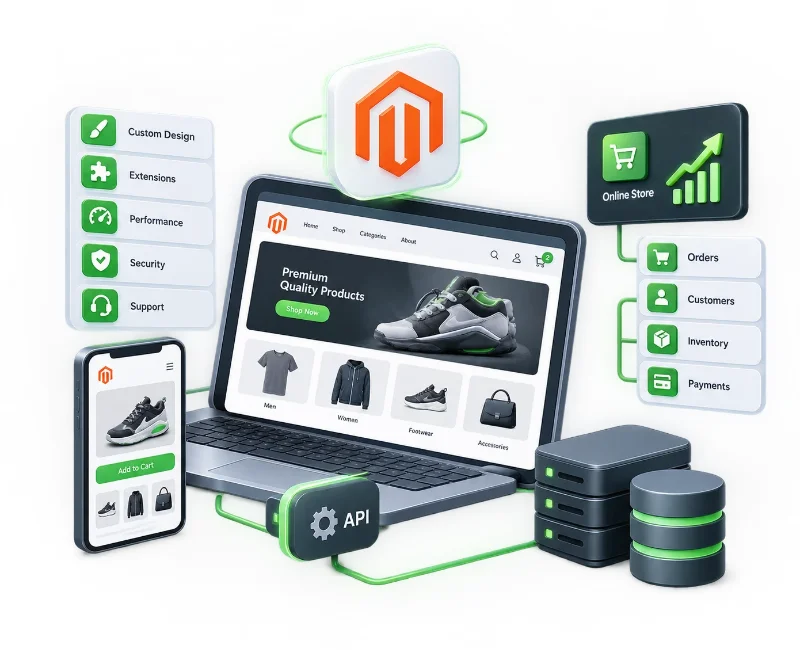
Magento development for businesses that need more than a standard online store. Falconics IT Solutions builds and customizes Magento ecommerce experiences around your catalog, customer journeys, integrations, operational workflows, and long-term technical requirements.
Whether you are launching a new store, improving an existing Magento website, migrating from another platform, or adding complex functionality, we focus on creating a dependable ecommerce foundation rather than adding features without a clear business purpose.
Build a Magento store around your business — not the other way around.
Custom ecommerce functionality aligned with your workflows
Third-party integrations for payments, shipping, ERP, CRM, and other systems
Scalable architecture for growing catalogs and transaction volumes
Ongoing technical maintenance and optimization
A Magento store can support sophisticated ecommerce requirements, but the platform delivers value only when its architecture, storefront, integrations, and administration are configured correctly.
Falconics approaches Magento development from the business side as well as the technical side. We first understand how products are managed, how customers purchase, how orders move through your organization, and which systems need to communicate with the store.
That foundation helps us determine where Magento's existing capabilities are sufficient and where custom development or integrations are genuinely required.
Our Magento development services can cover individual requirements or a complete ecommerce implementation, depending on your project.
Magento Store Development
For new ecommerce businesses, we can develop a Magento storefront around your catalog structure, customer experience, checkout requirements, business rules, and operational needs. The objective is to create a store that is usable from launch and flexible enough for future improvements.
Custom Magento Development
When standard Magento functionality does not accommodate a specific business workflow, custom development can bridge the gap. This may include custom modules, product logic, customer-specific functionality, checkout modifications, dashboards, or other store-specific features.
Magento 2 Development
We develop and customize Magento 2 stores with attention to storefront experience, backend functionality, integrations, maintainability, and technical performance.
Magento Migration
Moving an ecommerce operation to Magento requires more than transferring products. Depending on the existing platform, migration can involve product data, categories, customer accounts, orders, media, URLs, integrations, and business rules.
A structured migration helps reduce disruption while giving the new store a cleaner technical foundation.
Magento API & Third-Party Integrations
Your ecommerce store may need to exchange information with payment gateways, shipping providers, ERP systems, CRM platforms, inventory software, marketplaces, analytics tools, or other business applications.
We can plan and implement integrations according to the systems and workflows your business actually uses.
Magento Performance Optimization
Slow pages, inefficient database operations, excessive extensions, poorly configured hosting, and inefficient custom code can all affect an ecommerce store.
Performance work focuses on identifying the underlying bottlenecks and improving the technical areas that are limiting the store's responsiveness and reliability.
Magento Maintenance & Support
Magento stores require ongoing attention as technologies, integrations, security requirements, extensions, and business needs change. Ongoing support can include technical troubleshooting, updates, bug fixes, performance improvements, compatibility work, and feature enhancements.
Magento becomes particularly useful when an ecommerce operation has requirements that extend beyond a basic product-and-checkout setup.
Depending on the project, your store can be structured around:
Large or complex product catalogs
Multiple customer groups and pricing rules
B2B purchasing workflows
Multiple websites, stores, or regional storefronts
Custom checkout and ordering requirements
Payment and shipping integrations
ERP, CRM, inventory, and business-system connections
Product configurations and business-specific purchasing rules
The exact implementation depends on your existing systems, business model, catalog structure, and operational requirements. We recommend functionality based on its practical role rather than adding complexity simply because Magento supports it.
A successful Magento project starts before development begins. Our process is structured to reduce avoidable rework and keep technical decisions connected to business requirements.
01 — Discovery & Requirement Mapping
We examine your business model, products, customers, current technology stack, integrations, operational workflows, and project objectives. For an existing store, we also identify technical limitations and areas requiring improvement.
02 — Architecture & Planning
The requirements are translated into a practical development plan covering functionality, integrations, data structures, storefront requirements, and technical dependencies.
03 — Development & Integration
Our developers build the required Magento functionality, configure the store, implement integrations, and develop custom components where standard functionality is not sufficient.
04 — Testing & Quality Checks
Before launch, the store is tested across key customer and administrative workflows. Functional behavior, integrations, forms, checkout processes, responsive experience, and relevant performance considerations are reviewed.
05 — Launch & Ongoing Improvement
After deployment, we can continue supporting the store with maintenance, troubleshooting, enhancements, performance work, and technical updates according to your requirements.
The exact deliverables depend on your scope, but a Magento development engagement can include:
| Area | Potential Deliverables |
|---|---|
| Storefront | Magento ecommerce website, responsive interfaces, navigation and shopping experience |
| Development | Custom modules, functionality, business rules and Magento configurations |
| Integrations | Payment, shipping, ERP, CRM, inventory, API and third-party integrations |
| Migration | Product, customer, order, category and relevant store data migration |
| Performance | Technical analysis and targeted optimization |
| Quality Assurance | Functional, responsive and integration testing |
| Support | Maintenance, troubleshooting, updates and further development |
Only the components relevant to your project are included in the final scope.
B2C Ecommerce
For consumer-facing stores, development can focus on product discovery, merchandising, customer accounts, checkout, promotions, payments, and a friction-free purchasing journey.
B2B Ecommerce
B2B businesses often require different rules around customer accounts, pricing, approvals, quantities, ordering, and purchasing workflows. Magento can be customized around these requirements rather than forcing B2B processes into a consumer-oriented experience.
Growing Ecommerce Businesses
Businesses moving beyond a basic ecommerce setup may need stronger catalog management, integrations, automation, performance improvements, or a more flexible technical foundation.
Established Ecommerce Operations
For businesses with an existing Magento store, the requirement may be modernization rather than rebuilding everything. Targeted improvements can address technical debt, integrations, performance, UX, or new business functionality.
Magento projects often begin with a specific business problem rather than a desire for technology alone.
Falconics can help address situations such as:
An existing store has become difficult to maintain or extend
The ecommerce platform needs functionality that standard features cannot provide
Business systems are not exchanging data reliably
A store needs to migrate from another ecommerce platform
Complex product, pricing, customer, or ordering rules need to be implemented
Store performance needs technical investigation and improvement
New ecommerce requirements require ongoing Magento development support
The solution begins with identifying the actual constraint. A store does not necessarily need a complete rebuild when a targeted technical change can solve the underlying problem.
Falconics IT Solutions brings web development, ecommerce, technology, analytics, automation, and digital growth capabilities under one organization. This can be useful when your Magento project involves more than development alone.
Our approach emphasizes understanding the business requirement before deciding how it should be implemented. That means technical choices are considered alongside usability, integrations, maintainability, and the wider ecommerce operation.
You also have access to related capabilities when your project requires them, including ecommerce development, SEO, analytics, custom software, cloud infrastructure, AI automation, and digital growth services.
The result is a development relationship built around the actual requirements of your ecommerce operation rather than a fixed package of unrelated features.
Magento development pricing varies significantly because projects can range from a focused customization to a complex ecommerce implementation.
The main factors include:
Number and complexity of required features
Custom design and frontend requirements
Catalog size and product complexity
Third-party integrations
Migration requirements and data volume
B2B or multi-store functionality
Existing code quality and technical debt
Performance, hosting, security, and infrastructure requirements
Ongoing maintenance and development support
Rather than applying a generic package price, the appropriate approach is to define the scope first and then estimate the development effort required.
The timeline depends on the size and complexity of the implementation. A focused customization will naturally require less work than a new ecommerce platform involving extensive integrations, migration, custom workflows, and multiple storefronts.
Project progress can also be affected by factors outside development, including requirement changes, third-party systems, data preparation, content availability, approvals, and client feedback.
Before development begins, the scope should establish what is being built, which systems are involved, what information is required from the client, and how the work will be reviewed.
If you already have a Magento store, we can discuss the technical or business issue you are trying to solve. If you are starting from another ecommerce platform, we can review your requirements and determine what the Magento implementation needs to support.
Magento development involves building, customizing, integrating, migrating, and maintaining ecommerce stores using the Magento platform. It can range from creating a new store to developing custom functionality for an established ecommerce operation.
Yes. Magento stores can be developed around your product catalog, customer journey, integrations, business rules, and operational requirements. The scope is defined according to what the business actually needs.
Yes. Existing stores can be enhanced through custom modules, functionality changes, integrations, performance work, frontend improvements, and other technical modifications.
Magento migration can involve transferring relevant store data and rebuilding or adapting functionality for the new platform. The migration approach depends on your current ecommerce platform, data structure, custom features, integrations, and SEO requirements.
Magento can integrate with external business systems through APIs and other integration methods. The exact approach depends on the ERP, CRM, inventory system, data requirements, and workflows involved.
Yes. B2B ecommerce may require functionality such as customer-specific pricing, account structures, purchasing rules, approval workflows, bulk ordering, or other business-specific processes. These requirements can be assessed during project planning.
There is no single timeline for every Magento project. The duration depends on the number of features, design requirements, integrations, migration complexity, custom development, testing, and the speed of requirement approvals.
There is no fixed price without understanding the scope. Development cost is influenced by functionality, integrations, customization, data migration, technical complexity, and ongoing support requirements.
Yes. Ongoing technical support can include troubleshooting, updates, bug fixes, performance improvements, compatibility work, maintenance, and additional development based on the store's needs.
Typically, we need information about your business model, products, current platform, desired functionality, integrations, existing technical environment, and project objectives. For an existing store, access to relevant technical information may also be required during assessment.
Start by sharing your ecommerce requirements, existing website or platform, and the main problems you want to solve. We can then discuss the appropriate development scope and next steps.
Magento development is most effective when the technology supports the way your business actually sells, operates, and grows.
Whether you need a new ecommerce store, custom functionality, migration, integrations, performance improvements, or ongoing development support, Falconics IT Solutions can help define and build the right technical solution.
Contact our expert team today for a tailored strategy and free consultation.
Get a Free Consultation