
Ready to transform your business with Infrastructure Management?
Contact our expert team today for a tailored strategy and free consultation.
Get a Free ConsultationNo services available in this category yet.
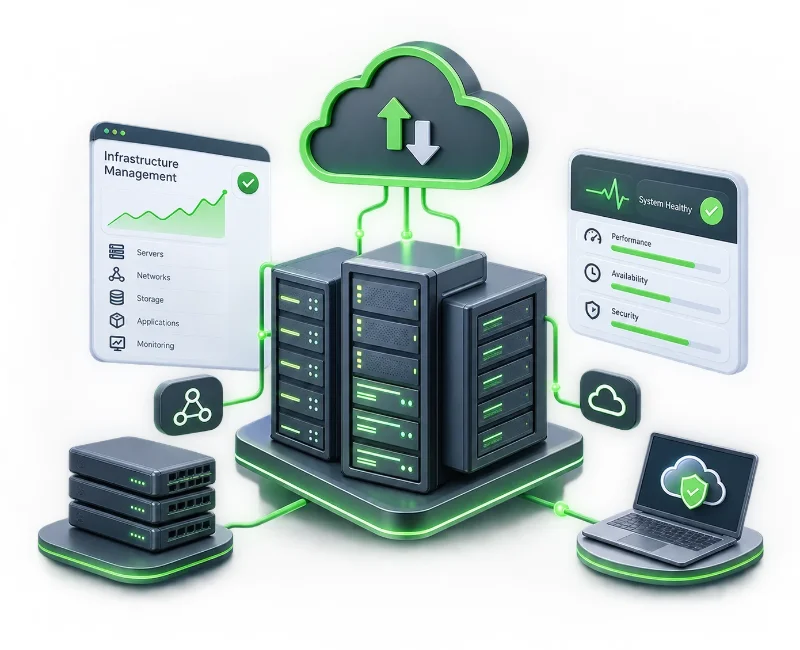
Your IT infrastructure supports the applications, websites, databases and business systems your organization depends on every day. When servers become difficult to maintain, cloud environments grow without proper oversight, or technical issues repeatedly consume internal resources, infrastructure management becomes an operational priority.
Falconics provides infrastructure management services designed around the actual technology environment and requirements of your business. From ongoing administration and monitoring to security, maintenance, troubleshooting and optimization, we help keep the underlying IT environment organized and dependable.
What we can manage:
Servers and hosting environments
Cloud infrastructure and resources
Databases and supporting systems
Network and connectivity components
Infrastructure security and access
Monitoring, maintenance and technical support
Infrastructure management is the ongoing administration and oversight of the technology systems that keep business operations running. It is not limited to fixing issues after they occur; it also involves monitoring system health, maintaining configurations, applying updates, reviewing performance and identifying potential problems before they become disruptive.
The appropriate scope depends on your environment. A growing business running websites and cloud applications may need a different management model from an organization operating multiple servers, databases and interconnected business systems.
Falconics can structure infrastructure management around your existing setup rather than applying the same service checklist to every business.
Servers require regular administration to remain secure, properly configured and capable of supporting business workloads.
Infrastructure management can include server administration, operating system maintenance, configuration changes, resource monitoring, troubleshooting, updates and performance checks. The scope can be aligned with the operating systems, applications and hosting environment being used.
For businesses without dedicated infrastructure administrators, managed support can also reduce the amount of routine technical work handled internally.
Cloud environments can become increasingly complex as applications, databases, storage, users and services expand.
Cloud infrastructure management focuses on maintaining the underlying environment while keeping configuration, performance, security and resource usage under control. Depending on the environment, this can involve cloud resource administration, monitoring, configuration support, access management, deployment assistance and ongoing optimization.
The objective is not simply to move infrastructure to the cloud, but to maintain an environment that remains practical to operate as business requirements change.
Applications are only as reliable as the infrastructure and databases supporting them.
Infrastructure management can work alongside database administration to address areas such as database monitoring, backups, configuration, performance considerations, security and maintenance. Where an issue crosses the boundaries between application, server and database layers, looking at the wider environment can help identify the underlying cause rather than treating only the visible symptom.
Infrastructure problems are often easier to address when they are identified before they become business-critical.
Monitoring helps track relevant infrastructure conditions and resource usage, while scheduled maintenance keeps systems updated and properly configured. Performance optimization can then focus on the source of a problem, whether that involves resource utilization, configuration, application dependencies or infrastructure capacity.
The exact monitoring and maintenance approach should reflect the systems being managed and their operational importance.
Security is an ongoing part of infrastructure management.
Depending on the environment, infrastructure support can include security updates, configuration reviews, access controls, account administration and other appropriate technical safeguards. Security requirements vary between systems, so controls should be considered in relation to the applications, users, infrastructure architecture and business requirements involved.
More specialized cybersecurity requirements can be addressed separately where the environment requires deeper security assessment or protection.
The final scope is defined around your infrastructure rather than a fixed package. Depending on your requirements, an engagement may include:
Infrastructure assessment and technical scope definition
Server and system administration
Infrastructure monitoring and health checks
Operating system and software maintenance
Cloud environment administration
Performance troubleshooting and optimization
Security updates and access management
Database and backup-related support
Infrastructure troubleshooting
Technical documentation and status information
The agreed scope should clearly identify the systems covered, responsibilities, support requirements and any areas that require separate technical services.
Infrastructure management becomes particularly useful when technical responsibilities start affecting day-to-day operations.
Common situations include:
Recurring server or infrastructure issues
Slow applications or resource-related performance problems
Infrastructure that has become difficult to maintain
Limited internal IT administration capacity
Cloud environments requiring ongoing technical oversight
Security updates and configuration tasks being delayed
Database or backup maintenance requiring specialist attention
Infrastructure changes creating unexpected technical dependencies
The appropriate response depends on the underlying issue. Increasing resources, for example, may not solve a problem caused by poor configuration, inefficient applications or database bottlenecks.
01 — Understand the Environment
We begin by reviewing the existing infrastructure, systems, applications, dependencies, access requirements and current technical challenges.
02 — Define the Management Scope
The findings are translated into a practical scope covering the systems and responsibilities that need ongoing attention. This establishes what is managed, how it is monitored and where responsibilities sit.
03 — Manage & Maintain
Required administration, updates, configuration changes, troubleshooting and maintenance are performed according to the agreed scope.
04 — Monitor & Optimize
The infrastructure is reviewed continuously or at agreed intervals to identify operational issues, performance concerns and opportunities for improvement.
This keeps infrastructure management connected to the actual technology environment rather than reducing it to a generic list of IT tasks.
Falconics approaches infrastructure as part of the wider technology environment. This matters because server, cloud, database, application and deployment issues can often overlap.
The broader IT capability allows infrastructure requirements to be considered alongside related areas such as cloud hosting, server management, DevOps, database management, cybersecurity and technical support.
The engagement can also be scoped around the systems you actually operate, allowing businesses to address specific infrastructure responsibilities without adopting an unnecessarily broad managed-services package.
Infrastructure management can support businesses that rely on dependable technology but do not want every infrastructure responsibility handled internally.
It can be particularly relevant for:
Startups and growing businesses that need reliable infrastructure without immediately building a large technical operations function.
E-commerce businesses where website, application and database availability directly supports customer activity.
B2B and professional service companies operating business-critical websites, applications or internal systems.
Technology and SaaS businesses managing application environments that require continuous technical attention.
Businesses with internal developers that want infrastructure administration handled alongside development work.
Organizations moving to cloud infrastructure that need continued management after implementation or migration.
Infrastructure management is an ongoing technical function rather than a one-time project with a guaranteed outcome.
The time required to establish the service depends on the condition and complexity of the existing environment. Before ongoing management begins, it is important to understand the infrastructure involved, business-critical systems, access requirements, existing technical issues and support expectations.
Some requirements may be addressed through routine administration or configuration changes. More complex problems may require application, database, architecture, security or capacity-level investigation.
Infrastructure management does not have a single fixed price because the appropriate scope varies considerably between businesses.
Pricing can be influenced by:
Number and type of systems or servers
Cloud, VPS, dedicated or mixed infrastructure
Operating systems and applications
Infrastructure complexity
Monitoring requirements
Security and access requirements
Database and backup responsibilities
Frequency of maintenance and administration
Required level of ongoing technical support
After understanding your environment, Falconics can define the relevant scope and provide a proposal based on your actual requirements.
Infrastructure management is the ongoing administration, monitoring, maintenance, security and optimization of the technology environment supporting a business. It can cover servers, cloud infrastructure, databases, networks and related systems.
The scope can include infrastructure monitoring, server administration, maintenance, security updates, cloud management, troubleshooting, performance optimization and database-related support. The exact deliverables depend on the systems and responsibilities included in the engagement.
Yes. Infrastructure environments vary significantly between businesses. The management scope can be structured around your existing technology, operational priorities, security requirements and level of internal IT support.
Yes. Cloud infrastructure can form part of the managed environment, including administration, monitoring, configuration and ongoing technical support. The specific responsibilities depend on the cloud architecture and services being used.
Yes. Server and database environments often depend on each other, so managing both within a coordinated infrastructure scope can make technical troubleshooting and maintenance more practical.
No. Growing businesses can also benefit when infrastructure becomes too important or complex to manage entirely through internal resources. The appropriate scope should reflect the size and complexity of the business rather than its size alone.
Ongoing technical support can be included according to the agreed engagement. Support requirements, monitoring responsibilities, maintenance activities and escalation processes should be established when the service scope is defined.
The setup period depends on the complexity and condition of the existing environment. An initial review is useful for identifying systems, access requirements, dependencies, current issues and the responsibilities that need to be managed.
Pricing depends on factors such as infrastructure size, system complexity, number of servers, cloud architecture, monitoring requirements, security needs and the level of ongoing technical support required.
The initial discussion typically covers your current infrastructure, applications, cloud or hosting environment, technical challenges, access requirements and support expectations. This information helps define an appropriate management scope.
Your infrastructure should support your business operations without becoming a recurring technical burden for your team.
Falconics can review your current environment, identify the areas requiring attention and define an infrastructure management scope based on your actual systems and operational requirements.
Contact our expert team today for a tailored strategy and free consultation.
Get a Free Consultation