
Ready to transform your business with GPT Integrations?
Contact our expert team today for a tailored strategy and free consultation.
Get a Free ConsultationNo services available in this category yet.
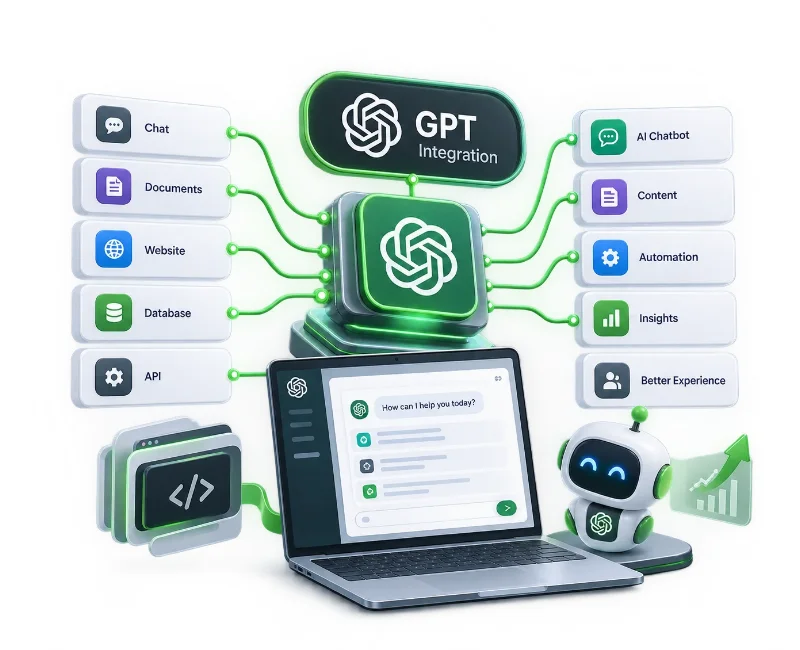
Bring GPT capabilities into the systems your business already uses. Falconics IT provides GPT Integration Services for companies that want to add conversational AI, intelligent automation, content generation, knowledge access, or natural-language functionality without rebuilding their entire technology stack.
From initial use-case planning to API integration, testing, deployment, and ongoing improvements, the focus is on making GPT useful within your actual business workflow—not simply adding an AI feature for the sake of it.
Key capabilities include:
GPT API integration with existing applications and platforms
AI-powered chatbots and conversational interfaces
Workflow and task automation
Knowledge-based assistants and intelligent search
Content and document processing
Integration with business data, APIs, and internal systems
GPT becomes considerably more useful when it is connected to the systems, information, and workflows your business already depends on.
Instead of operating as a standalone chatbot, an integrated GPT solution can interact with application data, retrieve relevant information, generate structured responses, assist employees, or trigger specific workflow actions according to the way your software is designed.
For example, an e-commerce application could use GPT to assist customers with product questions, while an internal business platform could use it to summarize documents, interpret requests, or help employees find information more quickly.
The right integration depends on the business problem first and the AI model second.
Connect GPT capabilities with your existing website, web application, mobile application, SaaS product, or internal software through an appropriate API architecture.
The integration can be designed around your application's existing authentication, business logic, databases, and user flows. This helps keep the AI layer connected to the actual context in which it is being used rather than treating GPT as an isolated feature.
Depending on the project, integration may involve request handling, response formatting, authentication, data exchange, error handling, usage controls, and application-level safeguards.
Add GPT-powered conversations to websites, customer portals, applications, or internal platforms.
A useful business chatbot needs more than the ability to generate natural language. It needs defined conversation boundaries, relevant information, appropriate escalation paths, and access to the information required to answer users accurately.
Falconics IT can help structure conversational experiences around specific business requirements, whether the objective is customer assistance, internal support, product guidance, lead qualification, or information retrieval.
GPT can be incorporated into workflows where employees currently spend time reading, writing, summarizing, classifying, or responding to routine information.
Potential applications include:
Summarizing incoming documents or customer conversations
Drafting responses from predefined business information
Classifying and extracting information from text
Converting natural-language requests into structured actions
Assisting internal teams with repetitive information-handling tasks
Automation should be designed around clearly defined business rules. GPT can handle language-intensive tasks, while conventional application logic can remain responsible for actions that require deterministic control.
Businesses relevant content. This can be particularly useful for internal knowledge assistants, support systems, documentation portals, product information often have useful information spread across documents, databases, product catalogues, support resources, and internal systems.
A GPT-based knowledge experience can help users interact with this information using natural-language questions rather than relying exclusively on traditional search interfaces.
Where appropriate, the architecture can connect GPT with approved business information so responses are grounded in relevant content. This can be particularly useful for internal knowledge assistants, support systems, documentation portals, product information, and other information-heavy applications.
GPT can be connected to the technology environment your business already operates.
Depending on your requirements, an integration may connect with:
Websites and CMS platforms
CRM and customer-support systems
ERP and business management software
Databases and internal applications
SaaS platforms and third-party APIs
Custom web and mobile applications
The objective is not to replace your existing infrastructure unnecessarily. It is to identify where GPT can add useful capabilities while fitting into the application's existing architecture.
Good GPT integration requires careful control over how the model receives information and how its output is used.
Prompt structures can be designed around your application's terminology, response requirements, business rules, tone, and expected output format. Structured outputs can also be used where downstream software needs predictable information rather than unrestricted conversational text.
This helps make the AI component more consistent with the surrounding application.
A GPT integration should be evaluated as part of the complete application rather than only by checking whether the model produces fluent answers.
Testing can cover response quality, edge cases, input handling, integration failures, response times, usage patterns, and the way AI output interacts with other application components.
After deployment, the integration can be reviewed and refined as usage patterns, application requirements, and AI capabilities evolve.
The value of GPT integration depends on the use case, implementation quality, and how closely the solution fits the business process.
When appropriately applied, it can help businesses:
Reduce repetitive information work
Automate or assist language-heavy tasks so employees can spend more time on activities that require human judgment.
Improve digital interactions
Give customers or employees a more natural way to ask questions, find information, and interact with software.
Make business information easier to access
Connect conversational interfaces with approved business knowledge and GPT as a component within SaaS products, customer portals, marketplaces, internal tools, and other digital experiences information sources.
Extend existing applications
Add AI functionality to current software without necessarily replacing the underlying platform.
Support scalable workflows
Handle high volumes of text-based interactions or processing tasks while maintaining application-level controls.
Create new product capabilities
Use GPT as a component within SaaS products, customer portals, marketplaces, internal tools, and other digital experiences.
Every integration begins with the business requirement rather than a predetermined technology stack.
1. Requirement and Use-Case Discovery
We understand what you want GPT to accomplish, who will use the feature, what information it needs, and how the result fits into your existing workflow.
2. Technical Assessment
The existing application, APIs, data sources, authentication requirements, and integration points are reviewed to determine a practical implementation approach.
3. Integration Design
The GPT interaction model, data flow, prompts, application logic, error handling, and relevant controls are planned before implementation.
4. Development and Testing
The integration is implemented within the appropriate application environment and tested against expected scenarios and edge cases.
5. Deployment and Refinement
After implementation, the solution can be monitored and refined based on actual usage, technical performance, and business requirements.
The exact deliverables depend on the scope of your project, but a GPT integration engagement may include:
| Area | Potential Deliverable |
|---|---|
| Discovery | Use-case assessment and technical requirements |
| Architecture | Integration and data-flow planning |
| Development | GPT/API integration within the target application |
| AI Experience | Prompts, conversational flows, or structured outputs |
| System Integration | Connections with relevant APIs, databases, or business systems |
| Testing | Functional, integration, and scenario-based testing |
| Deployment | Production implementation and configuration |
| Support | Post-launch troubleshooting and optimization |
The final scope is defined according to your application, business objectives, and technical requirements rather than using a fixed package for every project.
GPT integration can be relevant to businesses at different stages of digital maturity.
Startups and SaaS companies can incorporate AI capabilities into new products without building language-model infrastructure from scratch.
SMEs and established businesses can add AI to existing workflows, customer interactions, or internal applications.
E-commerce businesses can explore conversational product assistance, catalogue-related queries, content workflows, and customer support use cases.
B2B companies can use GPT to improve access to documentation, support information, product knowledge, and internal resources.
Technology teams can use an integration partner when they need additional expertise to evaluate, implement, or extend GPT functionality within an existing product.
A GPT project can become difficult when the AI component is treated separately from the rest of the application.
Common challenges include unclear AI use cases, disconnected business data, inconsistent responses, unsuitable prompts, difficult API integration, uncontrolled usage, and uncertainty about how AI output should interact with application logic.
The solution is usually not simply a more complicated model. A better result often comes from defining the workflow clearly, connecting the right information sources, establishing appropriate controls, and testing the complete user experience.
GPT integration can involve business information, customer inputs, application data, and third-party services. Security therefore needs to be considered as part of the architecture rather than added after development.
Depending on the project, relevant considerations may include authentication, authorization, data handling, API security, access controls, input validation, logging, usage limits, and the treatment of sensitive information.
The specific safeguards required should be determined by the application's architecture, data sensitivity, regulatory obligations, and intended use.
There is no universal timeline for GPT integration.
A straightforward API connection can require considerably less work than an integration involving multiple systems, private knowledge sources, complex workflows, custom interfaces, or extensive testing.
Project timing can depend on:
Existing application architecture
Number and complexity of integration points
Data availability and quality
AI workflow complexity
Testing requirements
Third-party API dependencies
Required customisation
A clearer timeline can be established after the technical scope and intended use case have been reviewed.
GPT integration pricing is determined by the requirements of the individual project rather than a fixed price for every business.
Factors that can influence the engagement include the complexity of the application, number of integrations, data sources, AI functionality, user volume, custom development requirements, testing scope, and ongoing support.
For an accurate estimate, the practical starting point is to review what you want GPT to do, where it needs to operate, and which systems it needs to connect with.
GPT integration sits at the intersection of AI capabilities and conventional software engineering. The quality of the result depends not only on the model but also on how that model is connected to the surrounding application.
Falconics IT approaches the service from the perspective of the complete digital solution: understanding the business requirement, assessing the existing technology, designing the integration, implementing the required functionality, and addressing practical considerations around testing and deployment.
This approach helps keep the project focused on a usable business application rather than an isolated AI demonstration.
GPT Integration Services involve connecting GPT capabilities with an existing website, application, software platform, workflow, or business system. The integration can support conversational interfaces, automation, information retrieval, content processing, and other language-based functionality.
Yes. GPT can be integrated into many existing web, mobile, SaaS, and business applications through APIs and supporting application logic. The technical approach depends on the application's architecture and the functionality required.
It can, depending on the architecture and use case. A solution may connect GPT with approved information sources so that the application can provide relevant business context while maintaining appropriate access and data-handling controls.
Not necessarily. Many use cases can be implemented using an existing GPT model with appropriate API integration, prompting, application logic, and access to relevant information. Whether additional model customisation is appropriate depends on the specific requirements.
Yes. GPT can assist with language-intensive tasks such as classification, summarisation, information extraction, drafting, and natural-language requests. Deterministic business rules and application logic can be used alongside GPT when specific actions require predictable control.
The timeline depends on the scope and technical complexity. A basic integration and a multi-system AI workflow are very different projects, so a realistic timeline can be established after reviewing the application, requirements, integrations, and testing needs.
Security depends on how the complete solution is designed and implemented. Relevant considerations can include authentication, authorization, data handling, API security, access controls, input validation, logging, and protection of sensitive information.
Potentially, yes. GPT can be connected with existing applications and third-party systems where suitable APIs or integration mechanisms are available. The feasibility needs to be assessed based on the specific systems involved.
Post-integration support can be included depending on the engagement. Ongoing support may involve troubleshooting, performance reviews, changes to the integration, and adjustments as application or business requirements evolve.
There is no single price that applies to every project. Cost depends on factors such as application complexity, number of integrations, custom functionality, data requirements, testing, and ongoing support. A project assessment is needed to provide a specific estimate.
Start by sharing your application, business objective, intended GPT use case, and any systems you need to connect. The requirements can then be reviewed to determine a suitable integration approach and project scope.
The most useful GPT implementation is one that solves a clearly defined business problem and fits naturally into the software and workflows you already use.
Whether you are planning your first GPT integration or extending an existing application with AI capabilities, Falconics IT can help assess the requirement and define a practical path from concept to implementation.
Contact our expert team today for a tailored strategy and free consultation.
Get a Free Consultation