
Ready to transform your business with Google Ads?
Contact our expert team today for a tailored strategy and free consultation.
Get a Free ConsultationNo services available in this category yet.
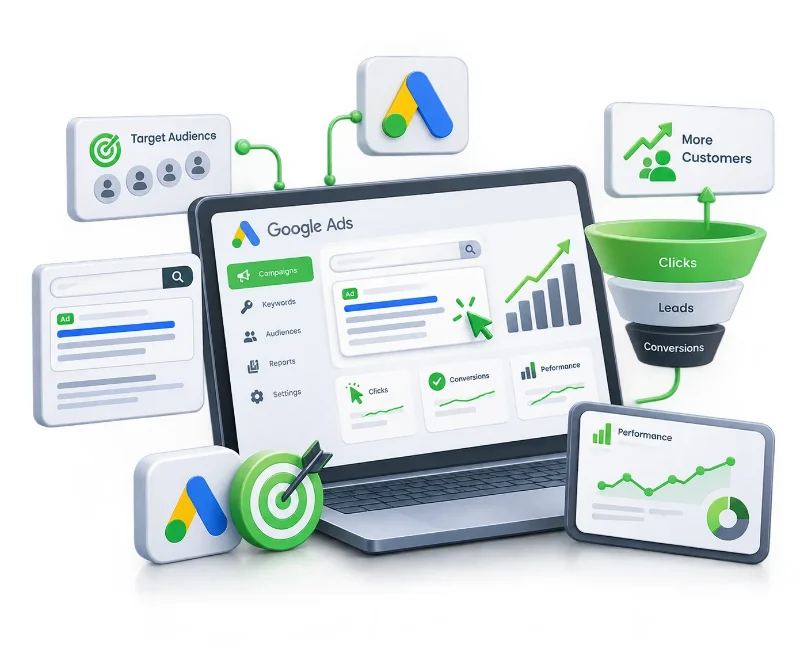
Google Ads can put your business in front of people actively searching for products or services like yours. But effective paid advertising involves much more than creating an ad and setting a daily budget.
Falconics IT manages Google Ads campaigns with attention to targeting, campaign structure, search intent, ad messaging, conversion tracking, landing-page experience, and ongoing optimisation. The objective is to help you make informed decisions about where your advertising budget goes and what it produces.
Whether you are launching paid search for the first time or have an existing account that needs restructuring, our approach is adapted to your business, audience, market, and campaign goals.
A well-managed account needs consistent attention across several connected areas. We focus on the parts of the campaign that influence traffic quality, conversion opportunities, and advertising efficiency.
We begin by understanding your products or services, target customers, locations, commercial priorities, and existing advertising activity.
Campaigns are then structured around relevant search themes, business objectives, locations, audiences, and conversion actions. A clear structure makes it easier to understand which areas of the account deserve more budget and which require adjustment.
Not every search related to your business is worth paying for.
Keyword research focuses on the terms and queries that have a realistic connection to your products, services, and customer journey. We also review search-term data to identify irrelevant queries and opportunities for refinement.
Negative keyword management is an important part of this process because excluding unsuitable searches can prevent budget from being spent on traffic that has little commercial value.
Search campaigns allow your business to appear when potential customers are actively looking for relevant solutions.
We work on keyword targeting, ad groups, responsive search ads, messaging, bidding settings, extensions and campaign organisation. Ad copy is aligned with the searcher's intent so the message they see is relevant to what they are looking for.
Where appropriate for the business, Google Ads management can extend beyond Search campaigns.
Performance Max, Display and remarketing can support different stages of the customer journey. These campaigns require appropriate audience signals, creative assets, exclusions, conversion data and budget controls rather than being treated as automatic replacements for a well-structured Search strategy.
The right campaign mix depends on your business model, conversion data, products or services, and advertising objectives.
Advertising decisions are only as useful as the data behind them.
We help establish meaningful conversion tracking for relevant actions such as form submissions, calls, purchases, enquiries, or other agreed business goals. Where the technical setup requires it, tracking can involve tools such as GA4 and Google Tag Manager.
This helps separate basic traffic activity from actions that have genuine business value.
A relevant ad can still produce poor results when the landing page does not answer the visitor's question clearly.
We review the relationship between the keyword, advertisement and landing page experience. Where improvements are needed, we can identify issues involving message consistency, page structure, calls to action, mobile experience, or conversion friction.
This creates a clearer path from search to action.
Google Ads management is not simply about increasing the number of clicks. The value comes from making better decisions throughout the advertising journey.
Better control over advertising spend: Budget can be reviewed across campaigns, keywords, locations, devices, audiences, and performance trends.
More relevant search traffic: Keyword and search-term management helps focus advertising on queries that make sense for the business.
Clearer conversion measurement: Tracking helps identify which campaigns and actions are producing meaningful enquiries or sales.
Improved campaign organisation: A logical account structure makes performance easier to understand and optimise.
Stronger ad-to-page alignment: Matching the advertisement with the landing experience can reduce unnecessary friction after the click.
Ongoing optimisation: Campaigns can be adjusted as search behaviour, conversion data, competition, and business priorities change.
We use a structured workflow so campaign decisions are based on business information and performance data rather than routine account changes.
01 — Understand & Audit
We review your business objectives, target audience, existing campaigns, account structure, conversion setup, keywords, ads, targeting, budget allocation, and available performance data.
02 — Research & Plan
We identify relevant search opportunities, customer intent, campaign priorities, negative keyword opportunities, and the appropriate account structure.
03 — Build or Restructure
New campaigns can be created from the ground up, while existing accounts can be reorganised where the current structure is limiting clarity or performance.
04 — Track & Measure
We establish or review conversion tracking so campaign decisions are connected to meaningful actions rather than relying only on impressions and clicks.
05 — Optimise & Test
Performance is monitored continuously. Search terms, bids, budgets, ads, targeting, exclusions and conversion data are reviewed to identify opportunities for improvement.
06 — Report & Refine
Performance findings are translated into practical recommendations, allowing the next round of optimisation to reflect what the account has actually learned.
Falconics IT brings digital marketing, web development, analytics, creative services, and technology capabilities together under one team. That broader capability can be useful when paid advertising performance is affected by factors outside the Google Ads interface itself.
Our approach is built around understanding the business before deciding how campaigns should be managed. We can also connect advertising considerations with website, analytics, landing-page, and broader digital requirements when those areas affect the campaign.
You also get a structured process rather than a set-and-forget approach. Campaign performance is measured, reviewed, and refined as new information becomes available.
Google Ads can be useful for businesses with a clear commercial offer and a defined audience searching for relevant products or services.
It can be particularly relevant for:
Service businesses looking to generate enquiries, calls, or consultation requests.
B2B companies targeting specific products, services, industries, or commercial search terms.
E-commerce businesses promoting products and driving online purchases.
Startups and growing businesses testing paid acquisition channels alongside organic marketing.
Local and multi-location businesses targeting customers within selected service areas.
Established businesses with existing campaigns that need better organisation, measurement, or ongoing optimisation.
The suitability of Google Ads depends on factors such as search demand, competition, customer value, margins, conversion rates, and the strength of the offer.
Many campaign problems are not caused by one setting. They often result from several parts of the advertising journey working poorly together.
Falconics IT can help address issues such as:
High spending with weak enquiry quality — Review targeting, search terms, campaign structure, and conversion data to identify where budget is being diluted.
Clicks without meaningful conversions — Examine keyword intent, ad messaging, landing-page relevance, and conversion tracking rather than assuming more traffic will solve the problem.
Poor visibility into campaign performance — Improve measurement and reporting so business decisions are based on meaningful conversion actions.
An account that has become difficult to manage — Restructure campaigns and targeting to make performance easier to interpret and optimise.
Uncertainty about where the budget should go — Use campaign-level performance and conversion information to guide budget allocation.
Depending on the agreed scope, Google Ads Management may include:
Google Ads account audit and campaign planning
Campaign setup or restructuring
Keyword and search-term research
Negative keyword management
Search ad creation and optimisation
Campaign targeting and audience configuration
Budget and bid management
Performance Max, Display or remarketing management where appropriate
Conversion tracking review and setup support
Landing-page recommendations
Ongoing campaign optimisation
Performance reporting and recommendations
The exact scope can be adapted according to your campaign type, advertising budget, number of products or services, target locations, and business objectives.
The strategy can be adapted to different commercial models rather than applying the same campaign structure to every business.
For example, an e-commerce campaign may focus heavily on products, purchase values, feeds, and shopping behaviour, while a professional service campaign may place greater importance on lead quality, calls, consultation requests, and the sales cycle.
For businesses with longer consideration periods, remarketing and carefully selected supporting campaigns may complement high-intent Search activity.
The time required to establish and optimise Google Ads depends on the starting point.
A new account may require additional time for research, campaign setup, conversion tracking, testing, and initial data collection. An existing account may require an audit and restructuring before optimisation decisions can be made confidently.
Performance can also be influenced by competition, search demand, budget, offer strength, landing-page quality, sales follow-up, seasonality, and conversion volume.
Google Ads should therefore be treated as an ongoing optimisation process rather than a channel where. Results depend on factors such as campaign history, budget, competition, search demand, conversion tracking, landing-page experience, offer strength, and sales processes. New campaigns generally need sufficient pricing, landing pages, offer quality, and how enquiries are handled. We focus on managing and measuring specific rankings, leads, revenue, or returns can be guaranteed in advance.
Google Ads management pricing depends on the scope and complexity of the account. Since your requirements may differ substantially from another business, we recommend assessing the account before defining the engagement.
Factors that can influence the management fee include:
Number and type of campaigns
Account complexity
Number of products or services
Target locations
E-commerce feed requirements
Conversion tracking requirements
Landing-page or analytics support
Frequency of optimisation and reporting
Ongoing strategic support
Your advertising budget is separate from the management service fee and is allocated to your Google Ads account according to the agreed campaign strategy.
Google Ads Management is the ongoing planning, setup, monitoring, optimisation, and measurement of paid advertising campaigns on Google. It can include keyword research, campaign structure, ad creation, bidding, budget management, conversion tracking, search-term analysis, and reporting.
Depending on the agreed scope, management can cover campaign setup or restructuring, keyword targeting, negative keywords, ad optimisation, bidding and budget decisions, audience settings, conversion tracking, landing-page recommendations, performance monitoring, and reporting.
Yes. An existing account can be audited to understand its structure, targeting, conversion setup, search-term performance, budget allocation, and other relevant areas before recommendations are made.
Yes. New campaigns can be planned and created according to the business's products or services, target audience, locations, budget, conversion goals, and search demand.
There is no universal timeframe. Results depend on factors such as campaign history, budget, competition, search demand, conversion tracking, landing-page experience, offer strength, and sales processes. New campaigns generally need sufficient data before performance decisions can be made reliably.
No. Google Ads performance depends on factors beyond campaign management, including market demand, competition, pricing, landing pages, offer quality, and how enquiries are handled. We focus on managing and measuring the advertising factors within the agreed scope rather than promising a fixed number of leads or sales.
Yes. Campaign scope can be adapted around your business model, products or services, locations, advertising objectives, existing account, conversion requirements, and level of ongoing support.
Yes. E-commerce campaigns can require a different approach from lead-generation campaigns, particularly around product data, purchase tracking, product-level performance, shopping campaigns, and revenue measurement.
Conversion tracking can be reviewed and configured according to the agreed scope. Relevant actions may include forms, calls, purchases, or other business-defined conversions, with tools such as GA4 and Google Tag Manager used where appropriate.
The first step is to discuss your business, current advertising activity, objectives, target market, and challenges. From there, Falconics IT can assess the requirements and recommend an appropriate management scope.
If your business is investing in Google Ads, the next step should be understanding where the budget is going, which actions matter, and what can be improved.
Falconics IT can review your requirements and build a Google Ads management approach around your business rather than forcing your account into a standard template.
Contact our expert team today for a tailored strategy and free consultation.
Get a Free Consultation