
Ready to transform your business with Email Marketing?
Contact our expert team today for a tailored strategy and free consultation.
Get a Free ConsultationNo services available in this category yet.
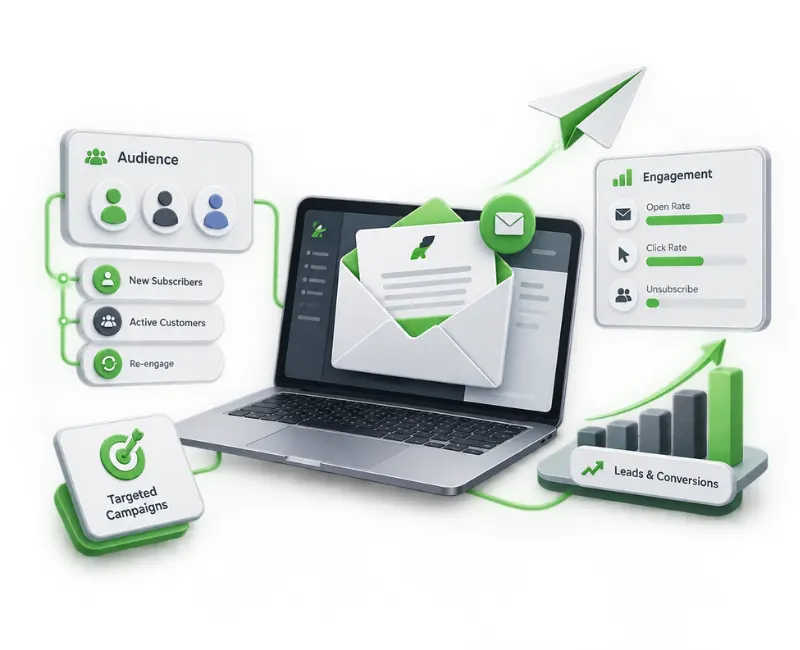
Email marketing gives businesses a direct way to communicate with prospects and customers without depending entirely on changing algorithms or paid media visibility. Falconics IT helps businesses plan, create, manage, and optimize email campaigns that support acquisition, nurturing, retention, and repeat engagement.
From promotional campaigns and newsletters to automated customer journeys, the focus is on sending relevant messages to the right audience at the right stage of the buying process.
Why businesses use email marketing:
Build and nurture relationships with prospects
Keep existing customers engaged
Support lead generation and sales conversations
Promote products, services, offers, or important updates
Automate relevant communication across the customer journey
Effective email marketing is more than sending a newsletter to a contact list. It combines audience understanding, messaging, segmentation, campaign planning, automation, and performance analysis to create a communication system that can support the wider marketing and sales process.
For a B2B company, that may mean nurturing enquiries until a prospect is ready for a sales conversation. For an ecommerce or D2C business, it could involve product launches, abandoned-cart communication, post-purchase engagement, or repeat-purchase campaigns.
The strategy depends on how customers make decisions, what information they need, and where email fits within the broader marketing funnel.
Falconics IT can structure email marketing around your existing marketing setup, customer journey, audience, and business objectives.
Strategy and Campaign Planning
We identify the role email should play in your marketing funnel, define campaign objectives, understand audience segments, and plan communication around meaningful customer actions rather than sending emails simply to maintain frequency.
Email Campaign Creation
Campaigns can include promotional emails, newsletters, product or service announcements, educational content, lead-nurturing messages, event communication, and customer engagement campaigns. Content and calls to action are structured around the purpose of each campaign.
Email Automation
Automated workflows can handle recurring customer interactions such as welcome sequences, lead nurturing, follow-ups, onboarding, re-engagement, and post-purchase communication. Automation helps maintain timely communication while reducing repetitive manual work.
Audience Segmentation
A single message rarely makes sense for every contact. Segmentation can be based on factors such as customer type, engagement, interests, lifecycle stage, purchase behaviour, or previous interactions, allowing campaigns to become more relevant to each audience group.
Email Design and Copy
The content needs to be clear before it can be persuasive. We structure email copy, messaging, calls to action, and visual elements so that recipients can quickly understand what the message is about and what action they are expected to take.
Performance Tracking and Optimization
Campaign performance is reviewed using relevant engagement and conversion indicators. Findings can then inform subject lines, content, segmentation, timing, calls to action, and future campaign planning.
The strongest campaigns usually begin with the business objective rather than the email itself.
1. Understand
We review your business, audience, existing customer journey, email database, current campaigns, and the role email needs to play.
2. Plan
Campaign themes, audience segments, messaging, automation opportunities, and communication priorities are mapped according to the intended customer journey.
3. Create
Email copy, creative direction, calls to action, and campaign assets are prepared for the relevant audience and objective.
4. Launch
Campaigns and automated sequences are configured, reviewed, and deployed according to the agreed plan.
5. Measure and refine
Performance data is used to identify what is working, where engagement is dropping, and what should be adjusted in subsequent campaigns.
This approach keeps email activity connected to a wider marketing objective instead of treating each send as an isolated task.
Depending on your requirements, an engagement may include:
Email marketing strategy and campaign planning
Newsletter and promotional campaign management
Lead-nurturing sequences
Automated email workflows
Audience segmentation
Email copywriting and content
Email design and campaign setup
Performance monitoring and reporting
Campaign testing and optimization
Ongoing email marketing support
The exact scope can be tailored to the size of your database, campaign frequency, automation requirements, internal resources, and business goals.
Email performance should be assessed in the context of the action a campaign is designed to generate.
For lead-generation businesses, email can help move prospects from initial enquiry toward a qualified sales conversation. For established customer bases, it can provide a structured channel for retention, education, updates, and repeat engagement.
A well-managed program can also create a more consistent communication experience. Instead of relying entirely on one-off campaigns, businesses can build planned touchpoints around different stages of the customer lifecycle.
The relevant success measures may include engagement, website activity, enquiries, conversions, customer actions, and revenue-related outcomes where reliable tracking is available.
B2B and Professional Services
Email can support longer buying cycles through educational content, lead nurturing, follow-ups, service updates, and communication designed to keep the business relevant between sales conversations.
Ecommerce and D2C
Campaigns can support product discovery, launches, promotions, abandoned-cart recovery, post-purchase communication, and repeat purchases.
Startups and Growing Businesses
A structured email system can help businesses communicate consistently as their customer base expands, while automation reduces the need for manual follow-up.
Local and Service Businesses
Email can be used for enquiries, appointment-related communication, offers, customer education, reminders, and ongoing relationship building.
Many businesses already have an email database but are not getting enough value from it. Common issues include inconsistent campaigns, generic messaging, weak segmentation, limited automation, low engagement, unclear calls to action, or a lack of meaningful performance analysis.
The solution is not always to send more emails. It may be to improve who receives the message, what they receive, why they receive it, and what happens after they interact with it.
Falconics IT approaches these issues by connecting campaign planning, content, audience logic, automation, and measurement into a more structured email marketing system.
Falconics IT approaches digital marketing as part of a broader business growth system rather than treating individual channels in isolation. This makes it possible to consider how email connects with your website, lead generation activities, content, analytics, advertising, and other customer touchpoints.
The engagement can be structured around your actual requirements rather than forcing every business into the same campaign model. Strategy, execution, measurement, and ongoing optimization can be adjusted as your audience and objectives evolve.
Clear communication and measurable performance are important throughout the process, so decisions can be based on campaign evidence rather than assumptions.
Email marketing can be particularly useful for businesses that already have, or are building, an identifiable audience they can communicate with appropriately.
It can be a strong fit for businesses with recurring customers, longer sales cycles, lead databases, ecommerce transactions, subscription models, service enquiries, or regular customer education requirements.
It is also useful when a business wants to complement other acquisition channels with a communication channel it can develop and manage over time.
Email marketing pricing depends on the scope and complexity of the engagement rather than a single standard package.
Factors may include the size and condition of your contact database, campaign frequency, number of audience segments, amount of content required, automation complexity, design requirements, integrations, reporting needs, and whether ongoing campaign management is required.
After understanding your requirements, the appropriate scope can be defined before the engagement begins.
The time required to launch an email marketing program depends on factors such as the existing database, marketing platform, integrations, content requirements, automation workflows, approval process, and campaign complexity.
Initial activity may focus on setting up the foundation, while ongoing work can involve testing, learning from campaign behaviour, and refining communication over time.
No responsible email marketing program should guarantee a fixed number of leads, sales, or conversions before the audience, offer, messaging, and tracking environment have been properly assessed.
Depending on the engagement, it can include strategy, campaign planning, email copy and design, segmentation, automation, campaign setup, reporting, testing, and ongoing optimization.
Yes. Small businesses can use email to nurture enquiries, maintain customer relationships, communicate offers, and encourage repeat business. The appropriate approach depends on the available audience and business model.
Yes. Automation can be planned for use cases such as welcome emails, lead nurturing, follow-ups, onboarding, re-engagement, and post-purchase communication.
Email copy can be included as part of the service. Messaging is developed around the campaign objective, audience, customer journey, and desired action.
An existing database can be incorporated into the strategy after reviewing its structure, segmentation opportunities, engagement history, and how it is currently being managed.
There is no universal frequency that works for every business. The appropriate schedule depends on audience expectations, content availability, campaign objectives, customer lifecycle, and engagement behaviour.
Measurement depends on the campaign objective. Relevant indicators can include delivery, engagement, clicks, website activity, conversions, customer actions, and revenue-related metrics where tracking is available.
Yes. Email can work alongside SEO, paid advertising, content marketing, websites, CRM systems, ecommerce platforms, and analytics to create a more connected customer journey.
Pricing is generally influenced by campaign volume, database size, content requirements, automation complexity, integrations, design, reporting, and the level of ongoing management required.
The starting information typically includes your business objectives, target audience, existing email database or platform, current campaigns, offers or services being promoted, brand assets, and any relevant customer journey or CRM information.
The first step is a conversation about your business, audience, current email setup, and objectives. From there, the scope and appropriate campaign approach can be defined.
Whether you need ongoing campaigns, automated customer journeys, lead nurturing, or a more organized email strategy, Falconics IT can help you determine where email fits into your wider marketing system.
Contact our expert team today for a tailored strategy and free consultation.
Get a Free Consultation