
Ready to transform your business with Cybersecurity?
Contact our expert team today for a tailored strategy and free consultation.
Get a Free ConsultationNo services available in this category yet.
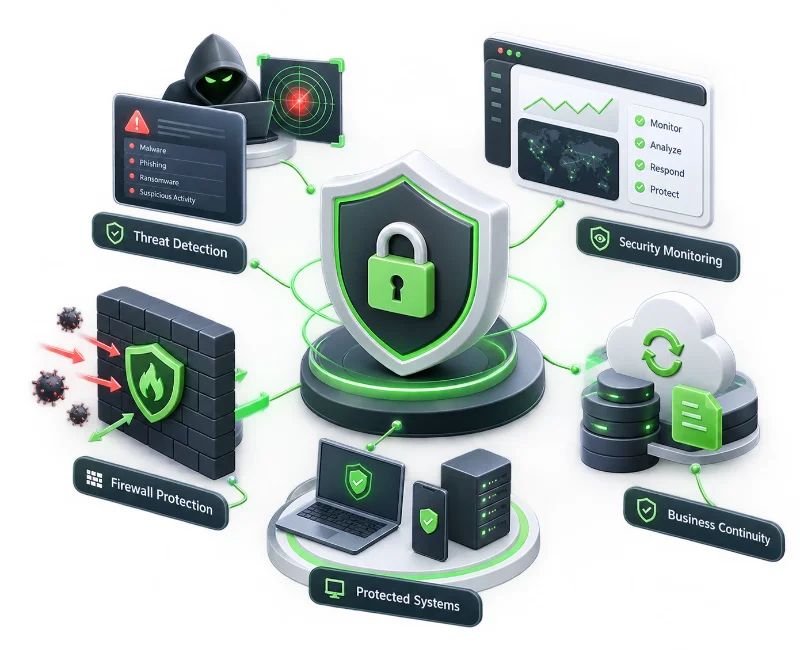
Modern businesses depend on websites, applications, cloud platforms, networks, APIs and digital data to operate. Every additional system and connection can also introduce security risks that need to be identified and managed before they affect critical operations.
Falconics IT provides cyber security services in India focused on understanding where risks exist, evaluating security controls and implementing practical measures to strengthen your digital environment.
Our approach considers security as an ongoing business requirement rather than a one-time technical exercise. Whether you need to assess an existing application, improve network protection, strengthen cloud security or identify vulnerabilities before deployment, the objective is clear: reduce avoidable risk while keeping your technology usable and operational.
Discuss Your Cyber Security Requirements
Cyber security is not simply about installing security software or adding a firewall. Effective protection requires understanding what needs to be protected, how systems interact, who has access and where vulnerabilities could expose the organisation.
A growing business may need better access controls and application security. An organisation moving workloads to the cloud may need to review configurations, permissions and data protection. A company operating customer-facing platforms may need regular vulnerability assessment and security testing.
Falconics IT approaches these requirements according to the technology environment and business priorities involved. This helps security efforts focus on meaningful risks rather than applying the same checklist to every organisation.
Cyber threats can originate at different layers of the technology environment. Our cyber security services can address applications, infrastructure, networks, cloud environments and business data depending on the scope of the engagement.
The assessment begins by understanding the systems involved and identifying areas where security controls, configurations or processes require attention.
Web, mobile and business applications frequently process sensitive information and connect with databases, APIs and third-party systems. Security weaknesses within these applications can create opportunities for unauthorised access, data exposure or misuse.
Application security focuses on identifying weaknesses within the application environment and improving the controls used to protect it.
Depending on the application and project scope, this can involve reviewing authentication and authorisation mechanisms, application configurations, exposed interfaces, data handling practices and other areas that influence application security.
Security considerations can also be incorporated earlier in the development lifecycle so that potential issues are addressed before they become more difficult to resolve.
Unknown vulnerabilities create unnecessary risk.
A structured vulnerability assessment helps identify security weaknesses across relevant systems, applications or infrastructure. Findings can then be reviewed according to their potential impact so remediation efforts can focus on the issues that matter most.
Rather than treating every finding equally, a practical assessment should help answer three important questions: What is vulnerable? How significant is the risk? What should be addressed first?
This gives technical teams a clearer basis for strengthening the environment.
Business networks connect employees, applications, devices, servers and external services. Weak configurations, unnecessary exposure or inadequate access controls can increase the available attack surface.
Network security services focus on reviewing how systems communicate and how access to important resources is controlled.
Depending on the environment, this may involve areas such as network access, firewall configuration, secure connectivity, segmentation, permissions and monitoring requirements.
The goal is to make legitimate business access possible without unnecessarily exposing critical infrastructure.
Cloud infrastructure provides flexibility and scalability, but security responsibilities do not disappear when applications and data move to the cloud.
Permissions, configurations, exposed resources, authentication controls and data handling practices all influence the security of a cloud environment.
Falconics IT helps businesses evaluate relevant cloud security risks and identify areas where configurations and controls can be strengthened. The approach can cover cloud-hosted applications, infrastructure and associated data based on the actual environment and project requirements.
Sensitive information should only be accessible to the people and systems that genuinely require it.
Data security therefore involves more than protecting files. It requires considering where information is stored, how it moves between systems, who can access it and what controls protect it throughout that process.
Appropriate authentication, permissions, encryption and access-control practices can help reduce the likelihood of unauthorised access or unintended exposure.
Not every organisation faces the same security risks.
A cyber security risk assessment examines the relationship between business assets, technology, existing controls and potential vulnerabilities. This creates a clearer understanding of where security improvements should be prioritised.
For organisations with limited security resources, prioritisation is particularly important. Addressing the most meaningful risks first can provide a more practical security roadmap than attempting to change everything simultaneously.
Systems are not automatically secure simply because they are running supported software.
Unnecessary services, weak permissions, insecure defaults, outdated components and configuration mistakes can increase exposure. Security hardening focuses on reducing that exposure by reviewing relevant configurations and strengthening the environment according to its intended use.
The exact measures depend on the technology being assessed rather than following a generic configuration template.
Public-facing websites and digital platforms are continuously accessible through the internet, making appropriate security controls particularly important.
A security review can examine relevant areas of the platform to identify weaknesses that could affect data, administrative access, application functionality or connected services.
For businesses launching a new platform or significantly modifying an existing one, security review can also become part of the pre-launch quality process.
A cyber incident can affect far more than the IT department.
Compromised credentials may expose internal systems. An application vulnerability may put customer information at risk. A cloud configuration issue may unintentionally expose data. A successful attack may also interrupt operations while technical teams investigate and restore affected systems.
Strong cyber security helps organisations reduce these risks by improving visibility into vulnerabilities and establishing appropriate controls around critical digital assets.
It also supports a more disciplined technology environment in which security is considered during development, deployment and ongoing operations rather than only after an incident occurs.
Effective cyber security should help a business make better decisions about risk, not simply produce a long list of technical findings.
A structured security programme can help organisations:
The value comes from connecting technical security work with the systems and information that matter to the organisation.
Some organisations already know they have a security problem. Others simply know that their technology environment has grown and their existing controls have not been reviewed closely enough.
Common situations can include applications with uncertain security posture, expanding cloud infrastructure, outdated configurations, excessive access permissions, newly deployed digital platforms or vulnerabilities identified during internal reviews.
The appropriate response depends on the problem. A configuration issue may require hardening, while an application-level weakness may require changes to code or authentication logic. The purpose of the assessment is to establish that distinction before remediation begins.
Effective security work starts with understanding the environment rather than immediately applying tools.
1. Discovery and Scope
We first understand the applications, systems, infrastructure and business requirements involved. Clear scope helps determine what should be assessed and what the engagement needs to accomplish.
2. Security Assessment
Relevant systems and controls are evaluated to identify weaknesses, vulnerabilities and potential areas of exposure.
3. Risk Prioritisation
Findings are considered according to their relevance and potential impact. This helps distinguish critical issues from lower-priority improvements.
4. Remediation Direction
Identified issues are translated into practical corrective actions so that development or IT teams understand what needs attention.
5. Validation and Improvement
Where included in the engagement, remediation can be reviewed to determine whether identified issues have been appropriately addressed and whether additional improvements are required.
Security requirements can continue evolving as applications, infrastructure and business operations change, so periodic review may be appropriate for environments that change frequently.
The exact deliverables depend on the scope of the security service selected.
A typical engagement may include an assessment of relevant systems, identification of vulnerabilities or configuration weaknesses, risk-based prioritisation and practical remediation recommendations.
Where appropriate, the engagement may also include implementation support or follow-up validation.
The objective is to provide useful technical direction rather than overwhelming stakeholders with findings that lack context or clear next actions.
Cyber security should not unnecessarily obstruct development or business operations.
Controls need to reflect how applications are built, how employees work, how infrastructure is managed and how customers interact with digital services. Security measures that ignore these realities can become difficult to maintain and may eventually be bypassed.
Falconics IT focuses on integrating security considerations with the broader technology environment. This allows security improvements to support development and operational requirements while reducing unnecessary exposure.
Startups and growing companies often develop technology quickly. New applications, employees, integrations and cloud resources may be introduced faster than formal security processes.
A focused security assessment can help identify where that growth has created gaps and which improvements deserve immediate attention.
This allows growing businesses to establish stronger security practices without attempting to build an unnecessarily complex security programme from the beginning.
Established organisations often face a different challenge: complexity.
Multiple applications, legacy systems, cloud resources, internal networks, third-party integrations and different levels of access can make it difficult to understand the organisation's complete security posture.
Cyber security services can help evaluate specific parts of this environment, identify weaknesses and create clearer priorities for improvement without requiring every system to be changed simultaneously.
Cyber security requires technical understanding, but technical findings only become useful when they can be translated into practical action.
Falconics IT takes a structured approach to security by first understanding the technology environment, identifying relevant risks and then determining appropriate security improvements.
The focus remains on clear communication, practical remediation and security measures aligned with the client's actual technology requirements.
Rather than making unrealistic promises of complete protection, the objective is to help businesses systematically reduce vulnerabilities, strengthen controls and improve their ability to manage digital risk.
No legitimate cyber security service can guarantee that an organisation will never experience a security incident.
Technology changes, new vulnerabilities are discovered, systems are updated and attack techniques evolve. Security therefore works best as an ongoing process of identifying risks, improving controls and reviewing important systems when the environment changes.
The outcome of an engagement also depends on its scope, the condition and complexity of the existing environment and whether recommended remediation is implemented.
A clearly defined assessment provides the foundation for making those decisions based on identified risks rather than assumptions.
The timeline depends on what needs to be assessed.
A focused review of a specific application may require considerably less time than an assessment involving multiple applications, networks, cloud environments and supporting infrastructure.
Before work begins, the scope should establish the systems involved, assessment requirements, required access and expected deliverables. This creates a more realistic project timeline and reduces ambiguity during the engagement.
Cyber security pricing depends on the nature and complexity of the environment rather than a universal package price.
Important factors can include the number of applications or systems being assessed, infrastructure complexity, cloud environment, testing requirements, project scope, required depth of assessment and whether remediation or ongoing support is included.
Falconics IT can evaluate your requirements and define an appropriate scope before providing commercial details.
Request a Cyber Security Consultation
What are cyber security services?
Cyber security services help organisations identify and manage risks affecting applications, networks, infrastructure, cloud environments and business data. Depending on the requirement, services may include security assessment, vulnerability identification, configuration review, security testing and remediation guidance.
What types of businesses need cyber security services?
Any organisation that depends on digital systems or stores sensitive information can benefit from appropriate security measures. Requirements vary significantly between startups, e-commerce businesses, technology companies, B2B organisations and larger enterprises, so the scope should reflect the actual environment.
Can you assess an existing application for security vulnerabilities?
Yes. An existing web, mobile or business application can be reviewed within an agreed scope to identify relevant security weaknesses and areas requiring improvement.
Do you provide cloud security services?
Cloud environments can be included in a cyber security engagement depending on the infrastructure and project scope. The assessment may consider areas such as permissions, configurations, exposed resources, access controls and data protection.
Is cyber security a one-time service?
A focused assessment can be performed as a defined project, but security itself is ongoing. New applications, infrastructure changes, software updates and emerging vulnerabilities can change an organisation's risk profile over time.
How often should security assessments be performed?
There is no single schedule appropriate for every organisation. The frequency depends on the sensitivity of the systems, rate of technology change, business risk and internal security requirements. Major application or infrastructure changes can also justify an additional review.
Will a cyber security assessment disrupt our business operations?
The assessment approach should consider the nature of the systems being evaluated. Scope, access requirements and testing methods should be agreed before testing begins, particularly for production environments and business-critical systems.
What happens after vulnerabilities are identified?
Findings should be prioritised and translated into clear remediation actions. Depending on the engagement, remediation support or subsequent validation may also be included.
Can cyber security completely prevent attacks?
No security programme can guarantee complete protection against every possible threat. The practical objective is to reduce exposure, strengthen controls, identify weaknesses and improve the organisation's ability to manage security risks.
How much do cyber security services cost?
Cost depends on the systems involved, assessment scope, complexity, testing requirements and level of ongoing support required. A defined scope is normally needed before accurate pricing can be established.
What information is needed to get started?
Initial discussions generally cover the systems or applications requiring assessment, the business objective, known security concerns, technology environment and desired scope. More specific technical access requirements can then be established for the engagement.
Can the service be customized to our requirements?
Yes. Cyber security requirements vary considerably between organisations, so the scope should be based on the systems, risks and business priorities involved rather than an identical package for every client.
Cyber security is easier to manage when risks are identified clearly and addressed according to priority.
Whether you need to assess an application, review infrastructure, strengthen cloud security or gain a clearer understanding of your current security posture, Falconics IT can help define a practical security engagement around your technology environment.
Contact our expert team today for a tailored strategy and free consultation.
Get a Free Consultation