
Ready to transform your business with CRM Development?
Contact our expert team today for a tailored strategy and free consultation.
Get a Free ConsultationNo services available in this category yet.
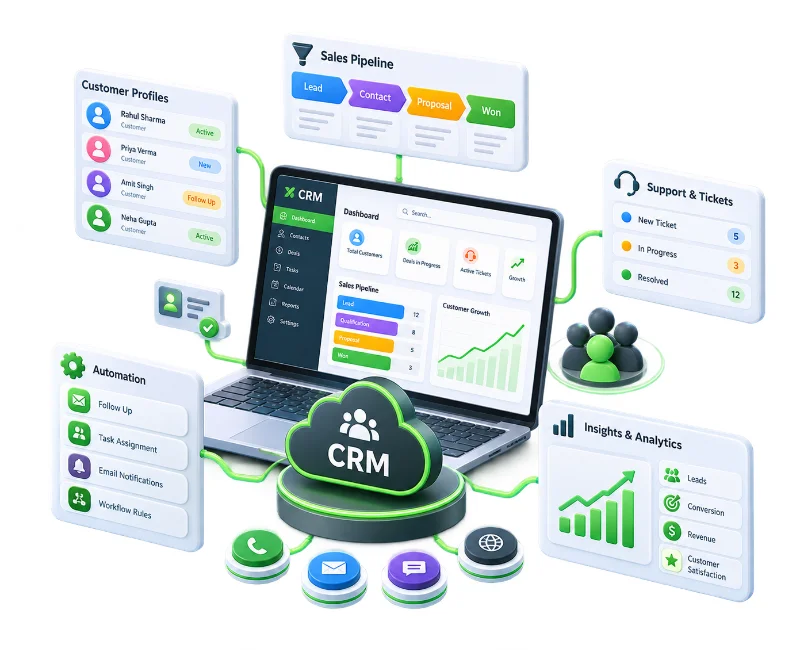
A CRM should do more than store customer records. It should help your teams understand leads, manage opportunities, follow up consistently, automate routine work, and access the information they need to make better business decisions.
Falconics IT provides CRM development services for businesses that need a system aligned with their actual sales and customer-management processes rather than a rigid, one-size-fits-all platform.
Key capabilities include:
Every business handles customers differently. A sales team may need detailed lead stages and follow-up automation, while a service business may require customer history, task management, ticketing, and service workflows.
Falconics IT can design and develop CRM functionality around these requirements. The objective is to create a system that fits the way your teams actually work, while leaving room for future changes as the business grows.
A custom CRM can also consolidate information that may otherwise remain spread across spreadsheets, email conversations, disconnected applications, and separate internal systems.
The scope of a CRM project depends on your business model, existing technology, users, and operational requirements. Falconics IT can support the development of the core CRM system as well as the integrations and functionality surrounding it.
Centralize customer and prospect information so teams can maintain consistent records throughout the relationship lifecycle. Lead sources, contact details, interactions, notes, follow-ups, and relevant account information can be organized within a unified system.
Create structured sales stages that reflect your actual sales process. Teams can monitor opportunities, assign responsibilities, schedule follow-ups, and understand where prospects are within the pipeline without relying on disconnected spreadsheets or manual updates.
Routine activities can be converted into defined workflows. Depending on the requirements, automation may include task assignment, notifications, follow-up reminders, lead routing, status updates, and other repetitive processes.
Automation should support the workflow rather than complicate it, so each process is designed according to the business rules agreed during the project.
A CRM becomes more useful when it can communicate with the other systems your business already uses. Depending on the project, integrations may connect the CRM with websites, applications, APIs, communication tools, marketing platforms, databases, or other business software.
The integration approach is determined by the systems involved and the data that needs to move between them.
CRM dashboards can bring important operational information into a more accessible view. Sales activity, pipeline movement, lead status, customer interactions, and other relevant metrics can be organized into reports based on management and team requirements.
The goal is not to produce more reports, but to make useful business information easier to understand and act upon.
If you are replacing an existing CRM or moving away from spreadsheets and legacy systems, the project may include data migration and restructuring.
Before migration, data requirements should be reviewed carefully to identify relevant records, duplicate information, incompatible fields, and other issues that could affect the new CRM environment.
For teams that work across locations or need access outside the office, CRM solutions can be structured for responsive or mobile access and cloud-based deployment where appropriate.
This allows authorized users to work with customer and sales information without being tied to a single workstation.
A CRM becomes valuable when it reduces operational friction instead of adding another layer of administration.
A properly planned system can help businesses:
The specific business impact depends on how the CRM is designed, adopted, integrated, and used by the organization.
Falconics IT begins with the business process rather than starting with a predefined feature list. This helps determine which functionality is genuinely required and which additions would create unnecessary complexity.
We review your business model, users, customer journey, sales process, existing tools, data structure, and operational challenges. This establishes the functional scope of the CRM.
The required modules, user roles, workflows, integrations, data relationships, and technical architecture are planned before development begins.
The interface and functionality are developed around the agreed requirements. The system can include custom dashboards, forms, workflows, permissions, integrations, and other required CRM components.
The CRM is tested against its functional requirements and expected user workflows. Issues identified during testing are addressed before deployment.
After implementation, the CRM can be deployed within the selected environment. Ongoing improvements, maintenance, integrations, and technical support can be handled according to the engagement scope.
The exact feature set should be determined by your requirements rather than by a generic checklist. Depending on the project, a CRM may include:
| CRM Area | Possible Functionality |
|---|---|
| Customer Management | Profiles, contact records, interaction history |
| Lead Management | Lead capture, assignment, qualification, status tracking |
| Sales | Pipelines, opportunities, activities, follow-ups |
| Automation | Notifications, reminders, task assignment, workflow rules |
| Communication | Interaction records and communication workflows |
| Reporting | Dashboards, sales reports, activity reports |
| Administration | User roles, permissions, access controls |
| Integration | APIs and connections with existing business systems |
| Data | Import, migration, organization, and structured records |
CRM development can be useful for businesses where customer information, sales activities, service interactions, or internal follow-ups have become difficult to manage using disconnected tools.
It can be particularly relevant for B2B companies, service businesses, sales-driven organizations, startups, growing SMEs, e-commerce businesses, and companies with multiple customer-facing teams.
The level of customization depends on the complexity of the organization's processes and the systems already in use.
Many CRM projects begin with a practical operational problem rather than a desire for more software.
Common challenges include customer information being distributed across different tools, inconsistent lead follow-ups, limited visibility into sales pipelines, repetitive manual tasks, difficulty tracking customer interactions, or business applications that do not share relevant data.
The development process translates these problems into defined workflows, system requirements, automation opportunities, and integration requirements.
CRM systems often contain commercially important customer and business information. Access therefore needs to be considered alongside functionality.
Depending on the project requirements, the CRM architecture can incorporate user roles, permissions, controlled access to information, structured data management, and appropriate security practices.
The exact security implementation depends on the application's architecture, hosting environment, integrations, and the type of information being managed.
The technology stack for a CRM should be selected according to the application's requirements rather than treated as a fixed package.
Falconics IT works across technologies including React, Node.js, Vue.js, JavaScript, Next.js, PHP, Python, Java, MongoDB, PostgreSQL, AWS, Docker, and API-based integrations, allowing the technical architecture to be aligned with the project's requirements.
Where an existing CRM or business application is already in place, the focus can instead be on customization, integration, modernization, or extending its functionality.
The final deliverables depend on the agreed project scope. A typical custom CRM engagement may include:
Additional modules can be introduced when they solve a clearly defined business requirement.
CRM development pricing cannot be determined responsibly from the service name alone. The cost depends on factors such as the number of users, required modules, workflow complexity, integrations, data migration, UI/UX requirements, technical architecture, security requirements, and ongoing support.
A simple internal CRM and a multi-department system with complex integrations can have very different development requirements.
For that reason, Falconics IT can determine the appropriate engagement scope after understanding the business process and technical requirements.
Falconics IT approaches CRM development as a business-system project rather than simply a software build.
The company works across web development, custom software, AI and automation, data and analytics, cloud technologies, and digital solutions, creating opportunities to connect CRM development with the wider technology environment of a business.
The emphasis is on understanding the workflow first, defining the required functionality, and then developing the technology around those requirements.
A successful CRM begins with a clear understanding of how customer information moves through your organization.
If your current process relies on spreadsheets, multiple applications, manual follow-ups, or an existing CRM that no longer fits your requirements, the first step is to identify where the system needs to improve.
Falconics IT can review your requirements and define a practical CRM development approach around your business.
CRM development is the process of designing and building a customer relationship management system around a business's specific sales, customer service, marketing, data, and operational requirements.
Depending on the project, custom CRM development can include customer and lead management, sales pipelines, workflow automation, dashboards, reporting, user permissions, integrations, data migration, and other business-specific functionality.
Yes. A CRM can be developed as a custom application when existing platforms do not provide the required functionality or when a business needs greater control over its workflows, integrations, and data structure.
Yes. Depending on the platform and technical requirements, an existing CRM can potentially be customized, integrated with other systems, extended with additional functionality, or migrated to a different solution.
CRM integrations can connect the system with other applications through available APIs or integration mechanisms. The feasibility and implementation approach depend on the systems involved and the data that needs to be exchanged.
Data migration can be included when required. The migration process should first assess the existing data structure, duplicates, field mapping, data quality, and compatibility with the new CRM.
There is no single timeline for every CRM project. Duration depends on the number of modules, workflow complexity, integrations, data migration, UI/UX requirements, testing, and other project-specific factors.
It can be, particularly when a business has workflows that standard CRM platforms do not handle effectively. However, the appropriate solution depends on the company's processes, budget, users, and expected requirements.
Yes. CRM automation can handle suitable repetitive processes such as task assignment, notifications, reminders, lead routing, status changes, and other workflow-based activities.
CRM solutions can be designed with responsive interfaces or mobile applications depending on the project's requirements. The appropriate approach depends on how users need to access and interact with the system.
Pricing depends on the project's scope, complexity, integrations, number of modules, data requirements, technical architecture, customization, and ongoing support needs. A requirement assessment is therefore necessary before determining the appropriate engagement.
Start by sharing your current CRM or customer-management process, the problems you want to solve, the systems you already use, and the functionality your teams require. This provides the foundation for defining the right CRM scope.
A CRM should simplify the way your teams manage relationships, sales activity, customer information, and business workflows—not force your organization into a process that does not fit.
Falconics IT can help turn your CRM requirements into a structured, scalable technology solution.
Contact our expert team today for a tailored strategy and free consultation.
Get a Free Consultation