
Ready to transform your business with CDN Setup?
Contact our expert team today for a tailored strategy and free consultation.
Get a Free ConsultationNo services available in this category yet.
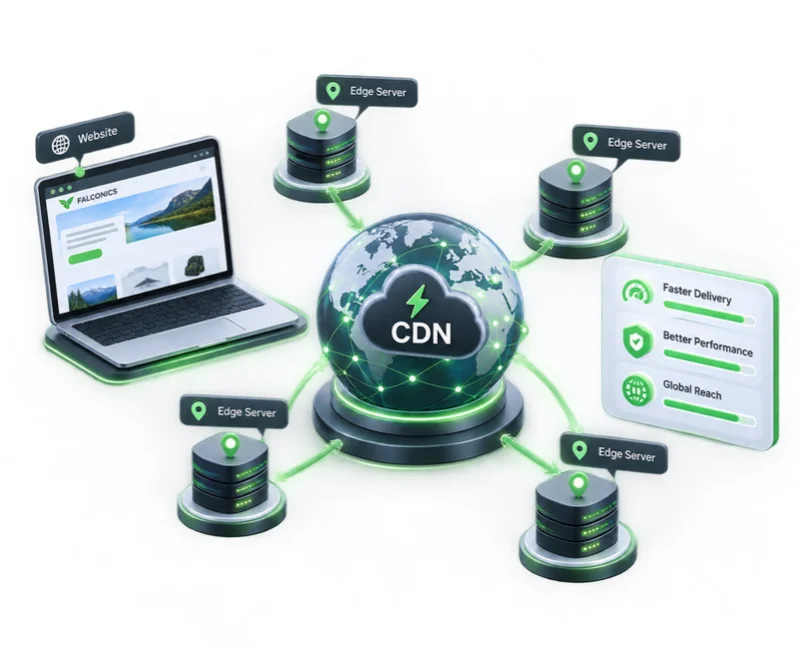
A slow or inconsistent digital experience can affect everything from user engagement to conversions. A Content Delivery Network (CDN) helps reduce the distance between your users and the content they request by serving cached content through strategically distributed edge locations.
Falconics IT helps businesses plan, configure and optimize CDN infrastructure around their website, application, media or cloud environment. The focus is not simply on enabling a CDN, but on configuring it correctly for the way your platform actually delivers content.
What you can expect:
Faster delivery of static and cacheable content
Better performance for users across different regions
More efficient handling of traffic spikes
Improved resilience for content-heavy websites and applications
CDN configuration aligned with your existing hosting or cloud infrastructure
A Content Delivery Network is a distributed network of servers, commonly called edge locations, that helps deliver web content closer to end users.
Instead of every request travelling directly to the origin server, cacheable content such as images, stylesheets, JavaScript files, videos and other assets can be served from an appropriate edge location. This can reduce latency and lower the amount of repeated content requests reaching the origin.
For businesses serving customers across multiple cities or regions, CDN architecture can be particularly useful when website performance depends on consistently delivering large volumes of digital content.
CDN implementation involves more than pointing a domain toward a CDN provider. Cache behaviour, DNS configuration, origin connectivity, security settings and application requirements all need to work together.
Falconics IT can support the key technical areas involved in deploying and improving a CDN environment.
We configure the CDN according to your website, application and infrastructure requirements. This can include connecting the CDN with your origin server, configuring delivery rules and establishing appropriate caching behaviour.
The objective is to create a reliable delivery layer without disrupting the existing application or website experience.
A CDN needs to work correctly with the technologies already running your business. We can help integrate CDN delivery with your hosting, cloud infrastructure, website or application environment.
Where dynamic content, APIs or authenticated areas are involved, configuration needs to distinguish between content that can be cached and requests that should continue to reach the origin.
Poorly configured caching can reduce the benefits of a CDN. We review caching behaviour and delivery rules to help frequently requested assets remain available at the edge while content requiring fresh origin responses is handled appropriately.
This can include cache-control considerations, asset delivery, cache invalidation and performance-oriented configuration.
A CDN can form part of a broader application and infrastructure security strategy. Depending on the CDN platform and business requirements, configurations may incorporate HTTPS delivery, traffic controls, access rules and protection against certain types of malicious traffic.
Security settings are configured with the application architecture in mind rather than treated as a separate layer.
CDN performance can change as your website, traffic patterns and content requirements evolve. Ongoing monitoring can help identify configuration issues, cache inefficiencies and unusual traffic behaviour.
Where ongoing management is required, Falconics IT can help review the CDN environment and make adjustments as the underlying platform changes.
A well-configured CDN can improve the technical foundation behind a digital experience without requiring a complete rebuild of the underlying website or application.
Faster content delivery
Static and cacheable assets can be delivered from locations closer to users, helping reduce network latency.
Better handling of traffic
A CDN can distribute delivery requests across edge infrastructure rather than relying entirely on the origin server.
Improved experience for distributed audiences
Businesses serving customers across different Indian regions can use edge delivery to provide a more consistent experience across locations.
Reduced origin workload
Frequently requested cacheable resources can be served without repeatedly requesting the same files from the origin.
Greater scalability
CDN infrastructure can provide an additional delivery layer when traffic volumes increase or content becomes more resource-intensive.
More resilient digital delivery
Separating content delivery from the origin infrastructure can help create a more robust architecture when properly designed and configured.
Every CDN engagement starts with understanding the existing environment rather than applying a generic configuration.
1. Infrastructure assessment
We review the website or application, hosting environment, traffic requirements, content types and existing delivery architecture.
2. CDN planning
The appropriate delivery approach is mapped around the origin infrastructure, caching requirements, geographic audience and application behaviour.
3. Configuration and integration
We configure the CDN, connect the relevant origin services and establish rules for caching, delivery and traffic handling.
4. Testing and validation
The implementation is checked to ensure that cached and dynamic content behave as intended and that the CDN does not interfere with critical application functionality.
5. Optimization and support
After implementation, configuration can be refined based on actual performance, content behaviour and changing business requirements.
CDN requirements vary depending on what a business delivers.
For e-commerce websites, CDN configuration can help deliver product images, scripts, stylesheets and other cacheable assets efficiently while keeping dynamic transactions connected to the appropriate application infrastructure.
For media-heavy platforms, efficient delivery of large assets such as images, audio and video becomes a central consideration.
For SaaS and web applications, CDN configuration may focus on static application assets while ensuring APIs, authenticated requests and dynamic functionality continue to operate correctly.
For business websites and portals, the focus may be on improving the delivery of frequently requested website resources and supporting reliable performance across different user locations.
A CDN can be technically active while still being poorly configured. Falconics IT can help address issues such as:
Slow delivery of static website assets
High latency for geographically distributed users
Excessive requests reaching the origin server
Incorrect or ineffective cache behaviour
CDN configuration issues following website changes
Difficulties balancing cached and dynamic content
Traffic spikes putting additional pressure on infrastructure
CDN integration requirements across hosting or cloud environments
The appropriate solution depends on the underlying architecture. We assess the cause before recommending configuration changes.
Depending on the project scope, CDN engagement may include:
CDN architecture and configuration planning
CDN account and domain integration support
Origin server configuration
Cache-rule configuration
DNS and delivery configuration
HTTPS and security configuration
Performance and caching optimization
Testing and validation
Documentation of relevant configuration
Ongoing monitoring or technical support where required
The exact deliverables are defined according to your infrastructure and CDN requirements.
CDN services can be relevant to businesses where website or application performance depends on delivering significant volumes of digital content to users across different locations.
This can include e-commerce companies, SaaS businesses, media platforms, technology companies, content publishers, online service providers and growing businesses with increasingly distributed audiences.
A CDN may also be useful when an existing hosting environment is capable of handling the application itself but needs a more efficient way to distribute static or cacheable content.
CDN pricing and implementation costs depend on the scope of the infrastructure rather than a single fixed service fee.
Factors can include the CDN platform selected, monthly traffic volume, data transfer requirements, number of domains or applications, origin architecture, security requirements, caching complexity, integration work and whether ongoing management is required.
After understanding your environment, the engagement can be scoped around the actual technical requirements rather than an arbitrary package.
CDN implementation does not automatically make every part of a website faster. The outcome depends on factors such as application architecture, origin performance, cacheability, asset size, network conditions and configuration quality.
A CDN is most effective when it is treated as part of the wider performance architecture. Website code, databases, hosting, image optimization and application response times may still need attention where they are contributing to slow performance.
This is why Falconics IT evaluates the delivery environment before recommending a CDN configuration.
Falconics IT brings CDN work into the wider context of hosting, cloud infrastructure, web development and technology operations.
That matters when the CDN cannot be treated as an isolated service. Website architecture, server configuration, application behaviour and content delivery often influence one another.
Our approach is focused on understanding those dependencies, implementing the required configuration and keeping the technical setup aligned with the business's actual requirements.
You can also work with Falconics IT when CDN requirements are part of a broader infrastructure, website or application project rather than maintaining separate technology relationships for each layer.
A CDN distributes and caches eligible digital content across edge locations so that users can receive that content from a location closer to them. This can reduce latency and improve delivery efficiency.
Not necessarily. A CDN primarily benefits content that can be efficiently cached and distributed. Server response time, database performance, application code and other technical factors can still affect overall website speed.
It depends on your traffic, audience locations, content types and infrastructure. A CDN becomes more relevant when a website serves users across different regions, handles substantial traffic or delivers many static or media assets.
In many cases, yes. A CDN can sit between users and an existing origin server or cloud environment. The exact integration depends on the hosting architecture and application requirements.
Some CDN platforms support different approaches to dynamic content, but caching dynamic or personalized responses requires careful configuration. Sensitive or user-specific content generally needs different handling from public static assets.
A CDN can contribute to a faster and more reliable website experience, which can support broader technical performance objectives. However, using a CDN alone does not guarantee improved search rankings.
The timeline depends on the number of domains, existing infrastructure, application complexity, DNS requirements, security configuration and testing needs. A straightforward setup can be significantly simpler than a multi-application or enterprise implementation.
Yes. Existing CDN configurations can be reviewed for caching behaviour, origin connectivity, delivery rules, security settings and other performance considerations.
Ongoing support can be scoped according to your requirements. This may include configuration changes, monitoring, troubleshooting and performance-related optimization.
Start by sharing your website or application details, current hosting environment, target audience and the performance or delivery issues you are experiencing. Falconics IT can then assess the requirements and determine the appropriate CDN approach.
A CDN should fit the way your website, application and infrastructure actually work—not simply be added as another layer of technology.
Talk to Falconics IT about your current setup, performance requirements and delivery challenges. We can help determine whether a CDN is appropriate for your business and define the configuration required to implement it effectively.
Contact our expert team today for a tailored strategy and free consultation.
Get a Free Consultation